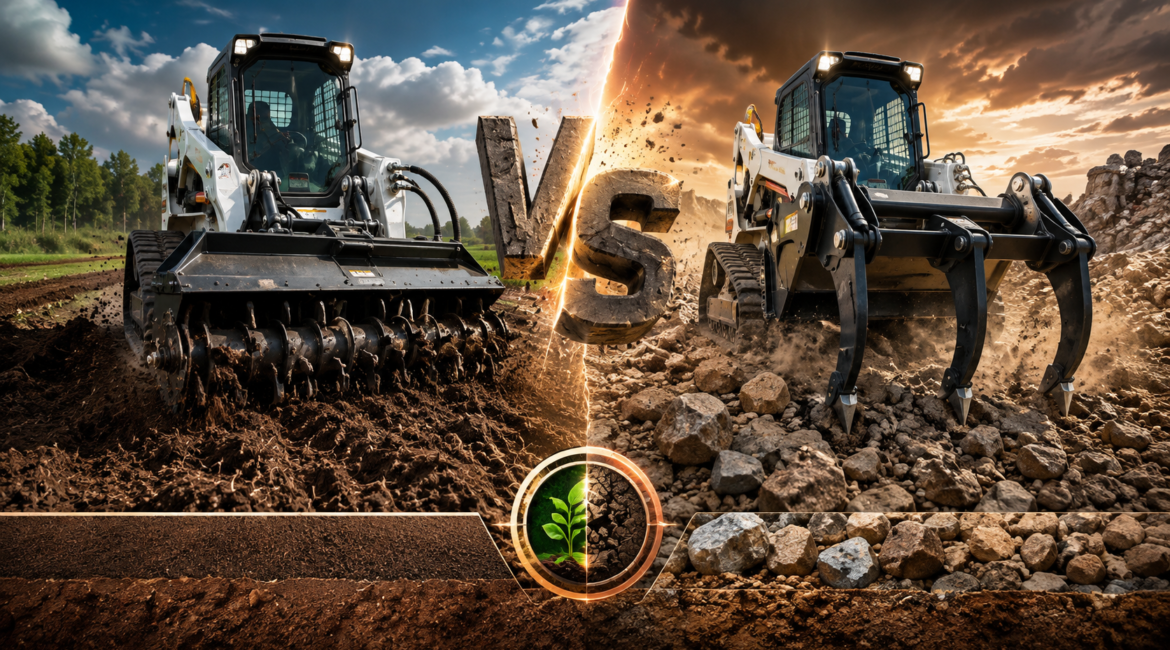
Rotary Tiller vs. 3-Tooth Ripper: Which Attachment Do You Need for Hard-Packed Soil?
If you’ve ever dropped your skid steer bucket into a patch of dirt only to hear a loud clanking sound while your teeth rattle in your skull, you already know exactly what hardpan is. This stuff is basically nature’s concrete which can be usually cleared by rotary tiller vs. 3-tooth ripper.
The Frustrating Reality of Hitting Hard-Packed Soil
Over months or even years of heavy machinery driving over the same spots, combined with baking sun and natural settling, the ground packs down so tight that standard equipment just bounces right off it.
It’s incredibly frustrating. When soil gets this compacted, it acts as a literal wall. On a landscaping or farming job, it suffocates roots because water and air literally cannot penetrate the surface.
On a construction site, it stops your grading work dead in its tracks. I’ve seen plenty of guys try to muscle their way through dense earth using the wrong tools, and it almost always ends the same way: with blown hydraulic lines, overheated engines, and a lot of wasted time.
Figuring out how to tackle this mess usually brings operators to one major debate: the Rotary Tiller vs. 3-Tooth Ripper. Making the right call here is what separates a profitable day from a massive repair bill.
- Hard-packed dirt completely chokes out root systems, creating a barrier that stops water from soaking in and leaves your site prone to nasty flooding.
- Trying to force a standard bucket or a lightweight attachment into hardpan is a fast track to overheating your skid steer’s hydraulics and snapping expensive shear pins.
- Taking the time to hook up the correct specialized heavy-duty attachment actually saves you hours of bone-rattling labor and protects your machine’s loader arms.
Getting Gritty: What Exactly is a 3-Tooth Ripper?
Think of the 3-tooth ripper as a massive, heavy-duty crowbar for the earth. It doesn’t have any fancy spinning parts, no complex hydraulic motors, and honestly, it doesn’t look like much—but man, does it deliver.
This attachment relies on pure, raw brute force and the traction of your skid steer. You drop those three aggressive steel shanks into the dirt, put the machine in reverse (or forward, depending on your setup), and just let the torque do the talking.
It violently tears the earth apart, ripping through thick clay, slicing massive tree roots, and popping hidden boulders out of the ground like they are pebbles. Because you can easily swap out the hardened steel teeth when they get dull, this thing is basically indestructible.
When you drag a ripper through heavily compacted zones, it fractures the soil deep below the surface without completely destroying the top layer. This lets the ground finally breathe and soak up water, setting you up perfectly for whatever grading or planting work comes next. If your job site feels like a parking lot, this is the tool you want.
- It features incredibly thick, heavy-duty steel shanks that are specifically built to handle the massive pulling forces required to crack open solid earth.
- The hardened steel teeth take all the abuse and are super easy to knock out and replace, so you aren’t constantly buying entirely new attachments.
- Ripping the ground fractures the deep subsoil to let water drain properly, all without making a massive, dusty mess of the topsoil.
The Finesse Tool: Understanding the Skid Steer Rotary Tiller
If the ripper is the muscle of the operation, the rotary tiller is the finesse tool. Once the heavy demolition is out of the way, the tiller steps in to make you look like a total pro. This attachment uses your skid steer’s hydraulic flow to power a heavy-duty gearbox, which spins a horizontal shaft loaded with curved steel tines.
As you drive over the dirt, those rapidly spinning blades chop, churn, and blend the top layer of earth until it looks like fluffy coffee grounds. It is the absolute best way to mix in bags of fertilizer, churn up compost, and chew through stubborn surface weeds all in a single pass.
But here is the catch: it is designed for the top few inches of dirt. While a good rotary tiller can easily handle moderately packed ground, dropping it straight onto untouched hardpan is a massive mistake. The blades will just skip off the surface, violently bouncing your skid steer around, dulling your tines, and potentially blowing out the gear box from the extreme vibration.
- The hydraulic-driven gearbox spins a set of aggressive tines that chew up clunky dirt and spit out a beautifully smooth, fluffy seedbed.
- It is the perfect tool for blending compost, topsoil, and fertilizers directly into the ground, instantly giving the earth a massive nutrient boost.
- It saves you back-breaking manual raking by leveli
- ng out mildly bumpy ground and shredding up annoying surface weeds in one quick, clean pass.
Head-to-Head Breakdown: Rotary Tiller vs. 3-Tooth Ripper
So, how do you actually choose between them? The whole Rotary Tiller vs. 3-Tooth Ripper debate really just comes down to reading your dirt. You have to be honest about the conditions you’re facing.
The 3-tooth ripper is your primary demolition tool. If you are dealing with frozen ground, thick, gummy clay, or soil that is loaded with hidden rocks and thick roots, the ripper is your only safe bet.
It won’t leave the ground looking pretty, but it gets the hard work done safely. On the flip side, the rotary tiller is a landscaper’s best friend. If the ground is already somewhat manageable and your goal is to lay down sod or plant grass seed by the end of the day, the tiller is what you need. One goes deep to break the tension, and the other stays shallow to condition the surface.
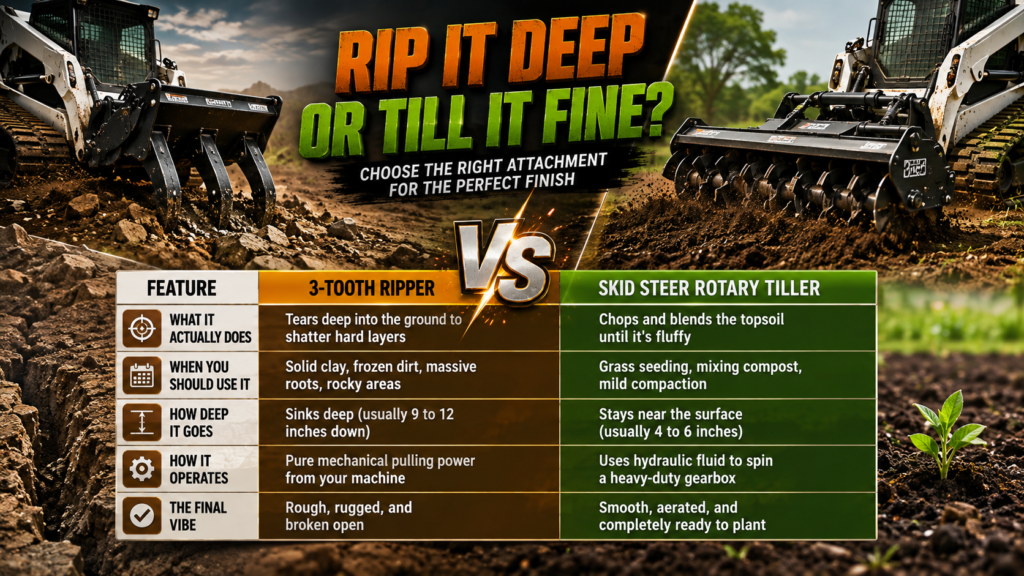
Table: Rotary Tiller Vs. 3-Tooth Ripper Features
| Feature | 3-Tooth Ripper | Skid Steer Rotary Tiller |
| What It Actually Does | Tears deep into the ground to shatter hard layers | Chops and blends the topsoil until it’s fluffy |
| When You Should Use It | Solid clay, frozen dirt, massive roots, rocky areas | Grass seeding, mixing compost, mild compaction |
| How Deep It Goes | Sinks deep (usually 9 to 12 inches down) | Stays near the surface (usually 4 to 6 inches) |
| How It Operates | Pure mechanical pulling power from your machine | Uses hydraulic fluid to spin a heavy-duty gearbox |
| The Final Vibe | Rough, rugged, and broken open | Smooth, aerated, and completely ready to plant |
- You use the ripper when you need to physically break the “crust” of the earth and rip out things that would otherwise destroy spinning blades.
- You hook up the tiller when you need a perfectly manicured, smooth surface that is ready for immediate planting or sodding.
- Figuring out if you have hidden rocks or severe compaction is the most important step before deciding which attachment to rent or buy.
The Secret Pro Strategy: Using Both Attachments Together
Here is a secret that experienced contractors know: when the dirt is absolute garbage, the real answer to the Rotary Tiller vs. 3-Tooth Ripper debate is actually both. If you want to do the job right and save your equipment, you use a two-step punch. First, you drop the 3-tooth ripper into the hardpan.
You drive over the site, letting the shanks snap the hidden roots, pop the basketball-sized rocks out of the dirt, and completely shatter the compaction. Now, the ground is broken, but it looks incredibly rough. That’s when you swap attachments.
Because the ripper already did the hard work of loosening the tension, you can safely drop your rotary tiller onto the dirt. The tiller’s hydraulic motor won’t struggle, the tines won’t bounce, and you can easily chop those broken clods of dirt into a perfect, butter-smooth finish. This strategy keeps your expensive hydraulic gear safe and gives your customer a jaw-dropping final result.
- Doing a first pass with the ripper takes all the fight out of the dirt and safely pulls up rocks that would otherwise bend your tiller blades.
- Following up with the tiller takes that ugly, ripped-up terrain and turns it into a perfectly blended, professional-grade seedbed.
- Using this exact one-two combo is the best way to keep your hydraulic fluids cool and guarantee you don’t ruin an expensive gearbox.
FAQs – Rotary Tiller Vs. 3-Tooth Ripper
Which attachment handles thick clay the best?
If you’re dealing with thick, heavy clay, the 3-tooth ripper is your absolute best friend. When clay dries out, it practically turns into a brick. If you try to run a spinning tiller over dry clay, the blades will just bounce off it, shaking you to death inside the cab and doing zero actual digging. You need to drop the ripper shanks down deep to physically pry and crack that clay apart.
- Clay binds together so tightly that it requires the raw, static pulling power of a ripper to break its structural hold.
- Spinning tiller tines will just scrape the top of dry clay, causing your skid steer to bounce dangerously.
- Once you rip the clay open and let some rain (or a hose) soften it up, then you can use a tiller to mix in sand.
Can I use my rotary tiller to break up frozen ground?
Honestly, absolutely do not try this. Frozen dirt is exactly like concrete. If you drop a high-speed, hydraulically spinning tiller onto ice-packed earth, you are going to shatter your shear pins, bend your tines, and likely destroy your gearbox. When the ground is frozen solid, the only thing you should be using is a 3-tooth ripper, because it uses the heavy weight of the machine to crack the frost line without relying on fragile spinning parts.
- Frozen ground completely rejects spinning blades and will send damaging shockwaves right back into your skid steer.
- A ripper is purely mechanical, making it the only safe tool for hooking under and snapping thick frost lines.
- Hitting frozen dirt with a tiller is the fastest way to void your warranty and end up with a busted attachment.
How much deeper does a ripper go compared to a tiller?
A rotary tiller is built to make the top layer of dirt look nice, so it usually only digs down about 4 to 6 inches—just enough for grass roots. A 3-tooth ripper is built for deep demolition. Depending on how heavy your machine is and how you angle it, a ripper can easily sink 9 to 12 inches deep, pulling up the deep, nasty subsoil that a tiller could never even touch.
- Tillers are strictly surface tools, doing their best work in the top 4 to 6 inches of the dirt.
- Rippers are deep-dive tools, plunging nearly a foot into the ground to destroy hidden hardpan layers.
- Most rippers actually let you adjust the depth of the shanks, so you can control exactly how far down you want to tear.
Is a tiller safe to use if my yard has big rocks and roots?
Not at all. While a good tiller will chew through old grass and tiny twigs without breaking a sweat, hitting a massive hidden rock or a thick oak root at high RPMs is a disaster. It will violently stall the attachment and can bend the central shaft. If your ground is full of debris, you absolutely must run a ripper through it first to safely pop those hazards out of the dirt.
- Tillers are made to blend dirt and compost, not to act like rock crushers or heavy-duty stump grinders.
- Hitting large stones will instantly ruin the edge on your tines and put massive strain on the drive motor.
- A ripper acts like a giant claw, easily hooking under heavy boulders and ripping them out of the way safely.
Do I need a high-flow skid steer to run a 3-tooth ripper?
That’s the beauty of the 3-tooth ripper: it requires exactly zero hydraulic flow. It doesn’t plug into your hydraulic couplers at all. It relies 100% on the horsepower, traction, and physical weight of your skid steer to pull it through the ground. Rotary tillers, on the other hand, absolutely need standard or high-flow hydraulics to make the blades spin with enough torque to actually dig.
- Rippers have zero motors or hoses—they rely completely on the pushing and pulling power of the machine.
- Because they don’t need hydraulic fluid, you can run a ripper on basically any old skid steer you have lying around.
- Tillers require a solid, steady flow of hydraulic power to keep the gearbox spinning when the dirt gets thick.
What actually happens if I run a tiller on solid hardpan?
It is not a fun ride. If you drop a tiller onto severely compacted ground, the tines can’t bite in. Instead, the entire attachment will just “walk” or aggressively bounce across the surface. Not only will you spill your coffee in the cab, but that violent shaking transfers directly into your loader arms and hydraulic pins, causing serious wear and tear on your expensive machine.
- The blades will fail to penetrate, causing the heavy attachment to skip and jump erratically across the yard.
- All that violent bouncing sends nasty vibrations directly into the joints and hydraulic lines of your skid steer.
- The extreme friction of spinning against solid ground will completely wear the metal off your tines in record time.
How do I take care of these attachments so they don’t break?
Taking care of them is how you make your money back. For a ripper, it’s super simple: just keep an eye on the replaceable teeth. Once they get rounded off and dull, knock the pins out and slide new ones on before you wear down the main metal shank. A tiller needs a lot more love. You have to religiously grease the fittings, check the gearbox oil, and manually pull out any wire or roots that get wrapped around the spinning shaft after every job.
- Never let the steel teeth on your ripper wear down completely, or you’ll start grinding away the expensive permanent shanks.
- Stick to a strict greasing schedule for your tiller to keep the fast-moving bearings from overheating and seizing up.
- Always clean out the tiller’s rotor shaft when you are done; wrapped-up weeds can easily slice into the rubber hydraulic seals.