
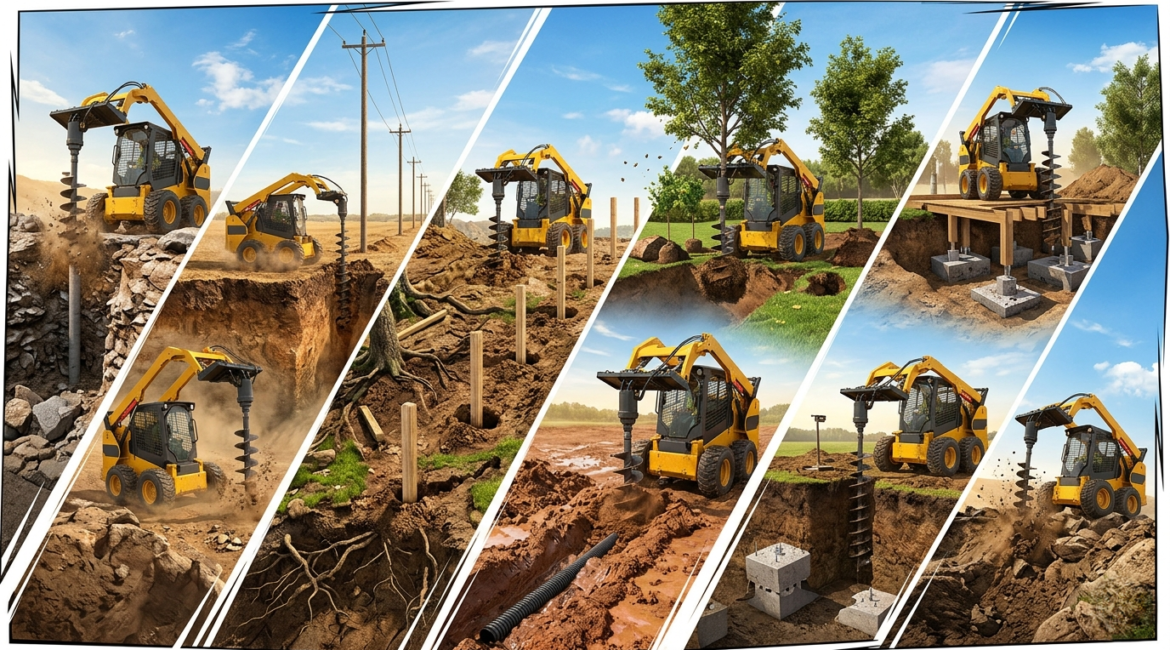
8 Ways Skid Steer Augers Save Time on Tough Digging Jobs
In the context of construction, landscaping, and farming projects, the time factor often transcends monetary value, becoming the primary determinant of whether one meets the deadline or gets behind schedule which can easily solved the best skid steer augers in the industry.
Manual digging, being the most physically demanding and least efficient activity on a construction site, naturally causes weariness and results in slower progress. In this scenario, the skid steer auger turns out to be an incredible breakthrough. By the transformation through a machine’s hydraulic power into high-torque rotational force, these attachments change hours of hard manual labor into efficient work of few minutes.
Regardless of whether you are working with flinty ground, solid rock, or heavy clay, a premium brand skid steer auger equipped with sharp bits has the power to punch holes the sizes a normal shovel would fail to produce.
Due to the high level of mobility of these machines, operators can seamlessly change amongst varied bit sizes and types, so the fully equipped machine after always tailoring the configuration to efficiently handle the specific terrain.
Top 8 Ways Skid Steer Augers Save Time on Tough Digging Jobs
Here are 8 points through which the skid steer auger usage will reduce project timings drastically and make you more profitable:
1. High Torque Output for Faster Soil Penetration
One of the biggest pros of a skid steer auger is the excellent torque level of the planetary drive system which besides putting out a force strong enough to overcome hand-held or manual post hole diggers etc could be considered, are more for resistance orbits at the earth’s level and operating them requires a fair degree of strength. You don’t only revolve a drill bit, you force it through the earth by exerting thousands of foot-pounds of pressure.
- Planetary Drive Efficiency: The motor’s torque is multiplied by high-quality planetary drives which can also help the bit to keep a good speed even while making the way through heavy clay.
- Reduced Resistance: Since the skid steer has a mechanical advantage, it means the operator makes less physical effort while the machine is doing the heavy lifting.
- Consistent Speed: You can maintain a constant RPM irrespective of how dense the soil is, which helps the bit to not get stuck or “walk” over the surface.
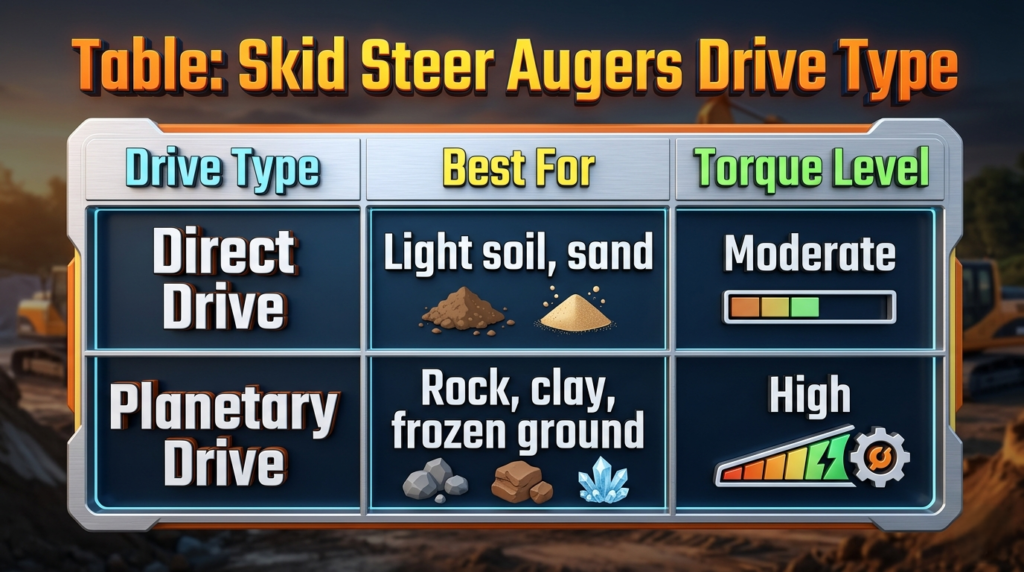
Table: Skid Steer Augers Drive Type
| Drive Type | Best For | Torque Level |
| Direct Drive | Light soil, sand | Moderate |
| Planetary Drive | Rock, clay, frozen ground | High |
2. Rapid Switching Between Different Bit Sizes
Speed and efficiency of a job site greatly rely on how fast it is possible to react to the changes of requirements. With a skid steer auger system, one will be able to make a fast change of bits which is a great time saver.
In other words, the change of switching from making holes for a fence post to digging a big hole for the root ball of a big tree will take you only a couple of minutes. This flexibility will allow you to operate one machine and one crew only while doing different hole diameter work thus saving you a lot of additional overhead.
- Universal Mounting: The majority of auger drives nowadays are equipped with a hub that allows hex or round bits which in turn facilitates quick bit changes.
- Range of Sizes: Normally the range will include small bits of around 6 inches for T-posts and heavy duty ones for example for landscaping which can go up to 48 inches.
- Adapters: Extending compatibility also among bits already owned can be achieved by using drive adapters.
3. Precision Placement and Straight Holes
There is no compromise when putting up utility poles or piers for foundations. If the holes are not straight, then it is more likely you’ll have to waste time filling them up and re-digging. Skid steer augers can be relied on heavy-duty stable platforms that will guarantee that each drilling is exactly vertical, even on a rough ground.
- Improved Visibility: A cab operator can see plainly which locations have been marked, and thus can drill exactly where required.
- Stability: Using the weight of the skid steer as a counter-weight to the auger will help to keep vibrations at a minimum and thereby assist in better precision.
- Vertical Accuracy: Self-leveling brackets and “flip mounts” features are capable of keeping the tool at 90 degrees to the ground irrespective of the loader’s position.
4. Effortless Debris Removal via Flighting
Just be clear, digging the hole is only 50% of the job; getting rid of the dirt is 50% more. Auger bits come with spirals that during the rotation mechanically force soil upward and out of the hole.
Even in cases when a hole is really clean, the remaining piece of soil will automatically be brought above ground by the screw action.” Flakes of dirt are also “flung” at high speeds when drilling reaches the bottom, which results in a clean surface ready for concrete or posts.
It is also much easier to go forward with backfilling post-set since the soil’s fabric of the rim is constant and hasn’t been displaced by an erratic pattern of dirt removed from the hole.
- Continuous Material Lift: The soil is pulled up with every rotation of the auger.
- Clean Hole Bottoms: The dirt at the bottom of the hole is separated and thrown away so the bottom is clean.
- Reduced Cleanup: The soil is deposited in a neat pile around the hole making it easy to backfill after setting the post.
5. Overcoming Extreme Ground Conditions
Challenging circumstances for the use of machinery may arise at frozen hardness or when there is a massive presence of solid stone. Generally, carbide-tipped teeth are hooked up on special skid steer auger-bit which has teeth that work like “jackhammers” and go through material which is beyond the reach of any manual tool.
- Rock Bits: They are made with heavy-duty teeth specifically to grind through solid rock and concrete.
- Frost Bits: Made for situations that involve working in winter when the ground can be as hard as concrete because of the “frost line”.
- Durability: Made with reinforcement flighting and heavy-duty center shafts for high failure environments.
6. Significant Reduction in Labor Costs
By mechanizing the digging process, one skid steer operator can operate at the productivity level equivalent to five workers with shovels. Man-hours reduction gives you room for reallocation your workforce to more skilled tasks only that you may be setting the posts or doing the landscaping up finishing speeding up the project lifecycle total.
- Lower Fatigue: Operators can stay fresh and productive if they operate in climate-controlled cabs instead of getting exhausted during manual work.
- Fewer Injuries: Mechanical digging reduces the risk of the back strain and repetitive motion injuries that are associated with manual labor adversely.
- Faster Turnaround: Resume the work in a single day that has previously taken three days, so you can bid on more jobs each month.
7. Multi-Tasking with Specialized Attachments
Using a skid steer auger does not mean you are limited to just digging holes. You can leverage additional stump augers and thus increase the utility and utility of your drive unit. This way, the need for renting a dedicated stump grinder will be removed as you will be able to use the auger/stump bit as a land-clearing tool, in one pass.
- Stump Augers: By boring into the center and breaking the wood apart, tree stumps can be ground down in no time.
- Tree Shapers: Specialized holes for root balls can be created that encourage a healthy growth and faster planting.
- T-Post Drivers: A few auger models can be modified to directly drive posts into the ground, thereby completely skipping the digging stage.
8. Minimal Site Disturbance
On many job sites, protecting the surrounding turf is a priority – especially the residential landscaping ones. Skid steers, first of all, are known for their great maneuverability, and secondly, since the auger is a tool that operates in the vertical plane, it takes up a very small “footprint” as compared to a backhoe or an excavator.
- Compact Design: Access tight spaces between houses or in wooded areas where larger machines cannot fit.
- Clean Operation: The soil is concentrated in one spot, preventing massive piles of dirt from covering the lawn.
- Easy Restoration: Because the hole is the exact diameter needed, there is less ground to repair after the job is finished.
Frequently Asked Questions (FAQs)
How deep can a skid steer auger dig?
Most skid steer augers are 4 feet length. Nonetheless, by making use of bit extensions and strong soil conditions, one can reach depths of 6 to 10 feet or even more, depending on machine hydraulic capacity.
What size auger do I need for my skid steer?
Mostly it will depend on hydraulic flow (GPM) of the loader. Standard flow machines are usually able to handle bits that are up to 24-30 inches, whereas high-flow machines can power 48-inch bits. Always check your drive unit torque rating before bit selection.
Can a skid steer auger dig through solid rock?
Yes, however, you must have a dedicated “Rock Auger” bit that is equipped with carbide bullet teeth capable of grinding through hard surfaces. Standard dirt bit will get damaged if used on rock.
What is the difference between a direct drive and a planetary drive auger?
Direct drive units are cheaper and perfect for soft soils. Planetary drives are geared to provide much higher torque, which is why they are the popular choice among construction professionals and in situations that require tough digging.
How do I maintain my skid steer auger attachment?
Planned maintenance is to check oil level(s) in the planetary gearbox(s),\nwater-resistant grease pivot points, and regularly inspect teeth and pilot bit. Replace teeth immediately once they start to wear as digging performance can be affected.
Will a skid steer auger work on a mini track loader?
Definitely many manufacturers make mini-skid steer auger units specifically designed for smaller machines. Only that you must be sure that the mounting plate and hydraulic couplers are compatible with your model.
Why is my auger spinning but not digging?
This can be because the teeth are dull or you are using the wrong type of bit for the soil. In the case of extremely hard ground you might have to press more using the skid steer’s arms to help the bit cut.