
15 Must-Have Skid Steer Attachments for Maximum Versatility on Job Sites
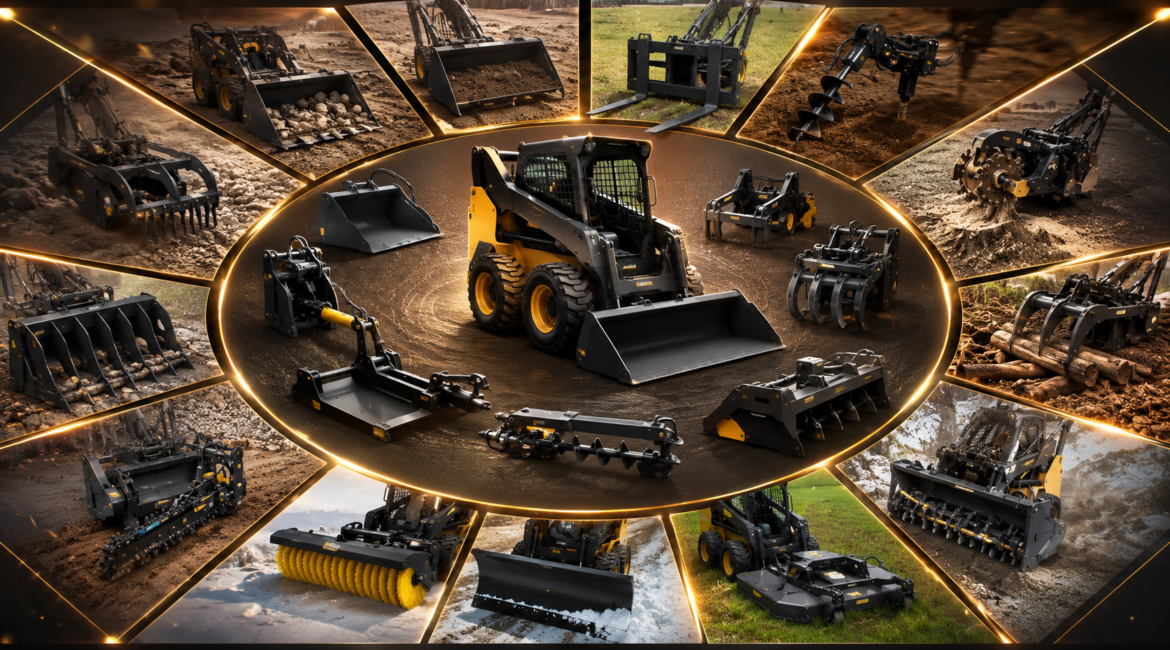
Let’s face it—a bare skid steer sitting on a dirt lot is essentially just a very expensive, heavy metal box on wheels or tracks. What actually makes this machine the undisputed king of the modern job site isn’t just the engine or the hydraulics; it is the massive ecosystem of skid steer attachments you can hook up to the front of it. By simply swapping out one tool for another, a single operator can go from moving mountains of dirt to precision grading, land clearing, tearing up old asphalt, or even plowing deep winter snow. Hence, investing in these top 15 Skid Steer Attachments to maximize versatility for every job requirement is mandatory.
If you run a construction crew, a landscaping business, or a farm, you already know that buying a dedicated machine for every single task is a fast track to going broke. Instead, investing in the right mix of skid steer attachments stretches your budget, keeps your crew working efficiently, and opens up entirely new avenues for bidding on different types of contracts. To help you figure out exactly what you need in your fleet, we have put together the ultimate guide to the 15 absolute best tools you can buy to turn your loader into a complete all-in-one powerhouse.
15 Must-Have Skid Steer Attachments for Maximum Versatility on Job Sites
1. General-Purpose and Specialty Buckets
You really cannot talk about skid steer attachments without starting with the classic bucket. It is the bread and butter of earthmoving, but stopping at just a standard dirt bucket is a huge mistake. The beauty of bucket attachments today is how incredibly specialized they have become. Whether you are hauling wet heavy clay, sifting out massive river rocks, or trying to back-drag a freshly poured gravel driveway, there is a specific bucket geometry designed to make that exact job significantly easier and faster for the operator inside the cab.
- Standard Dirt and Grading Buckets: These are your everyday heroes, built with a flat leading edge that is perfect for scooping loose mulch, hauling gravel, and doing smooth reverse back-dragging on uneven soil.
- 4-in-1 Multi-Purpose Buckets: If you only want to buy one bucket, this is it. It hydraulically opens up to act as a clam-style grapple, a bulldozer blade, a standard scoop, and a bottom-dumping box for loading tall trucks.
- Skeleton and Rock Buckets: Built with thick steel tines spaced a few inches apart, these allow all the useless dirt and loose sand to fall right through while you hold onto the big boulders, logs, and concrete chunks you actually want to move.
2. Heavy-Duty Pallet Forks
Next to a bucket, a solid set of pallet forks is easily the most used piece of equipment in any contractor’s yard. Turning your loader into an all-terrain forklift completely changes the game when you are dealing with uneven, muddy job sites where a standard warehouse forklift would immediately sink to its axles. When a flatbed pulls up loaded with heavy roofing shingles, stacked block, or bundled lumber, having this attachment ready to go means you can unload the truck and carry the materials straight through the mud right to where the guys are working.
- High-Visibility Backrests: A good fork frame is designed with a low-profile, see-through backrest so the operator isn’t flying blind and can clearly see exactly where the fork tips are entering the pallet.
- Fully Adjustable Tine Spacing: Whether you are dealing with standard grocery pallets, extra-wide custom crates, or long bundles of steel pipe, the tines can be quickly slid side-to-side to balance the load perfectly.
- Massive Lifting Capacities: Depending on your machine’s size, these heavy-forged steel forks can safely lift anywhere from 2,000 to over 6,000 pounds without bending or warping under pressure.
3. Root and Scrap Grapples
Trying to pick up a massive pile of twisted tree branches, jagged concrete, or tangled demolition wire with a standard dirt bucket is an absolute nightmare. That is exactly where hydraulic grapples come into play. These aggressive skid steer attachments act like a giant, metal hand. The dual hydraulic cylinders clamp down hard on whatever irregular, awkward mess you are trying to clean up, keeping it securely pinned against the frame so nothing falls out and hits the machine while you are driving across rough terrain.
- Independent Clamping Arms: Because the two top arms operate on separate cylinders, they can clamp down unevenly, which is totally necessary when you are grabbing an asymmetrical load like a giant tree stump on one side and a thin branch on the other.
- Open-Tine Floor Design: Just like a rock bucket, the bottom of a root grapple is completely open, letting all the topsoil drop back to the ground so you aren’t paying dump fees to dispose of good dirt.
- Abrasion-Resistant Steel Construction: Quality grapples are welded out of high-tensile AR400 steel to survive the brutal, high-impact abuse of slamming into scrap metal, concrete slabs, and thick hardwood trees every single day.
4. Planetary and Chain Drive Augers
If you have ever tried to dig thirty fence post holes by hand in hard, sun-baked clay, you know exactly why an earth auger is worth its weight in gold. Hooking up a hydraulic auger drive to your machine allows you to bore perfectly plumb, incredibly deep holes in a fraction of the time it would take a manual crew. Whether you are installing a long stretch of livestock fencing, pouring concrete deck footings, or planting a row of mature trees, matching the right drive motor with the right bit makes digging nearly effortless.
- High-Torque Planetary Gears: These specialized gearboxes take the hydraulic flow from your machine and convert it into massive low-speed torque, allowing the bit to chew through compacted gravel, thick clay, and roots without suddenly stalling out.
- Endless Bit Compatibility: You can swap out a narrow 6-inch bit for a standard fence post, attach a massive 36-inch bit for planting large tree root balls, or even throw on a rock-carbide bit for chewing through solid limestone.
- Instant Bi-Directional Reversing: When the bit inevitably catches on a massive hidden tree root or wedges under a boulder, the operator can instantly run the hydraulics in reverse to back the bit out and clear the jam safely.
5. Brush Cutters and Rotary Mowers
When you land a contract to clear a massive, overgrown commercial lot or maintain miles of utility right-of-ways, a standard zero-turn mower simply isn’t going to cut it. You need a heavy-duty brush cutter. These aggressive skid steer attachments are built like absolute tanks, designed to float over rough, unseen terrain while violently smashing through thick meadow grasses, dense blackberry bushes, and thick hardwood saplings. It is the ultimate tool for turning a wild, unmanaged property back into usable land in just a matter of hours.
- Direct-Drive Motor Systems: High-end models ditch the belts and use direct-drive hydraulic motors paired with heavy flywheels to keep the blade momentum going even when you drive into incredibly thick brush.
- Bi-Directional Swinging Blades: The cutting blades pivot on thick pins, meaning if you hit a hidden rock or a steel fence post, the blade bounces back safely instead of shattering or destroying the gearbox.
- Heavy-Duty Front Push Bars: A thick steel bar welded to the front of the deck pushes tall brush and saplings forward and away from the operator’s glass door, feeding the wood directly down into the spinning blades.
6. Forestry Mulchers
While brush cutters are great for overgrown fields, true land clearing requires a machine that can eat entire standing trees and leave behind a beautifully manicured, carpeted forest floor. Forestry mulchers are the undisputed heavyweights of the skid steer attachments world. Instead of cutting trees down and hauling the logs to a burn pile or a chipper, a mulcher simply drives right up to the tree, grinds it down from the top to the stump, and processes the wood down into rich, beneficial mulch right right on the spot.
- High-Speed Rotating Drums: These attachments use a massive horizontal spinning drum covered in dozens of carbide-tipped or hardened steel teeth that act like a giant cheese grater against thick timber.
- High-Flow Hydraulic Demands: To keep that drum spinning through a thick oak tree without stalling, these attachments almost always require a skid steer equipped with high-flow hydraulics pushing 30 to 45 gallons per minute.
- Adjustable Deflector Doors: Operators can hydraulically open or close the heavy rear door on the mulcher to control exactly how fine the mulch is processed and where the wood chips are thrown.
7. Trenchers
Any time you need to bury electrical conduit, lay down agricultural irrigation pipes, or install drainage lines, you want to disturb as little of the surface dirt as possible to keep restoration costs low. Running an excavator bucket makes a massive, sloppy mess. A trencher attachment acts like a giant chainsaw for the dirt, cutting a perfectly straight, narrow, and clean slot into the ground while keeping the bottom of the trench totally flat and ready for pipe installation.
- Deep Digging Capabilities: You can order these booms in multiple lengths—usually from 36 inches down to 75 inches—so you can easily dig well below the freezing frost line dictated by your local building codes.
- Customizable Chain Teeth: Depending on your local soil, you can outfit the chain with cup teeth for soft sandy dirt, aggressive rock-frost teeth for hardpan, or a 50/50 combination chain that handles a bit of everything.
- Integrated Spoil Augers: As the dirt is pulled up out of the trench, a large spinning auger pushes the loose soil off to one side, leaving a clean edge that won’t collapse and making it incredibly easy to backfill later.
8. Hydraulic Breakers and Hammers
Demolition crews know that breaking up an old parking lot or tearing out a failing concrete foundation is brutal, time-consuming work. Enter the hydraulic breaker. By taking the steady flow of hydraulic fluid and converting it into violent, rapid-fire percussion blows, this tool allows your skid steer to shatter reinforced concrete slabs, break apart massive fieldstones, and crack solid bedrock. It turns days of backbreaking jackhammer work by a manual crew into a comfortable, few-hour job from the seat of a cab.
- Massive Impact Energy: These hammers strike hundreds of times per minute, delivering focused, concentrated energy that easily fractures thick, rebar-laced concrete that would normally require a massive excavator to handle.
- Interchangeable Chisel Bits: You can swap out the working end with a sharp moil point for busting up general concrete, a wide chisel for cutting straight lines in asphalt, or a blunt tip for breaking large rocks into smaller pieces.
- Sound-Suppressed Housings: Because job site noise restrictions are getting stricter, top-tier breakers are built inside fully enclosed, shock-mounted boxes that reduce the deafening metal-on-metal ringing sound.
9. Power Box Rakes and Soil Conditioners
If your business does any kind of turf installation, seeding, or final driveway grading, a power box rake is one of the most profitable skid steer attachments you can own. When you pull onto a job site that is covered in hard tire ruts, heavy clay clods, and millions of tiny rocks, this tool will fix it in a single pass. It pulverizes the dirt, pulls the rocks out, levels the high spots, fills in the low spots, and leaves behind a soft, fluffy seedbed that is absolutely perfect for laying fresh sod.
- Carbide-Tipped Rotors: The main drum is covered in hundreds of tough little teeth that spin against the direction you are driving, actively chewing up hard dirt clods and separating out the trash.
- Hydraulic Angle Control: From the joystick, you can angle the whole rake 25 degrees left or right, which perfectly windrows all the rocks and debris into a neat line for easy scooping and disposal later.
- Adjustable End Plates: By dropping the side plates down, the rake acts like a push-box to carry dirt into low holes; flip them up, and it acts like a wide-area broom to blend the soil edges seamlessly.
10. Cold Planers and Asphalt Mills
Road repair is serious business, and patching potholes by just throwing loose asphalt into a hole is a recipe for failure. Cold planers are specialized skid steer attachments that allow paving crews to grind away the damaged, cracked top layer of an asphalt or concrete road. By milling the surface down a few inches, you create a perfectly textured, solid base with clean, square edges so the new hot asphalt bonds perfectly and lasts for years without peeling back up.
- Independent Depth and Tilt: The operator can adjust the left and right skids independently from the cab, allowing them to mill perfectly tapered edges or match the specific drainage slope of a city street.
- Replaceable Carbide Picks: The heavy steel milling drum is loaded with bullet-shaped carbide teeth that aggressively grind the pavement into small, reusable aggregate chunks.
- Dust-Suppressing Water Kits: Because milling dry asphalt creates massive, dangerous clouds of silica dust, these planers can hook up to roof-mounted water tanks to spray the drum, killing the dust and cooling the teeth.
11. Angle Brooms and Sweepers
Keeping the job site clean isn’t just about looking professional; it is usually a strict legal requirement to prevent mud and gravel from washing into public storm drains or causing traffic accidents on public roads. Rather than having four guys pushing hand brooms for hours, an angle broom attachment clears massive stretches of pavement in minutes. It is the perfect finishing tool for road construction crews, municipal street cleaners, and snow removal guys trying to get the last dusting of snow off a sidewalk.
- Hydraulic Swiveling: Operators can instantly angle the broom left or right on the fly, continuously casting dirt, mud, and debris off to the shoulder of the road without ever stopping the machine.
- Poly and Steel Bristles: You can load the broom core with standard soft poly bristles for sweeping warehouses, or mix in aggressive steel wire bristles to actively scrape dried, caked-on mud off asphalt.
- Enclosed Hopper Options: If you can’t just sweep the dirt to the side, you can buy a sweeper with an integrated dustpan hopper that catches all the dirt so you can dump it directly into a roll-off dumpster.
12. Snow Blowers and Snow Pushers
When winter hits hard, your earthmoving equipment doesn’t have to sit idle in the shop. With the right skid steer attachments, your loader transforms into an unstoppable snow-clearing beast. For massive commercial parking lots, a giant snow pusher box can clear acres of snow in record time. But when the snow gets too deep to push, or you need to clear narrow roads with massive drifts, a hydraulic snow blower will chew through the ice and throw it completely out of the way.
- Two-Stage Blower Action: The front auger aggressively breaks up hard-packed ice and frozen drifts, feeding the snow directly into a high-speed fan that launches it up to 45 feet away from the machine.
- High-Volume Containment Boxes: Snow pushers use tall, enclosed steel wings and rubber cutting edges to trap massive walls of snow, allowing you to push huge piles across a parking lot without spilling it off the sides.
- Electric/Hydraulic Chute Control: Operators can rotate the blower chute 270 degrees and adjust the pitch of the deflector tip right from the cab joysticks, placing the snow exactly where they want it.
13. Backhoe Attachments
Sometimes you are working in a tiny residential backyard, and dragging a full-sized excavator through the fence just isn’t going to happen. Adding a backhoe arm to the front of your loader gives you the true, deep-digging geometry of an excavator right on your existing machine. It is perfect for digging deep utility vaults, excavating small swimming pools, or trenching out a foundation footing in incredibly tight, restricted spaces where a large machine would destroy the property.
- 180-Degree Boom Articulation: The arm swings a full 180 degrees left and right, meaning you can dig a deep hole and dump the dirt far off to the side without having to constantly drive the skid steer back and forth.
- Drop-Down Stabilizer Legs: Because digging puts massive stress on the loader arms and tires, these attachments feature heavy hydraulic feet that push down into the dirt to anchor the machine solid while you dig.
- Various Bucket Sizes: Just like a real excavator, you can swap the buckets out. Throw on a narrow 12-inch bucket for delicate pipe work, or a 36-inch bucket for moving massive amounts of loose dirt fast.
14. Tree Spades and Nursery Grapples
If you are in the professional landscaping business or run a commercial tree nursery, moving live, mature trees is an incredibly delicate process. If you damage the root ball, the tree dies, and you lose thousands of dollars. Tree spade attachments eliminate the guesswork and manual labor of transplanting. They use immense hydraulic pressure to slice cleanly down into the soil, wrapping around the roots and lifting the tree perfectly intact, ensuring it survives the move to its new home.
- Overlapping Steel Blades: The attachment uses three or four heavy, pointed steel blades that slide down on a cone-shaped angle, severing roots perfectly clean and packing the soil tight around the base of the tree.
- Low-Profile Frame Geometries: These frames are built specifically to hug the ground and stay out of the way of the low-hanging branches, meaning you won’t snap the canopy of the tree while you are trying to dig it up.
- Uniform Root Ball Sizing: Because the blades form a perfect cone every single time, you can pre-dig the receiving hole with the exact same attachment, guaranteeing a flawless, airtight fit when you drop the new tree in.
15. Concrete Mixers and Dispensing Buckets
When you have to pour a concrete patio in a backyard, or set a hundred fence posts deep in the woods, getting a massive, heavy concrete mixer truck back there is physically impossible. Instead of running back and forth with wheelbarrows all day, concrete mixer attachments let you scoop up the raw dry materials, mix the concrete perfectly right inside the bucket using the skid steer’s hydraulics, and drive it straight to the exact spot where you need to pour.
- Internal Mixing Paddles: Inside the bucket, a heavy-duty hydraulic auger or chain-driven paddle system violently churns the water, sand, gravel, and cement together to create a perfect mix without clumping.
- Precision Chute Dispensers: Most of these buckets feature a side or bottom hatch that hooks up to a flexible rubber tube, letting you aim the wet concrete directly into tiny sonotubes or tight wall forms without spilling a drop.
- Self-Loading Capabilities: The front of the mixer is shaped exactly like a standard dirt bucket, meaning the operator can just drive the loader right into a pile of sand and gravel to load it up, saving massive amounts of back-breaking manual shoveling.
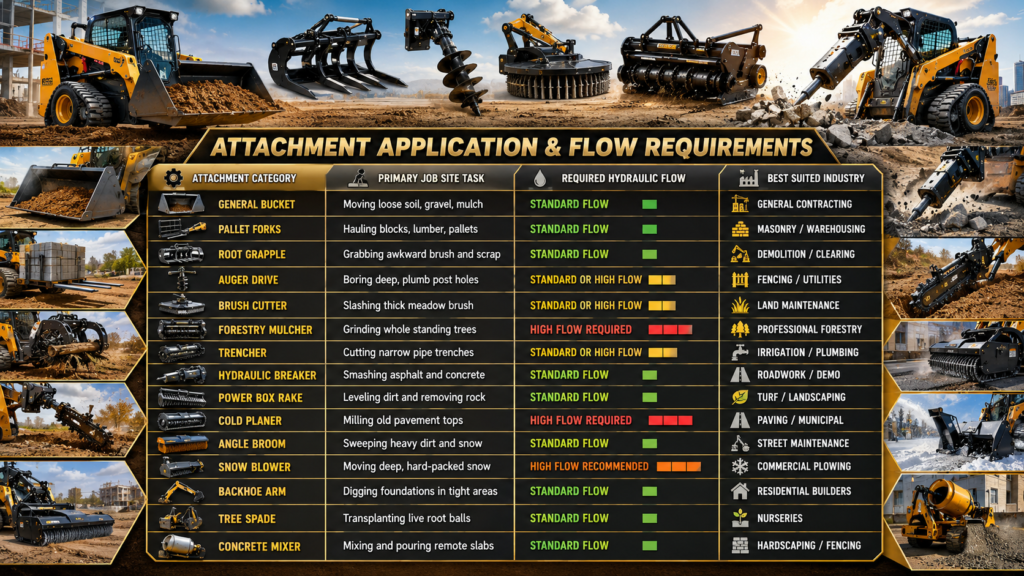
Table: Attachment Application & Flow Requirements
| Attachment Category | Primary Job Site Task | Required Hydraulic Flow | Best Suited Industry |
| General Bucket | Moving loose soil, gravel, mulch | Standard Flow | General Contracting |
| Pallet Forks | Hauling blocks, lumber, pallets | Standard Flow | Masonry / Warehousing |
| Root Grapple | Grabbing awkward brush and scrap | Standard Flow | Demolition / Clearing |
| Auger Drive | Boring deep, plumb post holes | Standard or High Flow | Fencing / Utilities |
| Brush Cutter | Slashing thick meadow brush | Standard or High Flow | Land Maintenance |
| Forestry Mulcher | Grinding whole standing trees | High Flow Required | Professional Forestry |
| Trencher | Cutting narrow pipe trenches | Standard or High Flow | Irrigation / Plumbing |
| Hydraulic Breaker | Smashing asphalt and concrete | Standard Flow | Roadwork / Demo |
| Power Box Rake | Leveling dirt and removing rock | Standard Flow | Turf / Landscaping |
| Cold Planer | Milling old pavement tops | High Flow Required | Paving / Municipal |
| Angle Broom | Sweeping heavy dirt and snow | Standard Flow | Street Maintenance |
| Snow Blower | Moving deep, hard-packed snow | High Flow Recommended | Commercial Plowing |
| Backhoe Arm | Digging foundations in tight areas | Standard Flow | Residential Builders |
| Tree Spade | Transplanting live root balls | Standard Flow | Nurseries |
| Concrete Mixer | Mixing and pouring remote slabs | Standard Flow | Hardscaping / Fencing |
FAQs About Skid Steer Attachments
Are skid steer attachments fully interchangeable between different machine brands?
Yes, for the most part. Almost all modern loaders built in the last twenty years use a universal quick-attach plate system. This means a bucket built by one company will physically hook up to a machine built by another. However, you still have to double-check that your machine’s hydraulic gallons per minute (GPM) matches what the tool actually requires to run properly.
What exactly is the difference between standard-flow and high-flow attachments?
Standard-flow skid steer attachments run perfectly fine on your machine’s normal hydraulic circuit, which usually pumps out between 15 and 25 GPM. High-flow tools, like massive forestry mulchers or heavy cold planers, require a specialized, upgraded hydraulic system that pumps 30 to 45+ GPM to deliver the extreme torque needed for heavy milling and grinding.
How do I know what size bucket to buy for my machine?
A good rule of thumb is to buy a bucket that is about two to three inches wider than the outer edge of your loader’s tires or tracks. This ensures that as you scoop, you are clearing a clean path for the machine to drive through. Just make sure the weight of the full bucket doesn’t exceed your loader’s safe lifting capacity.
Is it better to rent or buy these attachments?
If you are using a tool like pallet forks, a dirt bucket, or a root grapple every single week, you should absolutely buy it to get the long-term return on investment. If you just landed a weird one-off job that requires a highly expensive, specialized tool like a tree spade or a cold planer, renting is definitely the smarter financial move.
Do skid steer attachments require a lot of maintenance?
They take a beating, so yes, basic maintenance is non-negotiable. You should be greasing every single pivot pin daily. You also need to constantly wipe dirt off the hydraulic quick-couplers before plugging them in—if you force dirt into your loader’s hydraulic pump, you are looking at a massive repair bill.
Can my skid steer actually replace a mini excavator?
It really depends on the job. If you just need to dig a quick 3-foot trench for a sprinkler line or bore some fence posts, a skid steer with the right attachments will do the job perfectly and save you from buying another machine. But if you are digging massive, deep basements or working on terrifyingly steep hillsides, a dedicated mini excavator is still the right tool.
Why is my hydraulic attachment running slowly or stalling out?
If your hydraulic tool feels weak, you are probably dealing with low hydraulic fluid, a clogged filter, or worn-out quick couplers that are restricting the oil flow. It is also highly possible that you accidentally bought a high-flow attachment and are trying to run it on a standard-flow machine, which will never give it the power it needs.


[…] Read Also: Maximize job site efficiency with 15 Skid Steer Attachments! Unlock versatility wit… […]