
When mini skid steer rental vs buying Make Sense? – Financial breakdown for business owners
If you run a landscaping crew, manage a hardscaping outfit, or take on utility excavation jobs, you have probably spent a Sunday afternoon staring at invoices, wondering: How should I decide among mini skid steer rental vs buying?
It is one of the biggest capital questions small operators wrestle with. Renting keeps debt off the balance sheet and maintenance off your plate, while buying builds equity and eliminates project delays. But intuition won’t tell you which move protects your bottom line—only the math will.
Mini Skid Steer Rental vs Buying: When Does Buying a Mini Skid Steer Make Sense?
When evaluating mini skid steer rental vs buying, the decision rarely comes down to brand loyalty or gut feelings. It boils down to job frequency, true operating costs, and where your working capital works hardest.
1. The True Cost of Renting (The Sneaky Math)
Renting feels safe because there is no big down payment. You pick up the machine, knock out the grading or trenching, wash it off, drop it back at the yard, and move on.
Look closer at the line items on your monthly bank statements, however, and the expense adds up quickly:
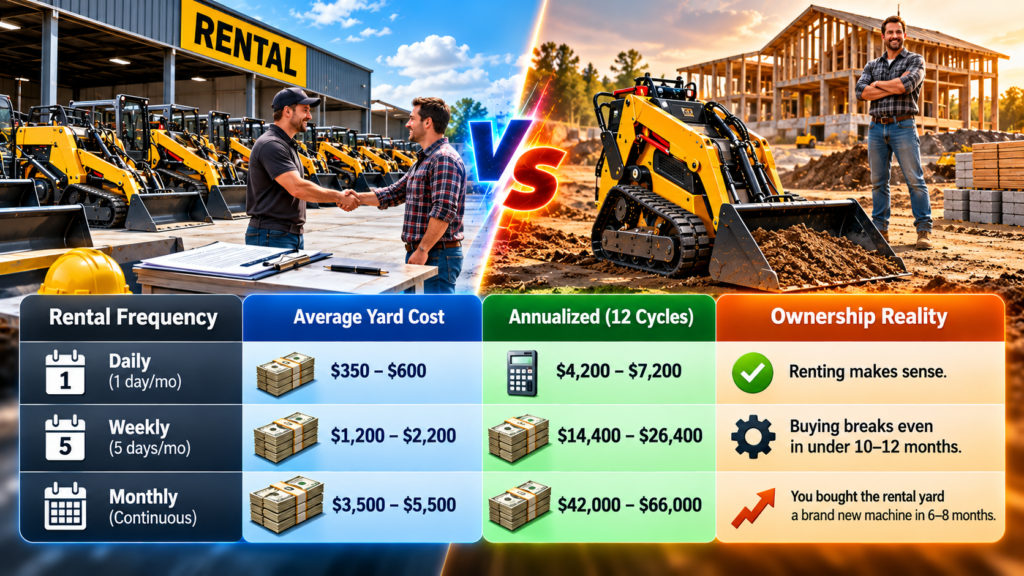
- Daily vs. Monthly Rates: Most equipment yards rent compact utility loaders for $350 to $600 a day. Five-day weekly rates average $1,200 to $2,200, and a 30-day rental runs anywhere from $3,500 to $5,500 depending on hydraulic flow ratings and machine size.
- The Surcharge Stack: That $400 day rate is rarely just $400. Once you add drop-off/pick-up delivery fees ($150–$300 round trip), compulsory loss damage waivers (often 10–15% of base rent), environmental fees, and fuel top-offs, a single rental day frequently creeps toward $600 to $750.
- The Cost of Waiting: When spring landscaping hits or fall trenching wraps up, rental inventory vanishes. Losing two sunny days because the local yard is out of track machines doesn’t just cost rental money—it stalls the job, delays client billing, and damages your reputation.
Table: Mini skid steer rental vs buying: Breakeven by Usage
| Rental Frequency | Average Yard Cost | Annualized (12 Cycles) | Ownership Reality |
| Daily (1 day/mo) | $350 – $600 | $4,200 – $7,200 | Renting makes sense. |
| Weekly (5 days/mo) | $1,200 – $2,200 | $14,400 – $26,400 | Buying breaks even in under 10–12 months. |
| Monthly (Continuous) | $3,500 – $5,500 | $42,000 – $66,000 | You bought the rental yard a brand new machine in 6–8 months. |
2. The Practical Business Case for Ownership
When analyzing mini skid steer rental vs buying, the standard industry rule of thumb is simple: if you run a machine more than 3 to 4 days a month consistently, buying is almost always the cheaper financial path.
Ownership changes how you bid and schedule:
- Immediate Job Availability: You don’t have to plan jobs around yard hours, holiday closures, or reservation queues. If a client asks for extra trenching on a Saturday morning, you fire it up and bill the extra work right away.
- First-Year Tax Advantages: Under U.S. IRS Section 179 depreciation rules, qualifying businesses can often write off up to 100% of eligible equipment purchase costs within the tax year it is placed in service. That deduction alone can offset thousands in income tax that rental receipts never touch.
- Building Equity vs. Flushing Cash: Rental receipts are dead money. A well-maintained diesel compact utility loader retains strong resale value on the secondary market. If you finance over 48 to 60 months, you eventually own a clear asset that strengthens your balance sheet.
3. Real Ownership Expenses: Beyond the Sticker Price
Sales reps often pitch monthly loan payments while skipping the realities of ownership. What does it actually take to operate a purchased mini skid steer every month?
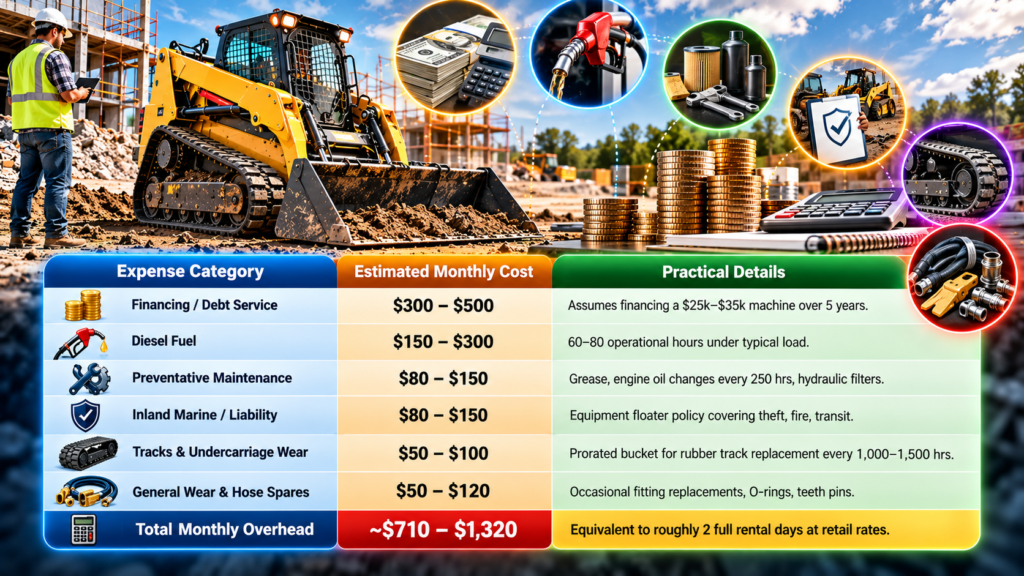
Assuming an operator runs a machine roughly 60 to 80 engine hours a month on active commercial job sites, here is an honest monthly breakdown:
Table: Real Ownership Expenses
| Expense Category | Estimated Monthly Cost | Practical Details |
| Financing / Debt Service | $300 – $500 | Assumes financing a $25k–$35k machine over 5 years. |
| Diesel Fuel | $150 – $300 | 60–80 operational hours under typical load. |
| Preventative Maintenance | $80 – $150 | Grease, engine oil changes every 250 hrs, hydraulic filters. |
| Inland Marine / Liability | $80 – $150 | Equipment floater policy covering theft, fire, transit. |
| Tracks & Undercarriage Wear | $50 – $100 | Prorated bucket for rubber track replacement every 1,000–1,500 hrs. |
| General Wear & Hose Spares | $50 – $120 | Occasional fitting replacements, O-rings, teeth pins. |
| Total Monthly Overhead | ~$710 – $1,320 | Equivalent to roughly 2 full rental days at retail rates. |
If your crew books just three project days a month that need a skid steer, your purchase overhead is already covered compared to rolling off a rental trailer.
4. When Renting Is Still the Smarter Move
Buying is not universal advice. Taking on debt or spending liquid reserves on a machine makes zero sense if your work profile looks like this:
- Infrequent, Seasonal Projects: If you only need a mini loader twice a year to clear snow or spread mulch on one big commercial property, paying 12 months of insurance, storage, and maintenance is a poor use of capital. Rent and write off the single invoice.
- Early-Stage Working Capital Pressure: If an equipment down payment drains your payroll cushion or stops you from buying job-critical materials, preserve cash and rent until customer receivables stabilize.
- Wildly Changing Job Specs: If Monday calls for a micro-walk-behind to squeeze through a 32-inch backyard pedestrian gate, but Friday requires an 80-horsepower full-size track loader to load high-side dump trucks, renting specialized machines per project is far smarter than locking into one middle-weight unit.
5. Machine Profile: TYPHON STOMP Series
For contractors looking to move out of the rental cycle without spending $55,000+ on Tier-1 brand markups, the TYPHON STOMP series (including the STOMP X1300 and STOMP 509, distributed via SkidSteer.Online and TYPHON Machinery) has gained traction among landscapers and general builders.
- Core Powertrain: Powered by a dependable Kubota D1105 25HP diesel engine paired with an Italian HANSA closed-loop hydraulic setup. This gives operators predictable joystick feathering and ample auxiliary flow for high-draw work.
- Tight-Access Dimensions: At roughly 900mm (35.4 inches) wide with a 2,352mm pin height, the STOMP X1300 walks through standard backyard privacy gates, loads single-axle dump trailers cleanly, and pivots inside fenced enclosures.
- Auxiliary Implement Range: Rather than relying on multiple machines, the universal mini mount runs specialized attachments:
- Forestry Mulcher (SKU: TYPH-5126 / ~$3,089.99) for brush clearance
- Digger Backhoe Arm (SKU: TYPH-5125 / ~$2,118.00) for trenching footings
- Rotary Tiller (SKU: TYPH-5115 / ~$2,505.00) for seedbed prep
- 4-in-1 Combo Bucket (SKU: TYPH-5106 / ~$2,256.00) for grading and back-dragging
- Hydraulic Wood Grabber (SKU: TYPH-5107 / ~$2,056.00) and 200mm Auger (SKU: TYPH-5109 / ~$2,586.00)
- Entry Economics: Flexible equipment financing starting around $171/month helps ease the transition from variable rental costs into predictable monthly overhead.
6. Three-Year Cash Outlay: Renting vs. Buying
Let’s model what happens over 36 months for an active crew requiring 8 machine days per month.
We’ll compare renting at a realistic all-in average of $450/day ($3,600/month) against owning a financed machine with full operating costs averaging $900/month plus an initial machine acquisition cost of roughly $25,000:
Table: Mini Skid Steer Rental vs Buying Business Differences and Milestones
| Milestone | Total Rental Spend (8 Days/Mo) | Total Ownership Cost (Financing + Ops) | Net Business Difference |
| Month 6 | $21,600 | $30,400 (Initial buy-in + maintenance/fuel) | Renting holds short-term cash advantage. |
| Month 12 | $43,200 | $35,800 total | Owner saves $7,400 |
| Month 18 | $64,800 | $41,200 total | Owner saves $23,600 |
| Month 24 | $86,400 | $46,600 total | Owner saves $39,800 |
| Month 36 | $129,600 | $57,400 total | Owner saves $72,200 + holds machine asset |
By year three, continuing to rent at just two days per week burns more than $72,000 in unnecessary capital—money that could have bought an additional machine, upgraded your truck fleet, or bolstered company profits.
Frequently Asked Questions – Mini Skid Steer Rental Vs Buying
What does it cost to rent a mini skid steer per day?
Standard day rates run between $350 and $600, not including fuel top-offs, environmental surcharges, delivery runs, or damage waivers. Once those add-ons hit the invoice, expect total out-of-pocket costs to sit around $500 to $750 for a single day of operation.
Is buying a mini skid steer worth it for a small landscaping business?
If you bill for grading, sod prep, retaining walls, or material movement more than 2 to 3 days each month, yes. Buying stabilizes your job scheduling and lowers your day-to-day machine costs. It also opens up higher-margin services you might otherwise skip due to rental logistics.
What is the break-even point in the mini skid steer rental vs buying comparison?
For a company putting 6 to 10 project days on a machine per month, the financial break-even point typically arrives between 10 and 16 months. Factoring in Section 179 tax deductions on qualifying new purchases can move that threshold even earlier.
Can I finance a compact utility loader easily?
Yes. Commercial equipment financing typically offers terms from 24 to 60 months with minimal down payments for established businesses. Packages like the TYPHON STOMP series offer financing structures starting around $171 per month, keeping payments well below the cost of a single day’s yard rental.
What attachments should an owner buy first?
Start with the basics that match your core service: a standard heavy-duty smooth or toothed dirt bucket, pallet forks for moving nursery stock or pavers, and an auger powerhead if you set fence posts or footings. Add specialized tools like trenchers, tillers, or brush mulchers as dedicated contracts demand them.
What routine maintenance is required to protect equipment value?
Grease all loader arm pivot pins daily (every 8–10 operating hours). Change engine oil and primary fuel filters every 250 operating hours, check hydraulic fluid levels regularly, monitor track tension, and blow out the radiator cooling fins after working in dry, dusty conditions.
The Takeaway – Mini Skid Steer Rental Vs Buying
When weighing mini skid steer rental vs buying, remember that renting is built for sporadic convenience, while owning is built for recurring production.
If your machine sits parked 28 days out of the month, call the rental yard and let them handle the storage and service. But if your crews are loading wheelbarrows by hand or repeatedly shelling out thousands in rental fees every season, stepping up to ownership stops profit leaks and gives your business the agility to take on bigger, more lucrative jobs.