Farm-to-Table Operations: Using Compact Equipment for Small-Scale Farming
Running a local food supply business is tough work. If you’re supplying restaurants or running a CSA, you already know the margins are razor-thin and your acreage is probably maxed out. Learn how to choose the best compact equipment for small-scale farming to avoid complications.
You can’t afford to waste space, and you definitely can’t afford to ruin your soil with massive, heavy machinery. That’s where a major shift is happening in agriculture. Growers are ditching the clunky old tractors and swapping them for compact equipment for small-scale farming. It just makes more sense.
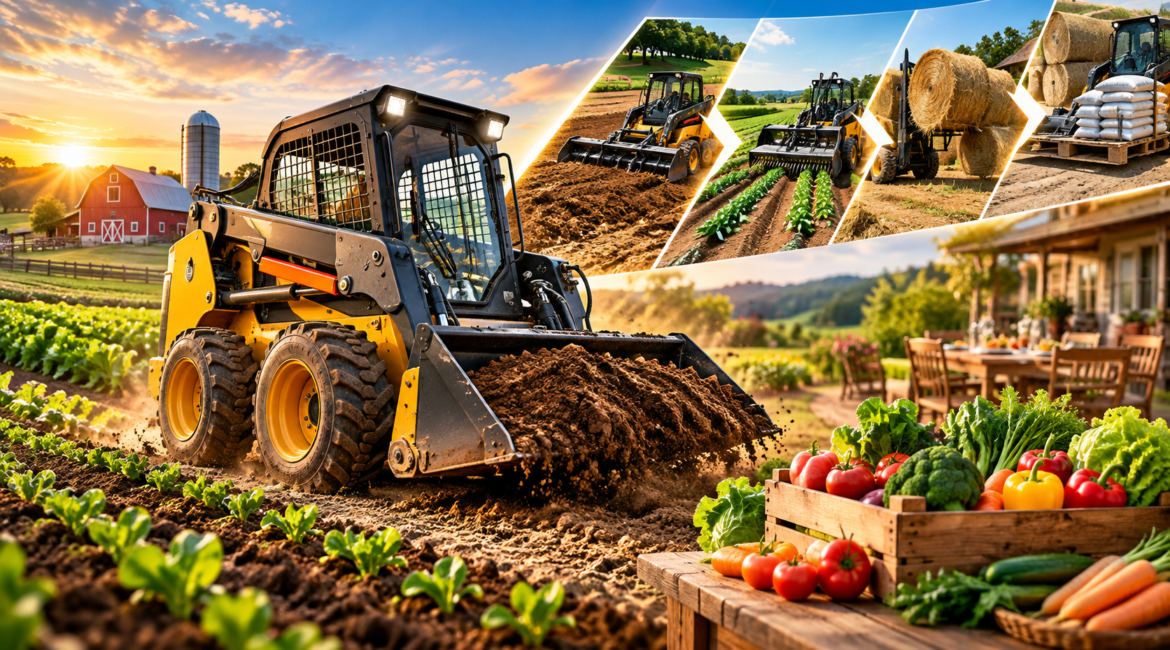
You need machinery that fits through tight greenhouse doors, turns on a dime, and doesn’t compress your topsoil into concrete. With a single base machine and a handful of smart attachments, you can prep beds, dig trenches, and load compost before lunch. Let’s look at how the right gear takes the back-breaking labor out of your daily grind.
Why Farm-to-Table Operations Are Downsizing Their Gear
The demand for local, organic food is through the roof. But scaling up your production on a small plot means getting creative. You need power, sure, but you need precision even more. A 10,000-pound tractor might look great on a massive commercial farm, but it’s a nightmare when you’re trying to navigate high tunnel greenhouses or densely packed vegetable rows. That’s why platforms like the STOMP series skid steers (specifically the STOMP X1300 and 509 models you’ll find at SkidSteer.Online) are taking over. They pack a punch with diesel engines but tread lightly.
- Save your soil’s health: Lighter machines mean less compaction. If you crush your soil, the microbes die, water pools up on top, and your roots can’t grow.
- Turn on a dime: True zero-turn capability means you can spin around at the end of a row without backing over your irrigation lines.
- Cut your overhead: Why buy a tractor, a backhoe, and a forklift when one base machine can run attachments for all three jobs?
Essential Compact Equipment for Small-Scale Farming Success
A skid steer without skid steer attachments is just a really expensive dirt-mover. The real magic happens when you hook up the right tools. To get the most out of your compact equipment for small-scale farming, you need to match your implements to your seasonal chores.
Need to bust up some hardpan clay before spring planting? Hook up a rotary tiller. Got a patch of overgrown brush blocking a new pasture? Run a forestry mulcher through it.
- Heavy-Duty Rotary Tillers: These are lifesavers for prepping seedbeds. They chew through dirt, mix your compost in evenly, and leave you with soft, fluffy soil.
- 4-in-1 Combo Buckets: If you only buy one attachment, make it this one. You can scoop dirt, bulldoze a path, grab loose branches, and grade a driveway without leaving the cab.
- Forestry Mulchers: Don’t pay a crew to clear land. This attachment shreds thick brush and small trees into organic mulch in minutes, right where they stand.
Navigating Organic Farming with STOMP Series Skid Steers
Going organic is a massive commitment. Since you can’t just spray chemicals to kill weeds, you’re looking at a ton of mechanical weed control. Honestly, pulling weeds by hand gets old fast.
This is where skid steer attachments for organic farming earn their keep. A quick pass with a tiller or a specialized sweeper tears up weeds by the roots without dumping a drop of synthetic herbicide on your crops. Plus, handling compost is way easier.
- Ditch the chemicals: Mechanical weed removal keeps you fully compliant with organic certifications.
- Move compost faster: Organic farms run on compost. Using a hydraulic grabber or a high-capacity bucket lets you turn and transport massive piles without breaking a sweat.
- Protect delicate root zones: The balanced weight distribution on the STOMP series ensures you aren’t creating a hard layer of dirt that chokes out your crops.
Enhancing Orchards with Specialized Skid Steer Attachments
Orchard work is all about overhead clearance and tight spaces. You’re constantly weaving around mature trees, trying not to knock off any fruit or snap low-hanging branches. So, having a low-profile machine is non-negotiable. But it’s the orchard maintenance equipment attachments that actually get the work done. Need to plant fifty new apple trees? Don’t grab a shovel. Hook up an auger.
- Planting on autopilot: A 200mm hydraulic earth auger drills a perfect, uniform hole for new saplings in seconds, even in awful clay.
- Cleaning up pruning messes: After winter pruning, a hydraulic wood grabber easily pinches heavy, awkward branches and pulls them out of the rows safely.
- Trenching for irrigation: A single-arm backhoe digger attachment lets you bury drip lines right at the root zones where the trees actually need the water.
Vineyard Applications: Precision with Mini Skid Steers
Vineyards might just be the toughest environment to run machinery in. You’re dealing with steep hills, terraced slopes, and rows that feel like they’re inches apart. Traditional tractors just don’t fit, which is exactly why mini skid steers for vineyards are becoming the industry standard. You need something agile enough to squeeze through the vines without scraping the trellis wires.
- Navigate narrow rows safely: The compact footprint (some models are barely three feet wide) means you can drive straight down the row without damaging your grapes.
- Fix drainage issues: Hook up a 3-tooth ripper to shatter compacted soil deep underground. This helps water drain away so your vines don’t get “wet feet.”
- Speed up the harvest: Slap a set of pallet forks on the loader to move heavy macro-bins of picked grapes directly from the dirt to the crush pad in record time.
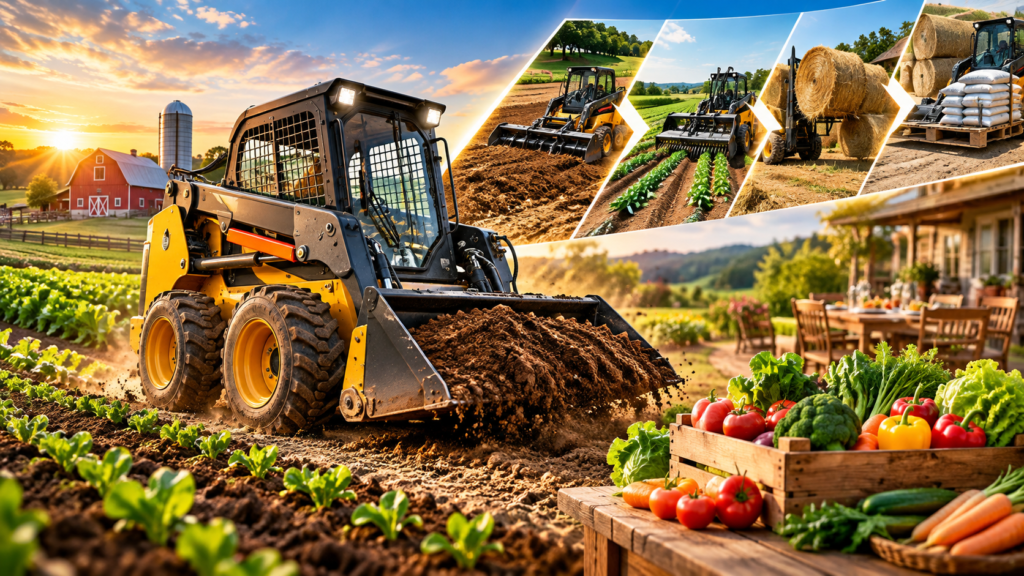
Comparing Attachments for Farm-to-Table Operations
Figuring out what to buy can be overwhelming. Let’s break down the heavy hitters so you can decide what actually makes sense for your budget and your daily chores.
Table: Compact equipment for small-scale farming
| Attachment | Best For | The Real-World Benefit | Monthly Finance Estimate |
| Heavy-Duty Rotary Tiller | Prepping soil & mixing compost | Kills weeds without chemicals and fluffs the soil for planting. | ~$209/mo |
| 200mm Hydraulic Earth Auger | Planting trees & setting posts | Drills through rocks and hard clay so your back doesn’t have to. | ~$216/mo |
| Forestry Mulcher | Land clearing | Eats brush and leaves behind a nice layer of moisture-saving mulch. | ~$257/mo |
| Single-Arm Digger | Burying irrigation lines | Lets you dig deep trenches in spots a regular backhoe can’t reach. | ~$177/mo |
| 4-in-1 Combo Bucket | A little bit of everything | Scoops, grabs, dozes, and levels. It’s the Swiss Army knife of farming. | ~$188/mo |
| 3-Tooth Ripper | Busting up hard ground | Tears through frozen ground and rocks to improve water drainage. | N/A ($1,421 outright) |
| Hydraulic Wood Grabber | Hauling brush and logs | Clamps down on awkward debris so it doesn’t fall on your hood. | ~$171/mo |
Maximizing Yields Using the Right Agricultural Attachments
At the end of the day, farming is a business. If your gear isn’t helping you turn a profit, it’s just taking up space in the barn. Using compact equipment for small-scale farming directly impacts your bottom line because it buys you time. When you aren’t spending six hours manually digging a trench or hauling feed by hand, you can spend that time actually managing your crops.
- Do more with less help: Good farmhands are hard to find. A skid steer loaders lets one person do the work of four people in half the time.
- Get consistent results: Hydraulic tools do the exact same thing every single pass, meaning your seedbeds are perfectly uniform across the whole property.
- Adapt to the season: When winter hits, take off the tiller and throw on a snow blower. The machine never has to sit idle.
Compact equipment for small-scale farming – Frequently Asked Questions
What is the best skid steer attachment for organic weed control? Without a doubt, it’s a heavy-duty rotary tiller. Since you can’t spray chemicals, running a tiller between your rows chops up the weed roots and flips them back into the dirt. It kills the weeds and adds organic matter back into the soil at the same time.
Can a mini skid steer actually be used inside a greenhouse? Yes, and they are incredible for it. Machines like the STOMP X1300 are narrow enough to drive right through a standard greenhouse door. They don’t weigh enough to tear up your flooring, and they make hauling heavy bags of fertilizer inside an absolute breeze.
How deep can a skid steer auger dig for tree planting? With a standard bit, you can easily punch holes three to four feet deep. That’s plenty of room for planting new orchard saplings or sinking heavy fence posts, even if your ground is mostly clay and rock.
What exactly is a 4-in-1 bucket used for on a farm? Think of it as four tools bolted together. You can use it as a regular bucket to scoop dirt. You can open the bottom to dump material precisely. You can use the front edge to bulldoze and grade a road, or use the clamshell action to pinch and grab awkward stuff like stumps.
Why are mini skid steers better than standard tractors for vineyards? It all comes down to space and soil. Tractors are wide and heavy. They smash the dirt down and have a hard time turning around in tight vineyard rows. Mini skid steers have a zero-turn radius and a much lighter footprint, so they don’t damage your delicate vine roots.
How do forestry mulchers benefit small-scale farming? If you have overgrown, useless land, a forestry mulcher fixes that instantly. It chews up thick brush and small trees and spits them out as mulch. You reclaim your land for farming immediately, and the mulch helps keep the soil moist during dry spells.
Do skid steer attachments require a lot of maintenance? Not if you stay on top of the basics. The biggest thing is keeping them greased. Wipe down the hydraulic couplers before you plug them in so dirt doesn’t get in your fluids, and grease the pivot points daily. Do that, and they’ll run forever.