
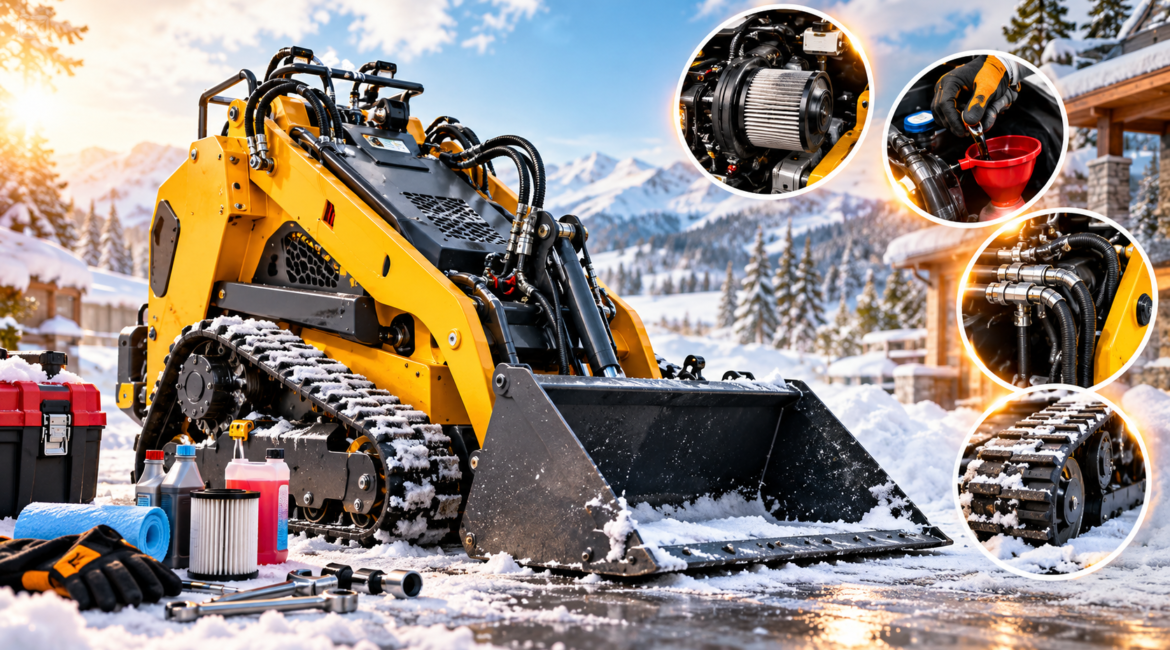
Winterizing Your Mini Skid Steer: Complete Maintenance Checklist
Winterizing your mini skid steer is one of the highest-value maintenance tasks you will perform all year — and one of the most skipped. One overlooked step in your cold-weather prep routine can mean a cracked hydraulic seal at dawn on your busiest job day, a dead battery in a foot of snow, or a fuel system so gelled it will not turn over. Winter does not forgive neglect, and compact loaders take the brunt of it.
At SkidSteer.Online, we work closely with operators, landscapers, contractors, and farmers who rely on mini skid steer maintenance to keep their machines productive through every month of the year. The consistent pattern we see is simple: operators who follow a thorough skid steer maintenance checklist before cold weather arrives run strong all winter. Operators who skip it spend the season chasing expensive, avoidable breakdowns.
This guide covers every system you need to address when winterizing your mini skid steer — fuel and engine, hydraulics, cooling, battery, tracks, attachments, cab controls, and long-term storage. It is written for operators of all compact loaders, with specific guidance for those running the TYPHON STOMP X1300 and STOMP 509 powered by the Kubota D1105 diesel engine. Work through this cold weather skid steer checklist once before the temperature drops, and your machine will reward you with reliable, consistent performance all season long.
Whether you are preparing for your first winter with a compact loader or looking to sharpen a seasonal maintenance routine you have been running for years, this is the most thorough mini skid steer winter preparation guide available. Let us get into it.
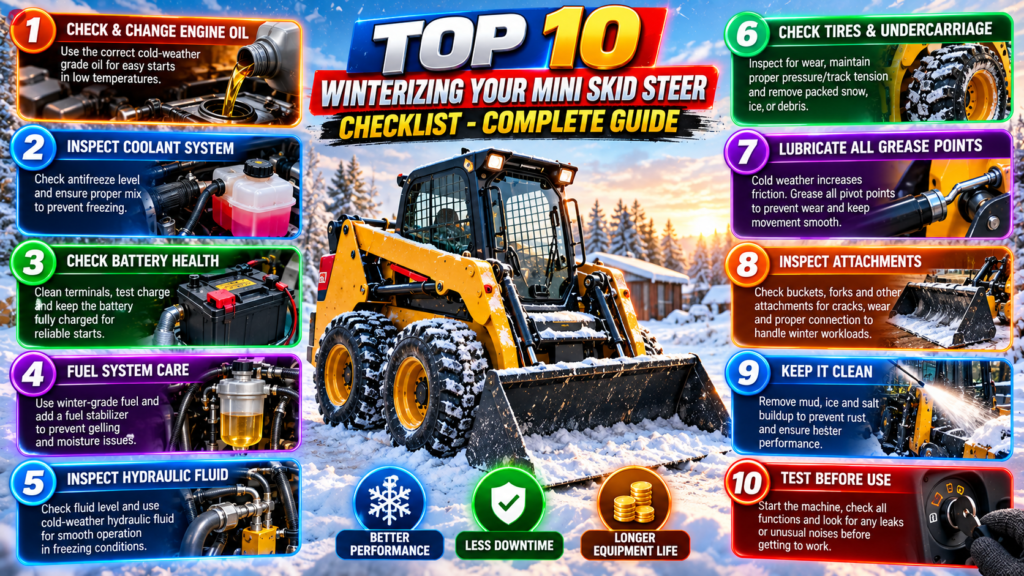
Top 8 Winterizing your Mini Skid Steer Checklist – Complete Guide
You may carefully complete this tiny skid steer maintenance checklist by system. Before temperatures persistently dip below 40 degrees Fahrenheit, do the checklist. Avoid waiting until the first hard freeze—damage may already be done. For the whole cold weather skid steer season, each item below outlines what to examine, replace, and do to safeguard your machine.
1. Start Here—Engine and Fuel System
Always start with gasoline and engine when winterizing your tiny skid steer. In cold weather, diesel engines are difficult to start, and contemporary fuel-injected engines with precise injector tolerances are fuel quality sensitive. The remainder of your seasonal maintenance schedule depends on fuel system accuracy.
- Add diesel anti-gel additive before filling below 40°F. Many industry professionals use Power Service Diesel Kleen (silver bottle for temperatures below 20 degrees Fahrenheit), Howes Diesel Treat, and Hot Shot Secret Diesel Winter Anti-Gel. Overfill a near-empty tank with treatment for maximum mixing. Stopping gelling costs pennies per gallon. A gelled gasoline system takes a day to thaw.
- Replace gasoline filter before winter. Candles and other particles that pass through the filter easily in summer might block it in winter. A new filter takes 15 minutes and a few bucks, but it’s essential to mini skid steer winter preparation.
- Check all gasoline lines for cracks, brittleness, and worn fittings. Rubber degrades quickly in cold. A January frost may break a gasoline line with a summer-heated surface fracture. Check every gasoline line on your skid steer maintenance checklist and replace any that appear suspect.
- Drain the fuel/water separator. Diesel fuel contains water year-round, but a frozen water pocket in the fuel delivery channel may stop fuel flow in winter. Check and empty the separator before cold-weather usage.
2. Change Engine Oil to Winter Grade
Engine oil viscosity reduces dramatically in cold. Oil that lubricates well at 60 degrees Fahrenheit thickens and resists at 10 degrees, leaving your engine without film lubrication during the initial seconds following a cold start. Daily chilly beginnings in winter add up to serious wear. For cold environment micro skid steer maintenance, oil selection is crucial.
- Use full synthetic 5W-40 or 0W-40 motor oil in winter. Synthetic oil flows better at low temperatures and reaches crucial bearing surfaces quicker after a cold start. Cold-start protection is best with 5W-40 or 0W-40 full synthetic on most micro skid steers, including those with the Kubota D1105 25HP diesel in the TYPHON STOMP series. Check your machine owner manual for viscosity limits.
- Replace oil and filter before storage or the first cold snap, not in spring. Acids, moisture, and combustion byproducts from the season are in used engine oil. Internal corrosion increases when impurities remain in the engine for months of cold storage. Take this compact loader winterization procedure before the equipment becomes chilly.
- Check and replace air filters as required. The intake of cold, thick winter air contains more moisture than summer air. In cold weather skid steer operation, a filthy, limited filter causes rich-running conditions that dilute engine oil, degrading lubrication for all engine parts.
3. Hydraulic System—Your Most Important Winter System
The hydraulic system is the most critical and easily damaged part of small skid steer winterization. It controls movement, lift, attachment, steering, and most machine functions. In winter, heavy, cold hydraulic oil causes pump wear, seal failures, and control sluggishness. The hydraulic system must be in top shape to operate TYPHON STOMP accessories like the Forestry Mulcher, Digger, and Rotary Tiller in winter.
- Change hydraulic fluid to winter-grade for cold environment operation. Below 32°F, ISO 68 hydraulic oil thickens. Use ISO 32 or ISO 46 hydraulic fluid cold weather grade for operating below 20 degrees, which flows more easily and offers responsive control even in harsh freezes. Thick cold oil causes circuit pressure that may blow seals, damage pump components, and make the machine sluggish and unpredictable.
- Allow for hydraulic warm-up before loading. Idle the engine at low RPM for 5–10 minutes in cold weather, then carefully cycle all hydraulic operations without load—extend and retract lift arms, tilt the bucket, activate auxiliary circuits. One of the most crucial cold weather skid steer practices is warming up the hydraulic circuit.
- Check all hydraulic hoses, fittings, and connections for wear. Cold brittles rubber hoses. January freezes may break a summer-aged hose’s surface fracture. Your mini skid steer maintenance examination should search for swelling, cracking, abrasion, and leaking fluid at every connection. Replace everything suspect before winter, not after the first failure.
- Inspect hydraulic fluid for water contamination. Before cold weather approaches, cleanse and replace tainted milky or foamy liquids. Freezing water in a hydraulic system may destroy pumps. This five-minute inspection is a must on every skid steer maintenance checklist.
- When using the TYPHON STOMP series with the Italian HANSA closed-loop three-pump hydraulic system, focus on the auxiliary circuit for attachments. Auxiliary circuits operate colder than the primary drive circuit and are more vulnerable to cold-oil sluggishness, particularly early in warm-up.
4. Cooling and Antifreeze Protection
Summer cooling protects the engine, but winterizing your tiny skid steer checklist includes freeze protection. A correctly mixed coolant system is easy to maintain, but cracked engine blocks, blown head gaskets, and split hoses may result from coolant freezing and expanding in confined passageways.
- Check coolant concentration with a refractometer, not visually. A 50/50 antifreeze-to-water combination protects to around -34°F, which is enough for typical North American operating conditions. A 60/40 or 70/30 blend protects against – 50 degrees in severe northern climes. One of the greatest tiny instruments in a seasonal maintenance box is a $15 refractometer, which offers a precise reading in seconds.
- Debris in radiator should be removed. Fall leaves, grass clippings, and organic stuff in front of the radiator trap moisture against the core and increase corrosion during winter freeze-thaw cycles. Cleaning the radiator during compact loader winterization is fast and beneficial to the cooling system.
- Check all coolant hoses and clamps at connecting locations. When pressed, an old coolant hose is stiff and brittle or mushy and spongy. Check clamp locations where hoses attach to the radiator and engine block, the highest-stress spots and most probable causes of gradual leaks that exacerbate in cold weather.
5. Electrical System and Battery
Battery failure is a typical cold-weather issue for any equipment. Physics are simple but harsh: cold temperatures impede electrochemical processes that create cranking current, lowering battery capacity by 35 to 60% when cold diesel engines need maximum cranking power to start. Every operator who ignored tiny skid steer battery winter preparation has a tale about a machine that wouldn’t start on the coldest morning.
- Load-test your batteries before winter, not simply voltage-check. A resting voltage of 12.6 volts hardly indicates cranking performance. A load test simulates a beginning load to see whether the battery can crank amps under duress. Many car parts businesses provide free testing. Any micro skid steer battery that fails a load test in October should be changed before winterization, not after a January work site failure.
- Thoroughly clean and safeguard battery terminals. Terminal corrosion increases resistance, amplifying cold-weather battery weaknesses. Reconnect wires, brush terminals to bright metal, and cover each terminal with dielectric grease or battery terminal protection spray. One of the biggest return-on-time investments in the skid steer maintenance checklist is this 10-minute step.
- Connect a battery maintainer during prolonged outage. A good battery maintainer maintains the battery charged without overcharging if the machine sits for longer than a week in cold conditions. Deeply drained batteries might freeze inside and be permanently damaged. Maintainers improve battery life and are inexpensive insurance.
- Use water-displacing spray to protect exposed electrical connections. Road and work site de-icing chemicals corrode electrical connections. Spray quality protectant on exposed connections, sensor harnesses, and switch contacts at winter’s start and midseason. Long-term electrical dependability is greatly improved by this small micro skid steer maintenance procedure.
6. Tracks and Undercarriage—Cold Weather Inspection
Most mini skid steer winter preparations neglect the undercarriage. Operators concentrate on fluids and engines, the machine’s mechanical heart, while tracks and rollers quietly endure ice, frozen muck, and freeze-thaw trauma. Undercarriage faults caught early avoid the most costly cold-weather repairs.
- Check and adjust track tension before temperature drops. Rubber tracks shrink in cold, shifting tension calibration. Check your machine’s tension range—over-tensioned and under-tensioned tracks wear quicker and derail more in cold weather skid steer situations. An ice work site track derailing is a safety problem, not merely a maintenance one.
- Pressure-wash the whole undercarriage before winter. Through winter freeze-thaw cycles, mud and organic particles in the undercarriage sponge up moisture and increase corrosion. Cleaning the undercarriage before winterization is essential for compact loaders. Be careful in roller contact regions, idler pockets, and drive sprocket channels where packing is severe.
- Check rubber tracks for damaged that can exacerbate in cold weather. Cuts, missing lugs, track body breaking, and steel cording should be checked. Cracks spread quicker in cold weather. A track that was just adequate in summer may deteriorate altogether during winter skid steer maintenance. Replace broken rails before the season, not halfway through February.
Switch to low-temperature arctic grease for all undercarriage fittings. Standard NLGI grease thickens in sub-freezing conditions and stops lubricating bearings. During cold weather, use a low-temperature arctic grease rated to at least minus 40 degrees Fahrenheit and cut your greasing intervals by half your summer interval.
7. Winterizing and Choosing Cold-Weather Tools
When winterizing your small skid steer, check your attachment array for cold weather suitability. Some tools are necessary winter gear. At typhonmachinery.com, on eBay (search: TYPHON Machinery skid steer attachments), and on Walmart Marketplace (search: tiny skid steer attachments), various accessories are designed for cold-weather compact loader operations.
- TYPHON Ripper 3-Tooth Attachment (TYPH-5108): $1,421 – top skid steer tool for cold conditions. Three heavy-duty shanks penetrate frost-hardened soil, frozen ground, and compacted ice layers that buckets cannot. Before winter usage, examine shank tips and mounting hardware and adjust all bolts. Vibration from hard frozen ground loosens hardware quicker.
- TYPHON 4-in-1 Combo Bucket (TYPH-5106) | $2,256 – a multipurpose compact skid steer winter preparation tool with dozer blade mode. Push snow into tight spots no plow can reach. In cold weather, check and replace the cutting edge if it’s worn. A dull edge is less effective at snow pushing and ice scraping.
- TYPHON Digger Attachment (TYPH-5125): $2,118 for winter trenching and utility work when manual digging is problematic due to frozen ground. Before winter usage, check bucket teeth and mounting pins during seasonal maintenance. Frozen ground puts larger impact pressures on the digger than soft summer dirt, making worn components dangerous.
To prepare attachments for winter storage, clean all ground-contact surfaces, apply rust-inhibiting spray to cutting edges and wear surfaces, and store on wooden pallets or rubber mats to avoid direct ground contact. To keep O-rings flexible in winter, lightly oil all hydraulic quick-connect couplers. Spring hydraulic leaks often occur from stiff, dry coupler seals.
8. Cab, Controls, Operator Comfort
Winter operator environment is very important. Cold, stiff controls impair operator accuracy and fatigue, making skid steer operation dangerous in cold weather. The whole winterizing small skid steer operation includes cab maintenance for enclosed-cab machines like the TYPHON TERROR XIX PRESTIGE with its built-in heating system.
- Test the cab heater before cold weather. A heater core or blower motor that has been idle since last winter may fail when switched on in the cold. In moderate autumn weather, test the heating system for a full workday so you can order parts and arrange repairs before the bad weather approaches.
- Lubricate joystick pivot points and control connections. Control responses might be slow or unpredictable because to cold stiffening connections. Mini skid steer maintenance before winter includes applying dry lubrication or low-temperature oil to all moving control components. Safety requires responsive, reliable controls, not simply pleasure.
- Check enclosed cab door and window seals. A damaged seal enables cold air and moisture into the operator cabin, limiting comfort and possibly causing electrical control panel dampness. A seal that no longer springs back when squeezed must be replaced before winter.
Frequently Asked Questions About Winterizing Mini Skid Steers
Can I drive a tiny skid steer on snow and ice?
Mini skid steers can handle cold weather, particularly in confined locations where bigger equipment cannot reach. Winterizing your tiny skid steer before the season makes it reliable. Correct winter fluid preparation, a thorough warm-up before load, track traction for the surface, and a heated cab for lengthy cold-weather sessions are essential for safe snow and ice operation. With an enclosed cabin and built-in heating, the TYPHON TERROR XIX PRESTIGE is designed for year-round use. Ice may make rubber tracks treacherous, thus some operators use anti-skid studs or traction cleats.
What hydraulic fluid is best for cold-weather micro skid steers?
ISO 68 hydraulic fluid should be replaced with ISO 32 or ISO 46 cold weather grade for cold-climate operation. In sub-freezing temperatures, these lower-viscosity oils flow more easily, offering responsive control and enough lubrication. Check your machine user manual—some manufacturers need warranty-approved fluids. TYPHON STOMP series operators should contact support@typhonmachinery.com or +1 213-214-2203 to validate the acceptable micro skid steer maintenance fluid specification for their machine configuration.
How do I keep my tiny skid steer tracks from freezing?
The most aggravating winter issue for operators is frozen tracks, thus full small skid steer winter preparation includes parking surfaces and routines. Park on concrete, compacted gravel, or asphalt instead than grass or bare dirt to prevent. Before closing, install thick rubber mats or plywood beneath the track contact area on unavoidable ground parking. Prevent ice bonding by lightly spraying track undersides with food-grade silicone before parking. If tracks freeze despite measures, melt contact ice with warm water. Never use a pry bar or push the machine free—this causes track ripping and undercarriage damage that costs more than a few minutes of patient thawing.
How frequently should winter micro skid steers be greased?
Cold-weather skid steer maintenance should reduce greasing intervals to half of summer intervals. If your machine needs lubrication every 50 hours in summer, grease it every 25–40 hours in winter. Cold temperatures accelerate lubricant migration from bearing surfaces, and frozen ground work increases impact stresses on pivot points and undercarriage components. Use a low-temperature arctic grease rated to at least minus 40 degrees Fahrenheit and pump until new grease emerges at the fitting edge to ensure you have entirely removed old contaminated grease from the bearing region.
Which diesel fuel additive prevents winter gelling best?
Equipment operators trust Power Service Diesel Kleen (white bottle above 20 degrees Fahrenheit, silver bottle below 20 degrees), Howes Diesel Treat, and Hot Shot Secret Diesel Winter Anti-Gel the most. Overfill a near-empty tank with treatment to mix. At temperatures below 40 degrees, treat every fill-up. A normal anti-gel won’t work on gelled gasoline. You need Power Service Diesel 911. Combine anti-gel treatment with PRI-D or Stanadyne long-term stabilizer for storage. This combined fuel method is essential for winterizing your tiny skid steer fuel system.
Does winter idling hurt micro skid steer diesel engines?
Every cold weather skid steer operation session should include five to twenty minutes of warm-up idling. However, keeping a diesel micro skid steer idle at low load for hours poses issues. Diesel engines running extended light-load cycles may not achieve maximum operating temperature, resulting in partial fuel combustion, cylinder wall fuel washing, and oil dilution. Extended low-load idling loads diesel particulate filters on current emissions-compliant engines. In practice, idle until the machine reaches operational temperature, then work or shut down. Mini skid steer maintenance should avoid cold starts and fuel-wasting idling.
What is the best winter storage for a tiny skid steer?
Heated storage above 40 degrees Fahrenheit is the best compact loader winterization method because it avoids most cold-weather equipment risks and simplifies spring starting. If heated storage is unavailable, fill the fuel tank with stabilizer and anti-gel, check the engine oil, disconnect or maintain the battery, lift tracks off bare ground, and cover with a breathable equipment cover. In climates where temperatures regularly drop below negative 20 degrees Fahrenheit, a programmable engine block heater makes cold starts much easier and reduces drivetrain wear.
Best TYPHON Machinery Attachments for Cold-Weather Operation
The right attachments are part of a complete mini skid steer winter preparation plan. The full TYPHON Machinery lineup — including the Ripper, 4-in-1 Bucket, Digger, Forestry Mulcher, Rotary Tiller, Wood Grabber, and Auger — is available at typhonmachinery.com. You can also find TYPHON products on eBay (search: TYPHON Machinery skid steer) and on Walmart Marketplace (search: mini skid steer attachments). All TYPHON products ship free on orders over $2,000 and include a one-year warranty with lifetime technical support.
Final Thoughts: Start Your Winterization Before the Cold Hits
Winterizing your mini skid steer is not glamorous work. It does not feel as immediately productive as a day of heavy earthmoving or as satisfying as a new attachment installation. But operators who take this skid steer maintenance checklist seriously — who work through it methodically before the first hard freeze — are the ones who get through winter without the breakdowns, the repair bills, and the lost production days that come from skipping it.
Your compact loader was built to work hard. The TYPHON STOMP series in particular was engineered for demanding, all-season performance. But no machine is immune to the damage that cold weather inflicts on unprotected fluids, rubber seals, batteries, and undercarriage components. Give your machine the seasonal maintenance attention it needs in the fall. It will give you reliable, consistent performance through the coldest months in return.