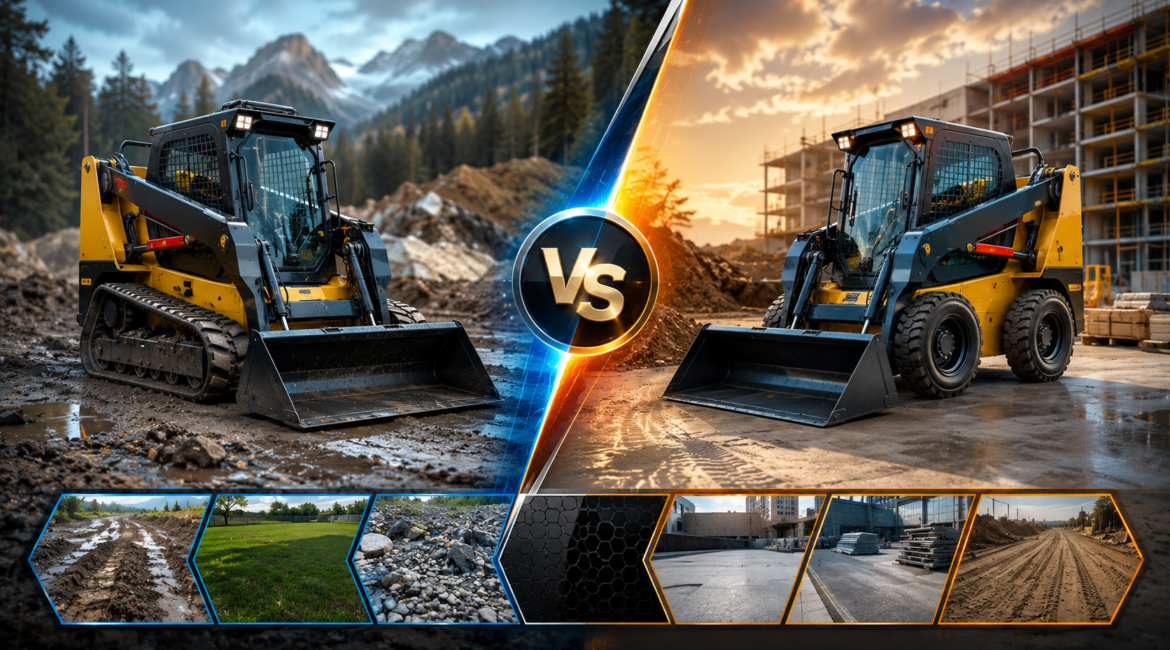
Tracked vs Wheeled Mini Skid Steers: Which Is Best for Your Project? – Application Specific Recommendations and Terrain Considerations
One of the most important considerations an operator, contractor or property owner will make when investing in small heavy equipment is tracked vs wheeled mini skid steers. Both machine platforms provide amazing work capacity in limited locations that typical earthmoving machines simply cannot reach, but their distinct ground-contact systems define how they operate across varied project sites.
Understanding the physics behind rubber tracks vs. pneumatic or solid rubber tires will help you to increase your production, save needless surface repairs and prolong the life of your machine components.
In this detailed guide, we will delve into the underlying technical differences between these platforms, evaluate their performance across different terrains and assess the synergy of top-tier machines like the TYPHON STOMP series with professional attachments for hard tasks.
The fundamental difference between tracked vs wheeled mini skid steers
The crux of the argument of tracked vs wheeled mini skid steers is based on the physics of ground pressure, traction distribution and mechanical powertrain simplicity. Both designs employ hydraulic fluid power to move the machine and to power high-performance auxiliary tools, but they deliver engine horsepower to the soil in fundamentally different ways. Understanding these fundamental principles can help you neither over or under specify your equipment for your main working environment.
The Engineering of Rubber Track Systems
Mini skid steers with tracks, often referred to as Compact Track Loaders (CTLs) or small track loaders, use continuous rubber tracks extended over an undercarriage assembly that includes driving sprockets, idlers, and rollers. This structure increases surface contact area, dispersing the operational weight of the machine over hundreds of square inches.
- Low Ground Pressure (PSI): Tracked loaders distribute the weight of the machine across a large surface area, allowing for extremely low pounds per square inch (PSI) and the ability to float over soft substrates where normal wheels would quickly sink.
- Improved flotation on soft ground: The bigger footprint means operators may keep applying tractive effort continuously in mud, loose sand, wet clay and newly graded topsoil without excavating ruts.
- better Machine Stability: Tracked undercarriages often have a wider and longer wheelbase footprint, allowing operators better tipping load capacity and confidence while lifting big loads at full boom height.
The Mechanics of Wheeled Skid-Steer Loaders
Mini skid steers with wheels have four separate tires, which may be heavy-duty pneumatic, foam-filled or solid rubber, and are operated by independent hydraulic wheel motors or chain drives. Wheels apply all of the weight of the machine to four relatively mini patches of contact, rather than spreading the weight out across a continuous track.
- Zero-Radius Turning Efficiency: Wheeled machines may skid turn by locking or reversing wheels on one side while pushing the other side ahead. This allows them to spin 360 degrees in their own footprint with very little resistance on hard surfaces.
- Lower Initial and Ongoing Maintenance Costs: Wheeled versions often have fewer complex drivetrains than rubber-tracked models, meaning much lower costs for maintenance and replacement over thousands of running hours, since there are no rubber tracks, idlers, rollers and tensioning systems to track.
- High-Speed Jobsite Mobility: Wheeled loaders have less mechanical rolling resistance than tracked undercarriages, achieving quicker travel speeds on asphalt, concrete, road surfaces and hard-packed staging areas.
Terrain Considerations: The Impact of Ground on Your Decision
The main aspect that will determine whether tracked or wheeled mini skid steers will be most beneficial is the terrain under the machine. A machine that excels in a muddy residential backyard dig is going to be prone to premature wear in an abrasive demolition yard, and vice versa.
Assessing your standard work area can help you save time on the job, cut down on equipment wear and decrease restoration expenses after the job is over.
1. Work on Soft, Uneven and Muddy Ground
Tracked equipment is the uncontested king of the jobsite when the weather turns rainy, or your project takes you into underdeveloped, marshy or loose soil conditions.
- Traction Loss Elimination: Rubber tracks contain powerful tread lugs that dig into soft ground and mud so the machine can push heavy stuff or climb hills without spinning off.
- Protection From Ruts: Tracked loaders don’t leave deep and expensive tire ruts on completed lawns, golf courses and agricultural fields, decreasing the effort needed to restore the landscape after the project is complete.
- Gradeability and Slope Safety: The extended track footprint offers better lateral grip on slopes, embankments and ditch lines where wheeled equipment have the danger of sliding laterally or losing stability.
2. Asphalt, Concrete and Gravel Operations
If your major contractual activity is urban construction, warehouse maintenance, paved road right-of-way repairs or hard-packed gravel yards, wheeled mini skid steers have obvious operating benefits.
- Reduced Undercarriage Wear: Running rubber tracks constantly over abrasive asphalt or concrete may increase lug wear and reduce track life; industrial tires are designed for operation on tough paved surfaces.
- No Pavement Scuffing: Tight skid turns with tracks may leave black rubber smear marks on ornamental pavement or driveways, but wheeled loaders (particularly when managed smoothly) generate less surface friction and esthetic disturbance.
- Improved Curb and Obstacle Clearance: Wheeled loaders may roll over curbs, exposed rebar and rocky construction waste without the danger of slicing a rubber track or derailing the undercarriage assembly.
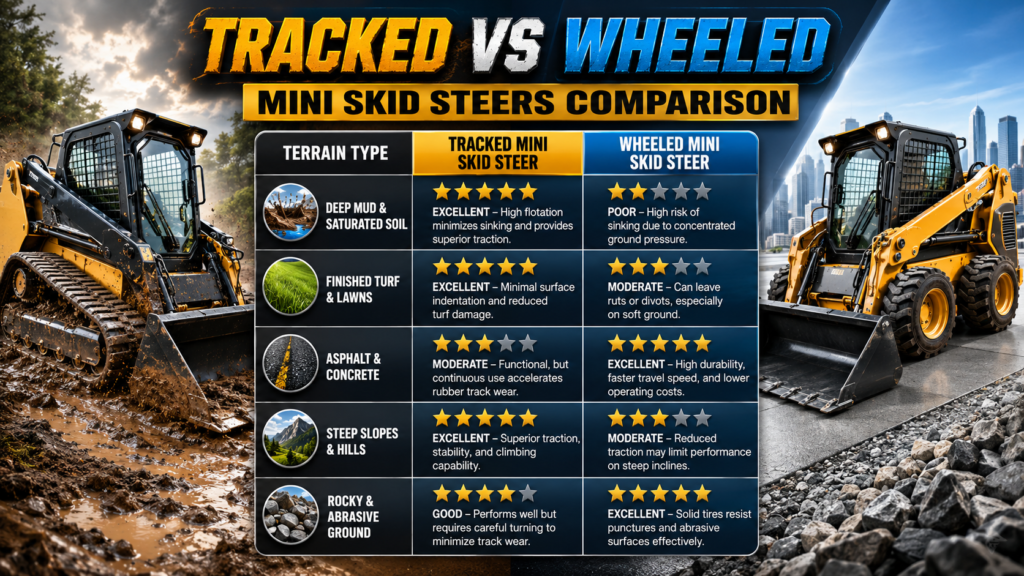
Table: Tracked vs Wheeled Mini Skid Steers Comparison
| Terrain Type | Tracked Mini Skid Steer | Wheeled Mini Skid Steer |
| Deep Mud & Saturated Soil | ⭐⭐⭐⭐⭐ Excellent – High flotation minimizes sinking and provides superior traction. | ⭐⭐☆☆☆ Poor – High risk of sinking due to concentrated ground pressure. |
| Finished Turf & Lawns | ⭐⭐⭐⭐⭐ Excellent – Minimal surface indentation and reduced turf damage. | ⭐⭐⭐☆☆ Moderate – Can leave ruts or divots, especially on soft ground. |
| Asphalt & Concrete | ⭐⭐⭐☆☆ Moderate – Functional, but continuous use accelerates rubber track wear. | ⭐⭐⭐⭐⭐ Excellent – High durability, faster travel speed, and lower operating costs. |
| Steep Slopes & Hills | ⭐⭐⭐⭐⭐ Excellent – Superior traction, stability, and climbing capability. | ⭐⭐⭐☆☆ Moderate – Reduced traction may limit performance on steep inclines. |
| Rocky & Abrasive Ground | ⭐⭐⭐⭐☆ Good – Performs well but requires careful turning to minimize track wear. | ⭐⭐⭐⭐⭐ Excellent – Solid tires resist punctures and abrasive surfaces effectively. |
Mini Skid Steers Application-Specific Recommendations
Your everyday applications and equipment you install to the front of the loader also have a big role in the decision of tracked vs wheeled mini skid steers. The TYPHON STOMP Series platform’s compact architecture, vertical lift designs and tough Italian HANSA closed-loop hydraulic systems are a perfect match for specialist attachments and machine stability.
Whether you’re using a small model like the STOMP X1300 (25HP Kubota D1105 diesel engine, narrow 900mm/35.4″ body width) or the heavier STOMP 509 (1.4-ton operating weight, 1065mm/41.9″ transport width, and 2150mm/84.6″ unloading height), the right mobility system, combined with the right attachment, is the key to jobsite profitability.
1. Forestry & Land Clearing Vegetation Control
Land clearing requires extreme pushing strength, steadiness on stump-filled terrain and the capacity to operate all day without overtaxing the engine. Tracked loaders are nearly usually recommended for these high duty forestry activities.
- Forestry Mulching: The TYPHON Forestry Mulcher Attachment (TYPH-5126) demands great tractive effort to push through thick bush and the 3-pump hydraulic system shreds small diameter trees into a thin mulch. Tracks keep the machine grounded on uneven woodland detritus.
- large Wood and Log Handling: Stacking firewood, clearing fallen storm branches or loading logs with the TYPHON Hydraulic Wood Grabber (TYPH-5107) demands rock-solid footing; tracks prevent forward tipping while lifting large loads at full reach.
- Right-of-Way and Firebreak Maintenance: Traveling off-road pipeline corridors or cutting firebreaks needs equipment that will span ditches and soft forest floor litter without getting high-centered or stuck.
2. Soil Preparation, Landscape Installation, and Trenching
Landscaping jobs are comprised of both heavy earthmoving and delicate decorative site work. Tracked mini skid steers are frequently the operator’s choice here for their turf-friendly floatation, but wheeled loaders dominate for hard-surface staging areas.
- Precision Excavation and Backhoe Work: The tracked base offers counterbalance and grip to dig utility trenches and foundation footings without moving when using the TYPHON Single-Arm Backhoe Digger Attachment (TYPH-5125) in tight backyards.
- Soil Conditioning and Seedbed Prep: The TYPHON Heavy-Duty Rotary Tiller Attachment (TYPH-5115) turns compacted soil beds into a fine powder for sod planting, and tracks make this task much easier by eliminating tire depression traces behind the tiller.
- Drilling Fence and Foundation Posts: The TYPHON 200mm Hydraulic Earth Auger Attachment (TYPH-5109) on a stable tracked platform guarantees that your drill holes stay plumb and true, even when drilling into stubborn clay on sloping lawns.
Tough Earthmoving, Ground Breaking and Multi-Tasking
Both of these platforms may shine for farm maintenance, demolition cleaning and general utility work depending on whether the working location is paved or unimproved soil.
- Breaking Hard-Packed and Frozen Soil: Tracked machines give the forward drawbar pull to rip through rocky terrain or frozen clay without tire slippage with the TYPHON 3-Tooth Ripper Attachment (TYPH-5108).
- Multi-Purpose Material Handling: The TYPHON 4-in-1 Bucket Combo (TYPH-5106) can be used as a standard bucket, dozer blade, clamshell and grapple on a wheeled loader for property maintenance purposes where operators are traveling between gravel driveways, barns and storage yards at speeds as high as 9 km/h (5.6 mph).
- Grading and Bulk Material Transport: Wheeled machines are the best choice for loading gravel from a pile on a paved driveway and carting it across hard roads, reducing undercarriage maintenance expenses.
Cost of Ownership, Maintenance and Durability Analysis
While the terrain performance is critical, the financial reality of tracked vs wheeled mini skid steers must be considered throughout the life of the equipment. The two systems have very different initial purchase prices, as well as timetables for periodic maintenance and component replacement.
Tracked Loader Life Cycle Cost Assessment
Compact track loaders demand a larger initial investment and require meticulous maintenance to safeguard undercarriage components from premature wear.
- Undercarriage Maintenance Rigor: Operators need to periodically wipe away the dried mud, boulders and gravel from the track frames, as debris may cause rollers to seize and stretch rubber tracks.
- Replacement Part Costs: The cost of replacing a set of rubber tracks, worn sprockets and sealed idler wheels is a large recurrent investment above the simple change-out of four tires.
- greater Resale Value: Tracked mini skid steers are in very high demand in contemporary landscaping and utility contracts, therefore they often maintain a greater residual resale value over time.
Advantages of Wheeled Loaders in terms of Finance
Wheeled mini skid steers are popular with budget-conscious contractors, rental yards and property owners that value mechanical simplicity and minimal operational expenses.
- Lower Upfront Purchase Price: Wheeled configurations often have a lower upfront investment, enabling operators to spend on higher-end attachments such as augers, tillers and mulchers.
- Low Undercarriage Maintenance: For tires, maintenance mostly involves monitoring air pressure (for pneumatic tires), looking for sidewall cuts and rotating tires to evenly distribute tread wear.
- Longer Tread Life on Abrasive Surfaces: If you’re operating largely on concrete or asphalt, industrial solid or foam-filled tires may survive thousands of hours of operation before replacement.
Your Fleet’s Last Decision
The decision between tracked and wheeled mini skid steers hinges on the ground conditions at your principal task sites, your budget, and the accessories you want to use. A systematic decision matrix enables you to confidently choose the equipment configuration that will optimize your operating efficiency.
Choosing a tracked mini skid-steer
If you are going to be using your everyday job in off-road locations, fragile soils or sensitive residential homes, choose a tracked model.
- Your Projects Are in Soft or Wet Terrain: Your job often involves mud, sand, marshes or freshly cleared soil, where flotation is critical to avoid becoming stuck.
- Turf Preservation is a Prime Requirement: Working on established lawns, parks or golf courses, avoiding tire ruts and soil compaction will save you hours of repair effort.
- You require maximum drawbar pull: You use high-duty soil engagement equipment such as the TYPHON 3-Tooth Ripper or need to push big brush loads with a Forestry Mulcher on steep hills.
When to Use a Mini Skid Steer With Wheels
Choose a wheeled one if your job is on hard terrain, speed, and reducing recurring maintenance costs.
- Your Work is Mostly on Paved Surfaces: Your work locations are concrete warehouses, asphalt road repairs, gravel farm yards, or paved home driveways.
- Faster Transit Speeds: You Need Faster Transit Speeds You navigate huge properties or multi-acre sites where faster travel speed (such the 9 km/h transit speed of the STOMP 509) boosts daily production.
- Lower Total expense of Ownership: You desire Lower Total expense of Ownership You desire less mechanical maintenance and want to avoid the periodic expense of replacing rubber tracks and undercarriage components.
FAQs – Tracked vs Wheeled Mini Skid Steers
What are the key benefits of tracked vs wheeled mini skid steers?
The main benefit of a tracked small skid steer is its low ground pressure and great buoyancy, so you can work effectively on wet muck, loose sand and finished grass without sinking or creating large ruts. However, wheeled mini skid steers are capable of traveling quicker on firm terrain, have cheaper initial purchase prices and much reduced maintenance expenses throughout the life of the machine.
Can wheeled mini skid steers perform well in muddy conditions?
Wheeled mini skid steers are capable of working in light soil and shallow mud, but are not effective in deep or saturated mud, or clay-heavy mud. Since the weight of the tracked loader is spread out across four mini tire contact patches, they tend to sink rapidly and easily lose traction or become stuck when a tracked loader would float over the surface.
Why do rubber tracks deteriorate quicker on concrete and asphalt?
Rubber tracks are made from proprietary rubber compounds that are designed to grip loose soils and soil. Continuous running on hard abrasive surfaces such as concrete or asphalt, particularly when making tight skid turns, may cause the abrasive friction to quickly scrape the rubber lugs away and cause the tracks to be replaced prematurely.
How long do rubber tracks last compared to tires on a mini skid steer?
A set of rubber tracks on a mini skid steer will last 1,200-1,500 hours of operation when properly maintained. This varies by terrain and operator experience. Heavy-duty pneumatic or solid rubber tires on wheeled skid steers may endure 2,000 hours or more, especially when working on smooth or medium-packed ground.
Tracked mini skid steers tend to be more stable on slopes than wheeled ones.
Yes, tracked mini skid steers provide far more lateral stability and traction on slopes and embankments. The extended broad footprint area of the tracks avoids side slippage and distributes the weight of the machine more evenly while running on hills.
Augers and trenchers attachments, are they superior on a tracked or wheeled loader?
Tracked mini skid steers are often better suited to ground-engaging attachments such as earth augers, backhoe diggers and trenchers. The tracks give a more solid, stronger anchor which will not move or slide when heavy torque is applied to hard dirt or rocky terrain.
How do I repair a mini skid steer undercarriage to prolong track life?
To enhance track life, clean up the undercarriage with a pressure washer everyday to remove dirt, pebbles and debris. Check the track tension as the manufacturer recommends, don’t spin the tracks needlessly on hard surfaces, and check the idler rollers and sprockets for early wear.