Skid Steer Controls Explained: Master Radial vs. Vertical Lift Models
The first step in getting the most out of any job site is knowing how modern heavy equipment operates. Both operators and fleet managers may feel that compact machinery is complex structurally and mechanically. But it doesn’t have to be that way, by breaking down the basics, it becomes much easier. Let’s understand the vital difference between radial vs. vertical lift models skid steer controls.
In earthmoving and material handling, the loader arm design of your machine plays a decisive role in how you get things done. A walk through different arm configurations among other things, will help you understand breakout forces, maximum height reach, stability, and overall operational cost.
Here, we dissect the main mechanical components differentiating the lift paths on today’s machines. Have a look at the control systems to gain more insights. You will get to know the different machines and the conditions in which they perform best by linking radial lift with vertical lift systems. Doing that will not only enhance your work process but will also make you less tired at the end of the day besides getting the wedge of the right machine for your project.
The Core Mechanics: What is a Radial Lift Skid Steer?
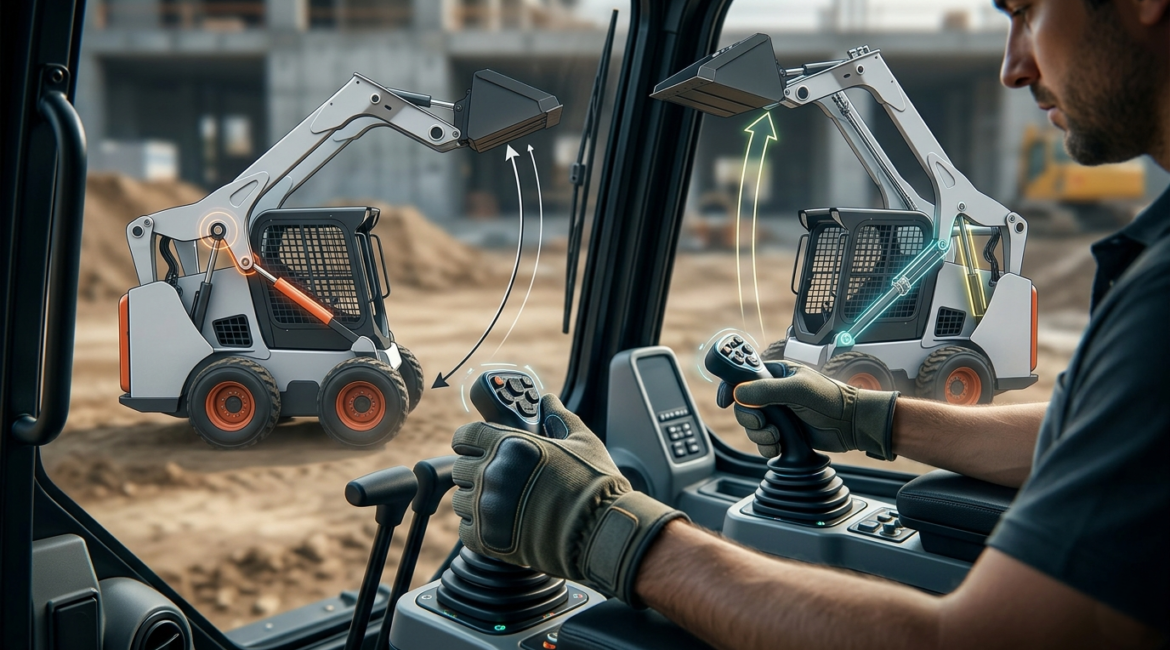
The radial lift design is the oldest and most basic type that compact loaders have used for a long time. It has a simple mechanical setup with one pivot point which is located toward the back of the machine frame. When the operator uses the hydraulics to raise the loader arms, the bucket or the attachment moves along an outward arc, a swinging circle.
- Lift Geometry: The path in the air is an arc, a smooth, sweeping, “C-like” curve in the horizontal direction which changes at different angles of the lift.
- Reach Dynamics: The radial lift achieves its greatest reach forward at about the lifting cycle’s mid-point, usually around the operator’s height.
- Structural Simplicity: With fewer parts to move, fewer links, and pins, the frame is very strong and live below wear points covering the potential of the machine.
Since the greatest leverage and maximum breakout forces are at ground level, these machines are structurally best suited for high-resistance, earth-engaging work. The loader arms tightly hugging the chassis as they dig deep, the frame is absorbing the force of pushing into the ground rather than passing the stress onto the complex linkage joints.
The Engineering Evolution: What is a Vertical Lift Skid Steer?
With the demands for construction practices moving towards the placement of materials being done at heights and heavier pallet handling, manufacturers came up with a vertical lift loader. Unlike the relatively straightforward designs, vertical lift features complex three-point linkages and double pivot sections on the two sides of the machine. These particular mechanisms allow the loader arms to go up almost vertically.
- True Linear Path: The attachment moves up and down parallel to a vertical line, which means that during the whole cycle, the load is kept at a relatively constant distance from the machine’s front frame.
- Maintains Maximum Reach Height: Unlike radial lifts whose forward reach declines after the lift gaining time, the vertical lift design keeps its maximum forward reach even at full extension.
- Load Proximity Engineered: The heavy load is balanced and situated closer to the center of gravity of the machine during the entire lifting operation, which greatly stabilizes the whole operation.
Although its construction features more hinges, lubrication points, and a complicated arrangement of the parts, it does away with the horizontal shifting of the load seen in the radial machines. This ensures that the load stays firmly in place and there is no accidental spillage of the material toward the operator’s cab while the lift is at full extension.
Head-to-Head Comparison: Radial vs. Vertical Lift Models Path
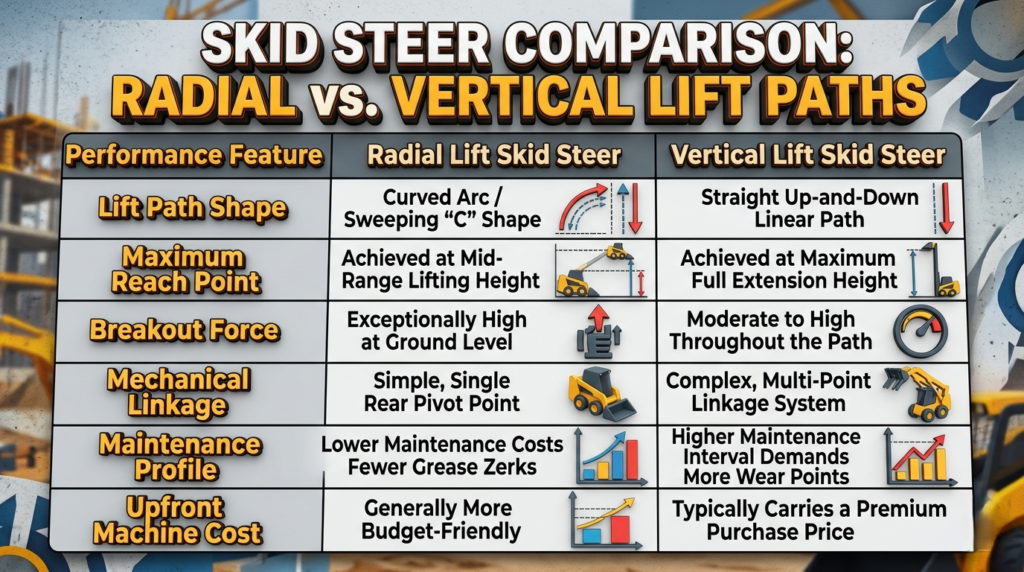
It is very important to side by side the different core engineering parameters of both of them to understand how they operate under the real world conditions.
| Performance Feature | Radial Lift Skid Steer | Skid Steer Vertical Lift Models |
| Lift Path Shape | Curved Arc / Sweeping “C” Shape | Straight Up-and-Down Linear Path |
| Maximum Reach Point | Achieved at Mid-Range Lifting Height | Achieved at Maximum Full Extension Height |
| Breakout Force | Exceptionally High at Ground Level | Moderate to High Throughout the Path |
| Mechanical Linkage | Simple, Single Rear Pivot Point | Complex, Multi-Point Linkage System |
| Maintenance Profile | Lower Maintenance Costs; Fewer Grease Zerks | Higher Maintenance Interval Demands; More Wear Points |
| Upfront Machine Cost | Generally More Budget-Friendly | Typically Carries a Premium Purchase Price |
Looking at these features, manufacturers of equipment can choose the right machine for the job by considering the requirements of the task. One path of the machine emphasizes the leverage of the ground, whereas the other one focuses on the clearance from the overhead while maintaining the capacity.
Decoding Skid Steer Control Systems
The productivity of the operator very much depends on the interaction between them and the hydraulic system. It is, therefore, an absolute must that one understands the control systems well.
Mechanical Linkage Controls
- Traditional controls are often long metal rods and physical linkages that connect directly to the hydraulic control valves.
- Operator exertion that comes with manual pushing and pulling of the levers engages the upper-body muscles and requires higher input force in long shifts.
- This setup gives the operator a rugged, highly tactile feeling of the machine’s mechanical limits but also contributes to physical fatigue after the long day.
Electro-Hydraulic (EH) Controls
- Electronic wrist action: These days, joysticks do the work in place of the heavy rods sending a digital signal to the hydraulic valve actuators.
- Customizable Performance Profiles: Operators can very easily change the responsiveness and even the joystick control configuration as in ISO or H pattern via a rocker switch in the cab.
- Fatigue factor: With very little effort, with the wrist only, the operator guides the machine, and this allows him/her greater precision and less fatigue over long hours.
Best Applications for Radial Lift Models
The greatest advantage of radial lift is seen when the main objectives of the job site are focused on or below the eye line.
- Heavy Grading and Excavation: Perfect for excavation, site prep, and trenching where you’d need toally dig into the ground and break up the soil regularly.
- Landscaping and Earthmoving: Excellent for scraping topsoil, pushing heavy debris, grading residential lawns, and backfilling open trenches.
- Mid-Height Dump Truck Loading: Works quite well at dumping aggregates over lower retaining walls or into flatbed pickup trucks.
Best Applications for Vertical Lift Models
In your choice of a vertical lift machine, you would definitely need it if your workflow involves high-clearance material handling and stacking heavy materials.
- High-Sided Truck Loading: Can be used to load very high-capacity dump trucks, as well as high sided feed hoppers and mixing containers, without the risk of structural frame collisions.
- Palletized Material Handling: The go to machine for working with forklift attachments, moving heavy concrete blocks, and stacking bricks at the warehouse.
- Heavy Industrial Infrastructure: Most suitable for heavy-duty commercial construction as well as agricultural work that needs stable, high-capacity material lifting and precise overhead placement.
FAQs – Radial vs. Vertical Lift Models Skid Steer Controls
Which is better for digging: a radial or vertical lift skid steer?
For digging, grading, and excavation, a radial lift skid steer is much better. Because the loader arms use a simple design with a single rear pivot point, the machine transfers force directly through the frame to the ground. This geometry produces the highest breakout forces and leverage at ground level, which allows the bucket to cut through hard-pack clay, rocks, and dense earth without a struggle.
Can a radial lift skid steer load high-sided dump trucks?
Technically, a radial lift skid steer can load small dump trucks, but it is not suitable for loading high-sided commercial dump trucks or tall hoppers. The reason is that at the outside of the lift cycle, the radial arm moves back close to the machine cab, which reduces the forward reach of the operator. So, coming into contact with the side of the truck accidentally is a possibility and it may happen due to that lack of space making the situation risky when trying to unload.
Why are vertical lift skid steers more expensive than radial models?
Vertical lift skid steers have a higher sale price and rental cost because of the complexity of the mechanical parts of their lifting arms. Instead of a single pivot pin, a vertical lift arm is made up of an intricate network of steel bars, multiple pivot joints, and heavy-duty linkages. These high-strength components and precise alignment requirements raise the manufacturing and maintenance costs.
What is the difference between ISO and H-pattern skid steer controls?
The main difference between ISO and H-pattern controls is in how the joysticks are used to manage the movement of the loader. The ISO control system has the left joystick controlling all movement of the machine (push, reverse, turning), while the right joystick is used to move the boom and bucket. On the other hand, the traditional H-pattern control divides the driving functions across both joysticks (left drives the left tracks/wheels, right drives the right tracks/wheels) and uses side-to-side movements to raise and lower the loader arms.
How do Electro-Hydraulic (EH) controls reduce operator fatigue?
Electro-Hydraulic (EH) controls replace the old mechanical linkages that required physical exertion. Traditional systems use rods that connect the operator lever directly to the hydraulic valve. This means that the operator is continuously pushing and pulling the levers and thus exerting upper-body force. EH joysticks have sensors that need very little effort and send digital commands to the machine. With an EH joystick, operators can work with the equipment for hours with just wrist movements.
Does lift path type affect the tipping load of a compact loader?
Indeed, the type of lift path affects the load tipping and rated operating capacity (ROC) of a compact loader. Vertical lift models keep the load close to the machine’s primary center of gravity even when the load is lifted high. Thus, the evenly distributed weight offers better operational balance at height. That is why vertically lifted machines almost always have a higher operating capacity rating than radial ones of similar size.
Which lift path configuration requires less maintenance over time?
The radial lift path configuration is less demanding in terms of maintenance and structural checks over its operational lifespan. Relying on a simple single-pivot design, it features fewer wear pins, bushings, and grease fittings that need inspection. Vertical lift, on the other hand, has multiple linkage configurations with numerous moving parts which mean more frequent lubrication intervals, part replacements, and monitoring of mechanical play.
Key Takeaways for Equipment Buyers – Master Radial vs. Vertical Lift Models
To figure out the machine configuration that fits you best, you need to look at the daily constraints of the job site in relation to the equipment’s key features.
- Look at the main work geometry: Work on mostly ground-level areas? Radial lift machines will be ideal. If, however, you raise loads above eye level frequently, go for a vertical lift model.
- Consider your budget and your tolerance for complexity: Don’t forget factor in maintenance for the long-term deciding on a simpler radial system that tends to lower preventive maintenance costs over time.
- Give operator control interface the priority: If your projects require high precision and involve multi-operator crews, look for modern EH controls with switchable patterns.
Matching your mechanical lift path and control configuration to the specific requirements of your operation will give you efficient material handling while protecting your bottom line.