Skid Steer Rollover Prevention: Essential Safety Features to Demand
Skid steer loaders rank among the most versatile, efficient, and productive machines one can find on construction sites, farms, and industrial yards. However, their small design, short wheelbase, and unique center of gravity make them prone to dangerous tip-overs and rollovers if operated without proper care or without the right Skid Steer Rollover Prevention.
In order to protect operators from final crushing injuries, it is a must for modern fleet managers and the owner-operators to put machine engineering first that is specifically designed to neutralize balance hazards. Adopting
Skid Steer Rollover Prevention is not just about safety but also about saving lives and having a zero-accident worksite.
Whether you are purchasing new equipment or adding safety devices to your existing fleet, it is essential to pick models that have the very latest, safety technologies that come from the manufacturers. This guide will show you the essential features that you must look for in terms of structures, electronics, and cab designs.
Once you learn how these safety components work together, you will be able to keep your workers safe inside the operator cabin at all times— regardless of how hazardous the terrain is.
Rollover Protective Structures (ROPS): The Structural Core
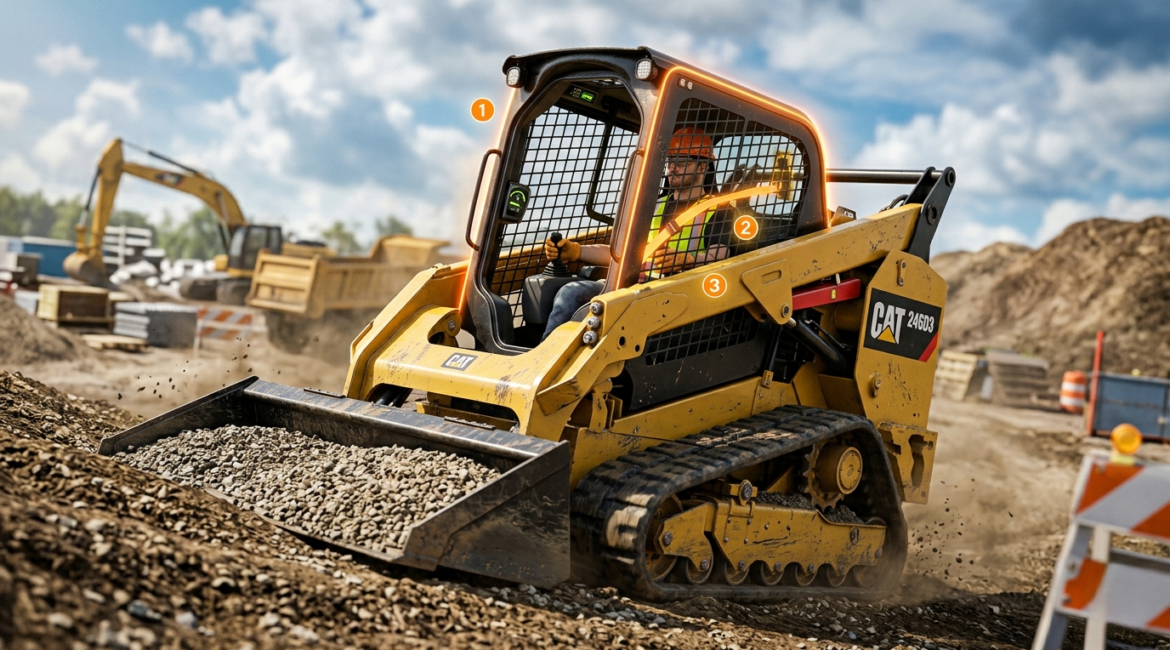
The most important pillar of Skid Steer Rollover Prevention is a reliable and sturdy operator cage. Heavy equipment companies produce these tough shells to stand up to the highest vertical and horizontal forces and to ensure that the space inside remains unscathed even in a crisis.
ROPS CRITICAL PERFORMANCE CRITERIA
- Energy Absorption via Controlled Metal Yielding
- Minimum Load Support of 2x the Machine’s Weight
- Complete Shielding Against Intruding Objects
- Deformation and Energy Absorption: The finest Rollover Protective Structures (ROPS) are designed through the use of special metallurgy which allows plastic deformation or yielding. This means that the structure is able to flex thereby able to absorb the violent impact energy instead of transferring it onto the operator, which in turn would be life threatening.
- Weight Capacity Thresholds: Minimum regulatory requirements state that a ROPS fitted vehicle should be able to withstand a test load of twice the ultimate weight of the machine which is in the fully loaded condition. This basically means that even if a skid steer is flipped upside down on a concrete slab, the cab would not cave in or require repairs that would render it unsafe
- Integral Side Screening Mesh: A solid ROPS design always includes a complete mesh made of heavy gauge steel along the sides and at the back which of course, has been perforated with holes of a certain size to allow visibility. This ensures that in the case of a rollover, the operator’s hands, head, or fingers do not protrude out of the cab where they might get caught under the moving lift arms or get crushed.
Electronic Defense: State-of-the-art Interlock Control Systems
Mechanical strength needs to be coupled with intelligent electronic system overrides which will be able to keep tabs on operator stability at all times. Today’s interlock control systems essentially serve as a digital prophylaxis mechanism that completely shuts down the skid steer hydraulic and drive functions when operators step outside designated safe limits.
INTERLOCK SYSTEM CHECKLIST
- Seat Sensor Activation (Operator Presence Detection)
- Restraint Bar Engagement (Lock Controls)
- Seat Belt Fastened (Hydraulics Enabled)
About Interlock Control Systems
- Operator Presence Seat Sensors: Under the driver’s seat there is a built-in electronic pressure sensor working the same way as those installed in commercial transport vehicles. Should the operator lift or get thrown off the seat during a rough ride, the sensor triggers an emergency shutdown of all movements.
- Mechanical Safety Restraint Bars: They are located just ahead of the operator and the handlebar can be pulled down to act as a safety lock. Not only does it prevent the operator from falling out during an accident but it also completes a circuit that allows the joystick controls to be activated when it is fully closed.
- Seat Belt Integration Matrix: The most sophisticated units have their seat belt assembly directly wired with the central control unit. The electronic valves remain locked for the lifting arms and drive motors when the seat belt is not buckled, thereby, enforcing the use of the safety belt.
Promoting Equipment Stability: Self-Leveling and Hydraulic Control Systems
Fewer rollovers happen when you have machines capable of making decisions about balance without any interference from the operator. Smart hydraulics keep an eye on the bucket’s positioning and respond with counterbalance movements in case of sudden transitions of machine center of gravity.
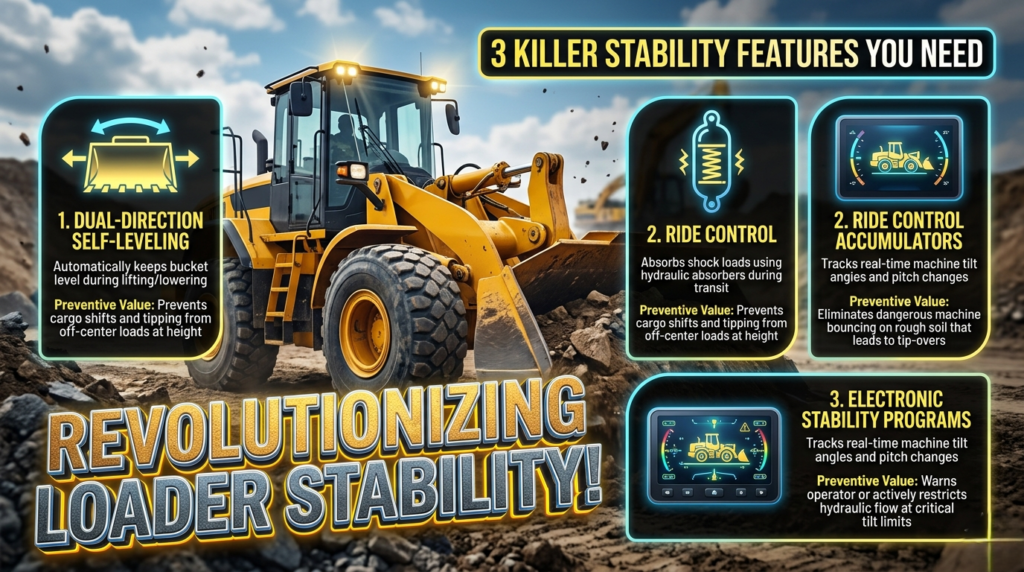
| Stability Feature | Primary Function | Preventive Value |
| Dual-Direction Self-Leveling | Automatically keeps the bucket level during lifting and lowering phases. | Prevents cargo shifts and tipping caused by off-center loads at high heights. |
| Ride Control Accumulators | Absorbs shock loads using hydraulic shock absorbers during transit. | Eliminates the dangerous machine bouncing that initiates tip-overs on rough soil. |
| Electronic Stability Programs | Tracks real-time machine tilt angles and pitch changes. | Warns the operator or actively restricts hydraulic flow when reaching critical tilt limits. |
- Dual-Direction Hydraulic Self-Leveling: When a machine is used for handling heavy stuff the angle of the attachment will change as the lift arms go up. This dual-direction self-leveling feature ensures the bucket stays parallel to the ground both during the upward and downward movements, which means that the center of gravity stays low and properly centered.
- Shock-Absorbing Ride Control: Keeping a bucket full of stuff and driving it along a bumpy construction site can cause a lot of vertical jolting. Ride control systems use specially designed nitrogen accumulators to add shock-absorption to hydraulic power, thereby smoothing out the ride and keeping rear tires from becoming airborne.
- Tilt-Angle Alert Monitors: The latest skid steer loaders are equipped with gyroscopic sensors that accurately measure the real time pitch and roll angles of the machine. The component will notify the operator through visual and audible warning when going over incline slopes that are outside the safety limits set during manufacturing.
Optimized Cab Configurations: Ergonomics and Visibility
Visual recognition is an essential aspect of Skid Steer Rollover Prevention. If an operator is not capable of clearly identifying the edges of the hazardous drop-offs, large ditches, or hidden boulders in a worksite, the most robust structural protections will meet their match in the end.
- Expansive Low-Profile Lift Arms: The standard vertical-lift design includes steel arms so bulky that they completely cut off the operator’s side vision. Demanding low-profile arm variants will maximize the glass surface of the cab and ensure the operator will have uncovered sight of nearby edges of trenches and slope transitions.
- Integrated Rear-View Camera Suites: That the operator’s back is right up against the engine compartment somewhat explains why a skid steer has always been a blind spot when backing up. Rear-view cameras coupled with high-quality in-cab monitors make sure operators spot changes in elevation before they are backed over.
- Three-Point Entry and Exit Systems: Most severe cases of slips and falls happen when an operator is at the door of a raised cab, accidentally knocking a hydraulic joystick in the process. Therefore, secure handholds, non-slip steps, and visible entry pathways are indispensable elements of any safe workstation.
Using Safe Operating Protocols to Oppose Rollovers
Even though machinery features take the biggest part in ensuring safety, the real safety of a worksite is decided by human choices in operations. Driving techniques that are tested and approved by manufacturers are a foolproof way to be part of the Skid Steer Rollover Prevention program.
- Keep an Extremely Low Bucket Position: Whether a loader is being transported or the work is going on, the bucket or any other attachment should never be carried higher than absolutely necessary. By keeping the load low, the contact patch area with the ground is maintained which is crucial not to get tipped over
- Learn to Cross Properly Slopes: A vehicle driving sideways over a hillside is a top-notch method for inducing a rollover. That is why it is very important that operators always try to keep their direction of travel directly uphill or downhill, with the heavy end of the machine facing the top of the slope at all times to maintain traction and balance.
- Strictly Follow the Rated Operating Capacity: One of the key factors contributing to overturns is the failure to adhere to the Rated Operating Capacity (ROC) that is clearly stated on every machine. The ROC is the maximum safe weight that a piece of equipment can carry. Going beyond this weight limit means the design counterbalance of the vehicle is completely thrown off, making it very likely to tip over during braking or sudden turning.
FAQs – Skid Steer Rollover Prevention
What causes the most skid steer rollovers?
Traveling with the bucket/product high on uneven and sloped terrain is the biggest single reason why a skid steer overturns. With the heavy load raised to a height, the center of gravity of the machine shifts significantly upwards and forward, so the chance of toppling over when it hits a small pothole/rut/boulder is extremely high.
Is it as easy to roll a track skid steer as a wheeled version?
Compact track loaders (CTLs) generally provide the best ground contact, traction, and flotation over soft terrain while wheeled models are more versatile on hard grounds and small areas. They both have their pros and cons but you can still roll the track loader if you get too close to the edge while you drive sideways. Track model’s footprint is wider and its center of gravity is lower compared to the wheeled one but the risk is still there.
What is the safest way to recover a skid steer after a rollover?
Heavy recovery equipment should be used to recover a skid steer that has rolled over. Heavy-duty tow straps are required, and you should not restart the engine immediately. Frame pull points should be used to upright the machine; after this point, a qualified mechanic must first inspect for hydrostatic lock before restarting the engine circle: engine oil in combustion chambers.
Does OSHA require ROPS on all skid steer loaders?
OSHA standard 1926.602 requires that earthmoving equipment, including skid steer loaders manufactured after 1972, be equipped with an approved Rollover Protective Structure (ROPS). Operating a machine without such a structure is a serious violation that poses an immediate risk to the operator’s life.
During a rollover, what should the operator do in the cab?
The operator should tuck the chin, brace their body tightly against the back of the seat, and hold firmly onto the steering handles or armrests during a skid steer rollover. Operators should never jump out of the cab during a roll as the falling ROPS frame will likely cause fatal injuries. Being securely buckled inside the protective cage is the only way to survive.
How frequently should safety interlocks on skid steers be inspected?
Safety interlock systems such as seat switch, seat belt connection, and restraint bar sensors should be checked and tested every time before the start of a work shift to ensure functionality. If any components of the electronic interlock system are found to be bypassed, damaged or unresponsive, the skid steer should be taken out of operation immediately until it is repaired by an authorized technician.
Could adding counterweights increase the risk of a rollover?
Adding counterweights approved by manufacturer can be used to optimize lifting performance safely up to a certain weight while adding unapproved or excessive weights can increase the risk of rear rollovers when the machine is traveling without load considerably. Excess rear weight greatly shifts the balance point toward the rear tires, which can lead to front wheels lifting and the machine tipping backward when climbing steep grades.
Skid Steer Rollover Prevention