Making the Most of Your Mini Skid Steer Right Grapple Attachment
A compact loader, with the correct tool, is a high output material handling machine not just a simple earth mover. The best way to minimize manual labor, safely clear job sites, and get more done in less time in the construction, landscaping, and agriculture industries is to max out your mini skid steer grapple attachment.
Compact machines function in tight residential backyards and small work zones. Matching your machine’s hydraulics and lift capability to an attachment built for your specific task is key.
Investing in a grapple replaces hours of chainsaw work, hand-loading and hard lifting with a hydraulic clamp that grabs loose debris, logs, rocks and scrap. Whether you are using open-bottom root rakes or multi-function 4-in-1 buckets, understanding the varied designs will ensure your operation is running at optimal efficiency and getting a great return on investment.
The Reasons You Should Get a Grapple Attachment For Your Mini Skid Steer
If you’re handling oddly shaped, bulky or loose materials, then the usual dirt bucket just won’t cut it. Trying to balance long branches, broken concrete or brush over the side of a flat bucket often results in spilled loads and damaged property.
Grapple attachment This is a special attachment that your machine can be equipped with to have an upper jaw with hydraulic cylinders to firmly pinch uneven materials for transportation.
- Security and Stability: Better cargo Security and Stability During Transport The hydraulic clamping force firmly secures loose logs, pipes and debris to the bottom frame so the cargo does not move when travelling over uneven terrain.
- Less Manual Labor and Crew Fatigue: Instead of three people chopping waste into little pieces and throwing them onto a trailer by hand, one operator may remove a mound in minutes.
- Increased Job Site Versatility: Whether it’s storm debris you’re clearing, firewood you’re moving, or old fencing you’re ripping out, a grapple can adjust to varying job site needs without the need to constantly change attachments.
Mini Skid Steer Grapple Attachment Types
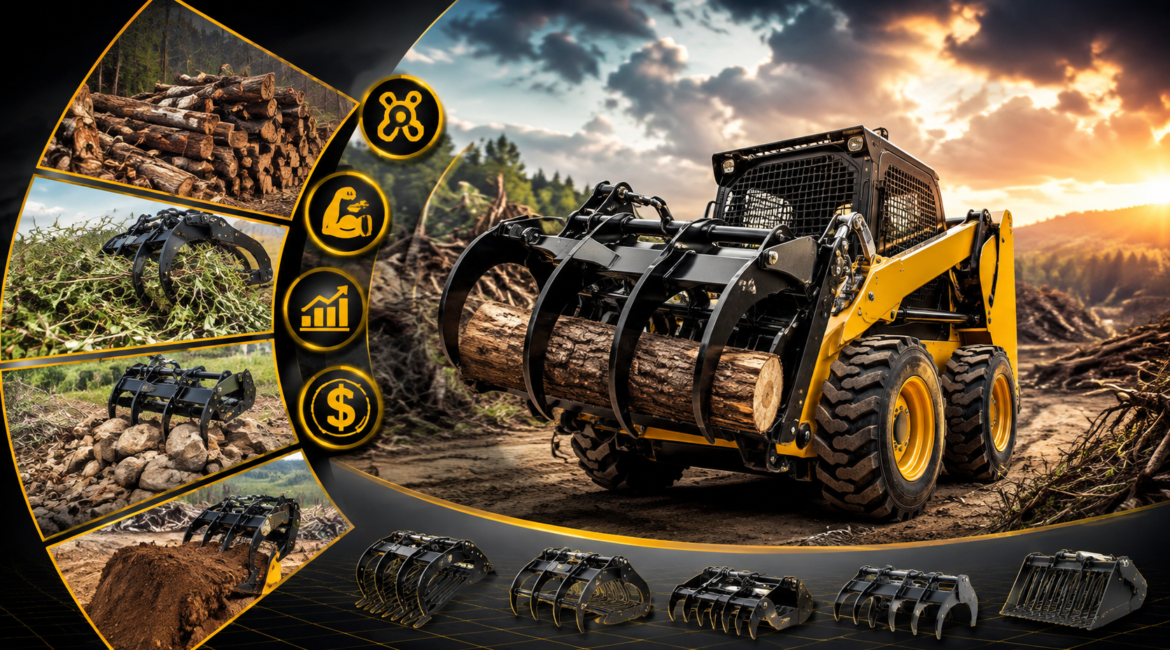
The correct attachment will depend on what you are moving. Grapples are classified as open-bottom “skeleton” types that allow earth to fall through, solid-bottom buckets that receive everything, and specialty types like 4-in-1 combo buckets that fulfill numerous duties.
- Root Grapple and Skeleton Rake Attachments: Grapples with tines spaced across an open bottom glide beneath brush, roots and boulders, letting clean dirt filter through so you don’t take away topsoil.
- Solid-Bottom Grapple Buckets and Scrap Grabbers: These grapple buckets are equipped with a solid bucket bottom and an upper hydraulic grapple arm. They are suitable for demolition, scrap yards and recycling applications where little debris needs to be trapped.
- Multi-Function 4-in-1 Combo Buckets: The TYPHON 4-in-1 Bucket Combo (TYPH-5106) is an example of a multi-function attachment that combines a normal bucket, a dozer blade for grading, a clamshell and a hydraulic grapple, all in one footprint.
- Specialized Hydraulic Wood Grabbers: Attachments such as the TYPHON Hydraulic Wood Grabber (TYPH-5107) are designed for forestry and timber operations and have strong jaws to grip logs and brush accurately.
Mini Skid Steer Grapple Attachment Types Industry Applications
A mini skid steer grapple makes work go faster in a number of key industries from private backyards to commercial construction sites. Machines such as the TYPHON STOMP Series (X1300 and 509) are designed to maneuver through tight gates and tight passageways, so adding a grapple creates valuable service opportunities.
- Landscaping and Property Maintenance: Landscapers use grapples to pull out overgrown bushes, move landscaping boulders, and clean brush without piercing existing turf or leaving soil beds untidy.
- Forestry, Tree Care and Storm Cleanup: Arborists use wood grabbers and root grapples to feed chippers, move trunk portions after a tree is felled and quickly clear driveways obstructed by fallen limbs after a storm.
- Construction and Light Demolition: Contractors utilize reinforced grapple buckets to remove broken concrete, discarded timber, twisted rebar and old roofing materials from tight interior or exterior job sites.
Important Things to Consider When Selecting Grapple Attachment
If the attachment is too big or too heavy, it will slow you down and be a tipping hazard. A loader can only handle so much weight. Before you decide, you need to consider the mechanical construction of the attachment and the operational parameters of your tiny machine.
- Operating Capacity & Attachment Weight: Always check your loader’s rated tip load and lift capacity. Heavy attachments pull your net payload down, so choose a grapple weight that leaves plenty of capacity for the load itself.
- Hydraulic Flow and Pressure Compatibility: Make sure the auxiliary hydraulics on your machine produce the necessary gallons per minute (GPM) and PSI to run the grapple cylinders without issue and to provide you plenty of clamping force.
- Material Durability and Gusseted Construction: Seek the highest yield strength steel, reinforced gussets at the tine tips, and protected hydraulic cylinders that can resist everyday impacts of rocks and logs.
How to Maximize ROI on Your Grapple Attachment
A good grapple attachment pays for itself quickly through reduced work hours and eliminates the requirement for single-purpose machinery. On commercial job sites an attachment that allows one operator to do the work of three quickly pays for itself.
- Huge Labor and Cleanup Savings: Faster loading of debris equals less time for your staff removing sites by hand, which means more billable hours for your next job.
- Less Machine Downtime and Fuel Consumption: Fewer trips around the job site to complete a cleanup assignment means less wear and tear on your track or tire system while reducing fuel expenses.
- Broader Bidding Options: Equip with a specialty grapple or a 4-in-1 combo bucket and your business can bid on higher-margin contracts such as land clearing, storm damage cleanup and site prep.
Mini Skid Steer Attachment Review
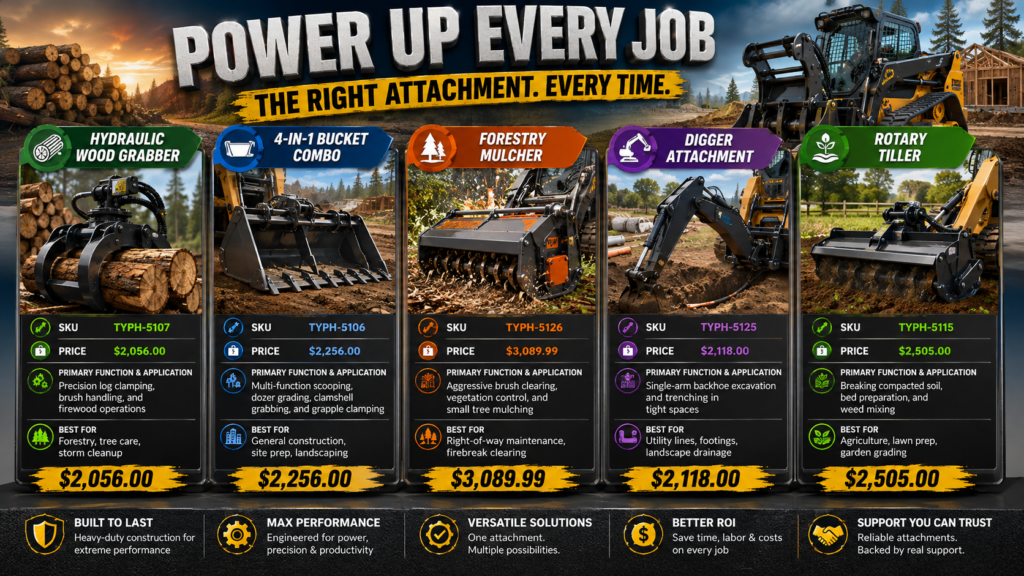
Visit this comparison matrix of common multi-function and material-handling attachments offered from SkidSteer to help you choose the correct equipment for your application. Available online:
| Attachment Name | SKU | Primary Function & Application | Best For |
| Hydraulic Wood Grabber | TYPH-5107 | Precision log clamping, brush handling, and firewood operations | Forestry, tree care, storm cleanup |
| 4-in-1 Bucket Combo | TYPH-5106 | Multi-function scooping, dozer grading, clamshell grabbing, and grapple clamping | General construction, site prep, landscaping |
| Forestry Mulcher | TYPH-5126 | Aggressive brush clearing, vegetation control, and small tree mulching | Right-of-way maintenance, firebreak clearing |
| Digger Attachment | TYPH-5125 | Single-arm backhoe excavation and trenching in tight spaces | Utility lines, footings, landscape drainage |
| Rotary Tiller | TYPH-5115 | Breaking compacted soil, bed preparation, and weed mixing | Agriculture, lawn prep, garden grading |
FAQs – Mini Skid Steer Grapple Attachment
What is a mini skid steer grapple attachment used for?
A mini skid steer grapple attachment gives you the ability to clamp, lift and carry large, irregular or loose material that a typical bucket can’t properly contain. It is often used to clear away brush, logs, rocks, roots, building waste and scrap metal.
What is the difference between a skeleton bottom grapple and a solid bottom grapple?
An open bottom skeleton grapple has tines spaced to let soil, sand, and small gravel to sift through while bigger objects such as boulders and branches are retained. The solid bottom grapple has a bucket-like base that is enclosed, so it captures all material, making it excellent for loose rubbish, scrap yard recycling and minor demolition debris.
How do I know if this grapple attachment will fit my mini skid steer?
You’ll need to confirm three things: the mounting plate style (most compact machines use a universal mini skid steer quick-attach), the hydraulic flow rate (GPM) and pressure (PSI) of your auxiliary hydraulics, and the rated operating capacity of your loader so you don’t overload it with attachment weight.
Are Mini Skid Steer Grapples Suitable for Tree Work and Logging?
Yes, arborists and forestry crews often employ hydraulic grapple attachments. In particular, specialized wood grabbers and root grapples are commonly used to move logs, load brush into wood chippers, and clear fallen timber without the need for manual lifting.
What maintenance is required for the hydraulic cylinders and tines of a grapple?
Routine maintenance includes greasing all pivot pins and cylinder bushings prior to use, checking hydraulic hoses and quick-connect couplers for leaks or abrasion, inspecting tines for being bent, and rinsing dirt or corrosive debris after each task.
Why do I want a 4 in 1 combo bucket instead of a regular grapple?
The 4-in-1 combo bucket is the more versatile, incorporating four tools into one attachment: a normal dirt bucket, a dozer blade for grading, a clamshell for bottom-dumping and a hydraulic grapple for clamping debris. That decreases the variety of accessories you have to bring to a job site.
What size grapple do I need for a mini skid steers?
Most mini skid steer grapples are between 36 inches and 48 inches in width. When operating in brush piles, select a width slightly wider than your machine’s tracks or tires to protect your loader, but keep the weight of the attachment well within your machine’s lifting capabilities.