
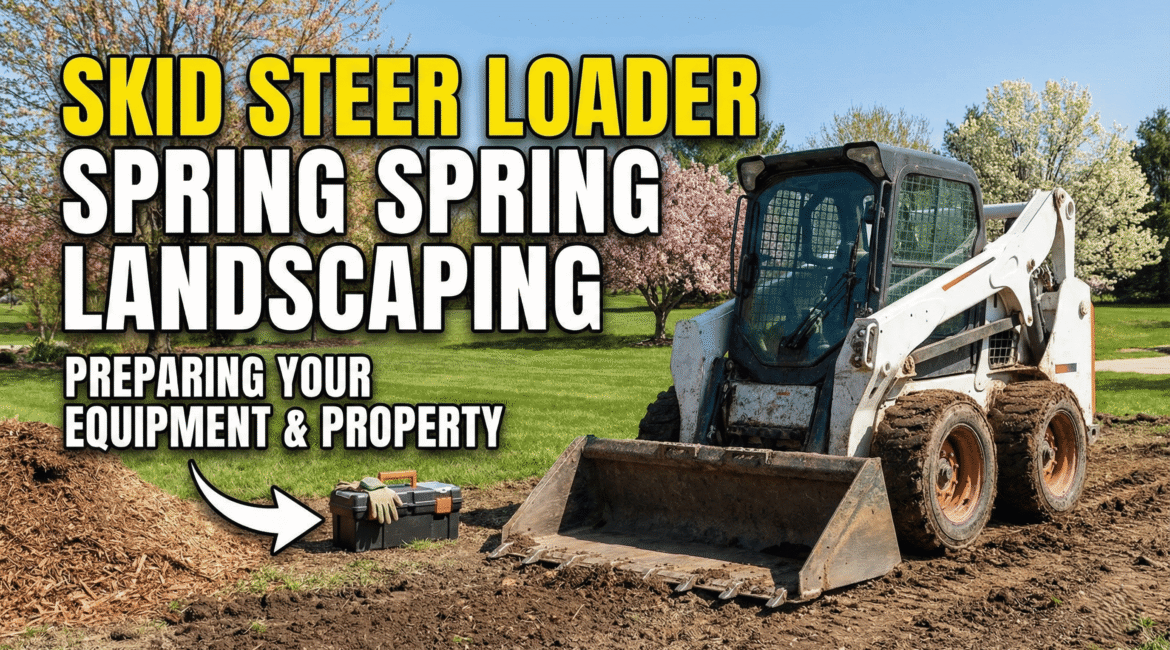
Skid Steer Spring Landscaping Projects: Preparing Your Equipment and Property – Seasonal Use Cases
Going from the cold and snow of winter to the colorful burst of spring is an important time for anyone who has a property or works professionally with landscaping. As the ground gets back to a normal temperature and little plants start appearing, the request for machines that can do a lot of work very quickly goes up drastically leads to increase in Spring Landscaping Projects.
At SkidSteer.online we know that your skid steer is like your main muscle. Clearing a path from the winter, doing the ground leveling for a new driveway, and getting a flower bed ready are things that depend on the preparation of the equipment and the property.
Importance of Spring Landscaping Projects
Spring landscaping projects should not be seen only as ways to beautify the surroundings, but more as ways to lay the functional foundation for the whole year. With proper skid steer attachments and a good maintenance plan, even a big seasonal change can become an easy and highly productive operation.
Spring brings about not just rejuvenation but also great challenges. Many tasks are laden with heavy work. The choices you make now, ranging from checking your hydraulic fluids to deciding whether to use a brush cutter or power rake, will influence how productive you will be later.
This detailed guide covers the main seasonal use cases of a skid steer, technical tips on how to maintain the machine after a long winter, and smart steps of property preparation that guarantee soil health and a good-looking environment. Let’s see how you can get the most out of your machine and professionally meet your spring landscaping projects requirement.
The Strategic Importance of Spring Equipment Maintenance
Even before your skid steer moves the first bucket of mulch, it is necessary that you do a thorough inspection of it. The effects of a machine being unused for a long time or running in cold weather are not visible until the end when they result in problems such as leaking hydraulic seals, reduced battery life, and worn rubber tracks. A well-maintained machine not only works faster but also more safely, thus reducing the risk of accidents and expensive damages that could cause project delays and frustration.
- Fluid and Filter Overhaul: Over time, fluids may have gotten condensation, so drain and change them. This not only refers to the engine oil but also to the hydraulic fluid and coolant. If necessary, replace the filters as well.
- Hydraulic System Integrity: Look over every hose and check if there is any sign of “checking” or fine cracks. A micro-leak in these high-pressure systems can quickly escalate into a major safety issue and even cause the entire system to break down when loaded.
- Battery and Electrical Diagnostic: Your battery’s power will be at its weakest after the winter season. Thoroughly clean the terminals with a wire brush so that not even a trace of oxidation remains. This will ensure that the alternator is always at peak efficiency during charging, which is crucial for supporting high-power attachments.
| Component | Spring Action Item | Importance Level |
| Hydraulic Hoses | Inspect for cracks/leaks | Critical (Safety) |
| Engine Oil | Change & replace filter | High (Longevity) |
| Air Filters | Clean or replace | Medium (Efficiency) |
| Grease Points | Lubricate all pivots | High (Wear Prevention) |
Clearing the Slate: Debris Removal and Site Prep
One of the very first tasks for fresh outdoor “seasonal use case” after the arrival of spring is cleaning up the site so that you can make good use of the land again with the best spring landscaping projects. Nature during the cold months after a storm will give birth to such things as broken branches that have fallen, dried leaves piled up in random heaps, and bushes that are so dense that ground covers can’t grow underneath anymore.
Doing this by hand is slow and very hard physically. However, a skid steer fitted with a proper grappling or clearing tool can accomplish in just one hour what four men would be able to do in a whole day.
- Grapple Bucket Operations: Attach a root grapple to your skid steer for gathering large logs and piles of brush without taking away loose dirt through the open bottom. This keeps your place nice and fresh while not damaging the nutrient-rich topsoil.
- Brush Clearing: A brush cutter is, without question, the best helper for your overgrown perimeter area. What it does is that it helps you get rid of saplings and thick weeds by essentially creating more space around your house.
- Surface Sweeping: When only the smallest debris left on the ground, a pickup broom or an angle broom is capable enough to remove sand, salt, and other winter grit from your driveway and walkways, making everything seem fresh and new.
Soil Preparation and Precision Grading
After the clutter has been cleared, the immediate concern is the land itself. It is during this time of spring season that soil preparation and grading are best done with the view to controlling surface runoff and leakage.
Most people tend not to pay much attention to drainage as they focus only on raising the soil level in their yards; this feature is nevertheless critical if one wants to have a healthy garden. The easiest way to correct pooling problem spots on the ground without damaging your landscaping is by using a skid steer.
- Power Raking for Seedbeds: A power rake or soil conditioner is the best tool for spring preparation. It breaks up the soil, rids it of unwanted stones and debris, and produces a nicely structured soil surface to be seeded or sodded.
- Grading and Leveling: You can use a land plane or a 4-in-1 bucket to spread soil. It is important to make a 1-2% slope going away from your house on all sides so that rainwater flows safely into the drainage line instead of damaging your foundation.
- Tilling for Garden Beds: Foodscaping or flower bed growing on a large scale can be accomplished by utilizing a tiller attachment which is great in that it deeply breaks the soil, mixes the compost, and aerates the earth all at once ensuring perfect nutrient availability.
Hardscaping and Infrastructure Projects
As far as spring season renovations go, it is the best time of the year to put in new patios, walkways, and retaining walls. Not only do such projects require the movement of massive amounts of heavy materials like pavers, crushed stones, and logs but also the need for speed and efficiency is very high.
A skid steer comes in handy here because it can be used as a high-capacity transporter which greatly helps in decreasing the number of “mowing” across the lawn thus preventing from unnecessary damages to it.
- Material Handling with Pallet Forks: Heavy stone pallets and sod rolls can be moved around the lawn easily and precisely when you use pallet forks on your skid steer. This way, less lifting work and more safety are achieved at the same time.
- Auger Drilling for Fencing: Should e.g. a new privacy fence installation or mature tree planting be part of your spring activities, then you definitely need an auger attachment. This tool allows you to make tightly packed and deep holes very quickly even if the ground is very hard.
- Trenching for Irrigation: As your property gets prepared, consider that water-saving smart irrigation systems are becoming more popular these days. A trencher helps you bury the pipes smoothly and discreetly without ruining the surrounding parts of the yard.
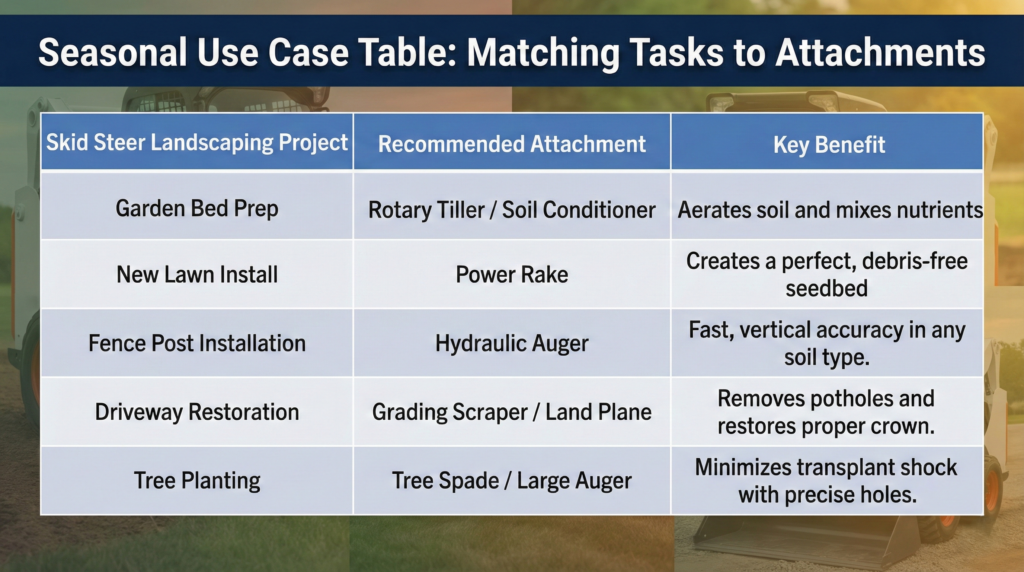
Seasonal Use Case Table: Matching Tasks to Attachments
| Skid Steer Landscaping Project | Recommended Attachment | Key Benefit |
| Garden Bed Prep | Rotary Tiller / Soil Conditioner | Aerates soil and mixes nutrients |
| New Lawn Install | Power Rake | Creates a perfect, debris-free seedbed |
| Fence Post Installation | Hydraulic Auger | Fast, vertical accuracy in any soil type |
| Driveway Restoration | Grading Scraper / Land Plane | Removes potholes and restores proper crown |
| Tree Planting | Tree Spade / Large Auger | Minimizes transplant shock with precise holes |
FAQs: Spring Landscaping Projects and Equipment
What is the best skid steer attachment for spring yard cleanup?
A root grapple is considered the most suitable tool for spring cleanup by the majority of people in the industry. It enables the handling of large accumulations of branches, logs, and debris caused by storms, thus making the work much easier. The open bottom design also ensures that soil and small organic matter can fall through, thereby leaving the site’s topsoil untouched.
How do I prepare my skid steer for the spring work season?
To begin with, have all the fluids in your machine tested (engine oil, hydraulic oil, coolant). Then, conduct a thorough check of all parts that are prone to wear such as tracks, tires, hydraulic hoses to find any damage caused during winter. If all points harnessed with grease are lubricated after this, then there is less friction thus parts don’t wear down so fast. Last but not least, check the battery as well because it has to endure equally high demands during spring cycles when using attachments.
Can I use a skid steer on wet spring soil?
It is possible but it is wise to invest first in a Compact Track Loader or wide-turf tires so that the pressure you exert on the ground is minimal. This way, your soil will not get so heavily compacted and you will prevent excessive rutting. By the time a heavy skid steer is put to work on such a difficult surface, the damage caused will require long-lasting remediation measures.
What are the top landscaping trends for 2025-2026?
Among the shifts of trends, there will be more attention drawn to gardens that have been “lived-in,” planting native species, and the rise of “foodscaping” (the practice of mixing edible plants with ornamental beds). Besides this, there is a significant move towards the use of smart irrigation systems as well as low-maintenance hardscapes such as stone paths and natural garden edges.
How much does it cost to rent a skid steer for a weekend project?
If you want to hire a mid-size skid steer, expect to pay anywhere between $250 and $450 on average for each day, depending on the region and attachments. For spring landscaping projects, attaching special tools like an auger or power rake can increase the daily charge by $50-$100.
Is a power rake better than a traditional bucket for leveling?
Definitely! Even though a bucket is more suitable for moving gross amounts of soil, a power rake works with a revolving drum, which can break down soil particles and move debris into neat rows at the same time. Thus, it can provide a much smoother finish, an absolutely necessary step if seeding and having attractive lawns is the goal.
How do I prevent hydraulic leaks when switching attachments?
Before you connect the halves of the quick-couple, make sure that their faces have been thoroughly cleaned. When tiny particles of dirt such as grit or even sand get into the seals, they cause microscopic damage that eventually cannot be stopped and results in slow leaks. Each time before disconnecting the attachments, release the system pressure so that the swap always goes without any problem and easily.