Heavy-Duty Clearing: How To Match Your Forestry Mulcher for Skid Steer’s Hydraulics Correctly
Land clearing, right-of-way maintenance, and forestry thinning demand amazing power, accuracy, and a sheer physical force. Outfitting a skid steer with a forestry mulcher is one of the best ways to turn dense brush, overgrown saplings, and tough trees into well-organized nutrient-rich mulch.
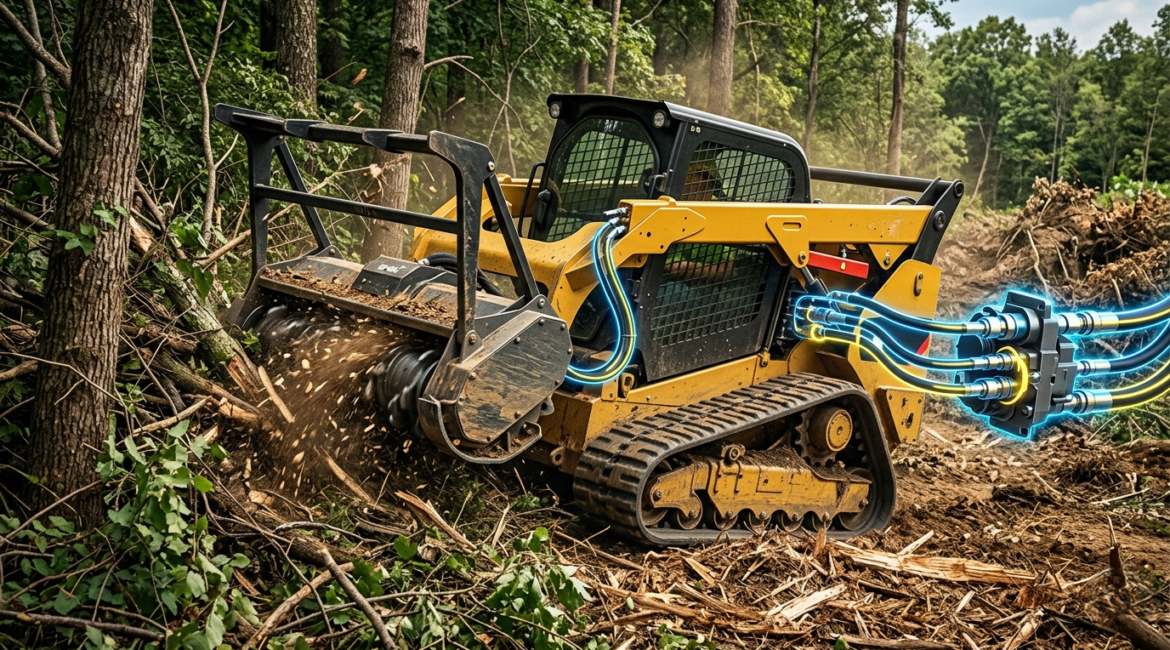
On the other hand, blindly purchasing the largest or most aggressive mulching head on the market will inevitably lead to mechanical failure. The real key to being successful in day-to-day operations resides neither in the famous brand of the attachment nor its structural width; it depends solely on how well you pair the forestry mulcher to the skid steer’s hydraulic system underneath the body.
Why Operating a Forestry Mulcher is of Great Significance
In order to use a heavy-duty clearing attachment, your carrier machine must give a consistent, very intense flow of pressurized fluid. If the skid steer fails to provide the exact quantity and pressure expected by the mulcher, the engine would bog down quite fast, the hydraulic system would overheat severely, and there would be a rapid increase in component wear.
In fact, matching your auxiliary hydraulic capacity with the right drum or disc mulcher is advantageous in many aspects: it results in the provision of the maximum possible cutting torque, downtime is reduced to a minimum, and the average performance (i.e., how much production is attained per hour) is significantly increased.
This detailed guide first helps you to understand your hydraulic flow; then, it is a matter of balancing your horsepower, choosing cutting technology that is most suitable for a skid steer, and finally, realizing maximum operational efficiency on the job.
Importance of Forestry Mulcher for Skid Steer’s Hydraulics Correctly
Hydraulic flow, horsepower, selecting the right cutting technology for your skid steer, and maximizing operational efficiency are all performance factors explored by this comprehensive guide.
The two main measures that define your skid steer’s auxiliary hydraulic performance are Gallons Per Minute (GPM) and Pounds Per Square Inch (PSI), so you must know these before buying a high-powered clearing attachment.
GPM measures the total volume of fluid that flow through the lines every minute. It, therefore, directly controls your mulcher’s rotor or disc rotational speed and recovery time. PSI is the fluid pressure or force that is backing up that volume. This pressure translates into the mechanical torque needed which you use to clamp down on the thick hardwood without your system being stalled at once.
To obtain hydraulic horsepower, multiply your machine’s auxiliary GPM by its maximum PSI, then divide that product by 1,714 (Hydraulic HP = GPM × PSI / 1,714). This particular formula is a lot more accurate in the estimation of attachment performance than engine horsepower alone.
You should, however, leave about 500 PSI as a kind of operating margin between your working pressure and relief pressure to prevent wasteful bypass venting that damages the oil quickly and leads to a lot of heat build-up.
Hydraulic flow rates affect rotor speed directly. Greater hydraulic flow rates mean more speed for rotor recovery time even during heavy loads, so your teeth do not lose momentum when cutting light brush or big timber.
Standard Flow vs. High Flow Hydraulic Systems
Most skid steers and compact track loaders can be divided into two main categories based on the hydraulic systems they have. Finding where your machine fits is the very first step that will naturally lead you to the right attachment. Standard flow systems are more than suitable for day-to-day construction work, light property maintenance, and landscaping on a small scale.
However, they are far from the power required for commercial forestry work in heavy conditions. High-flow systems, on the other hand, are specially designed to run heavy, continuous-duty attachments like cold planers, industrial snow blowers, and heavy-duty forestry mulchers.
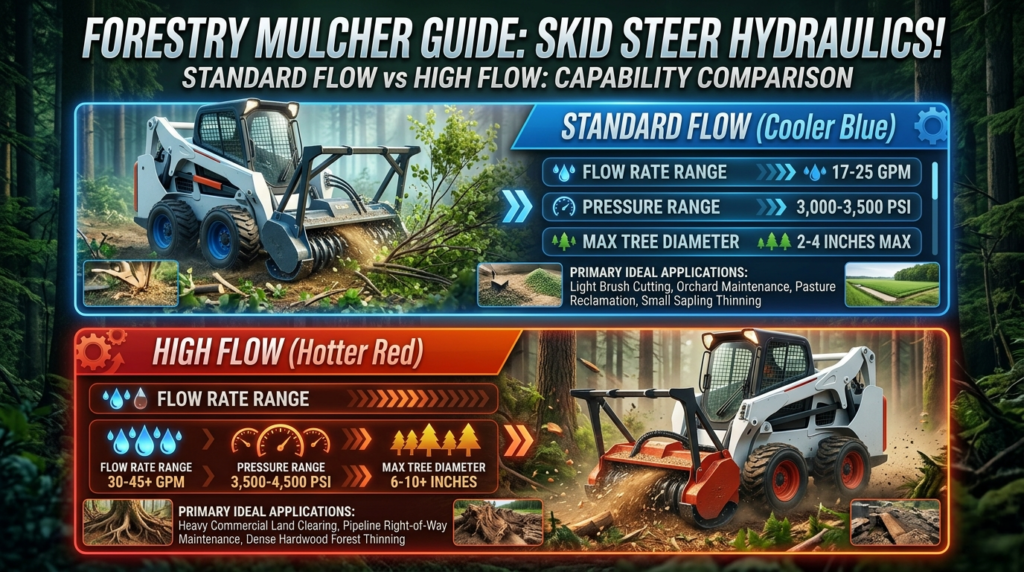
Table: Forestry Mulcher for Skid Steer’s Hydraulics System Type
| Hydraulic System Type | Flow Rate Range (GPM) | Pressure Range (PSI) | Max Tree Processing Diameter | Primary Ideal Applications |
| Standard Flow | 17 to 25 GPM | 3,000 to 3,500 PSI | 2 to 4 Inches Max | Light brush cutting, orchard maintenance, pasture reclamation, and small sapling thinning. |
| High Flow | 30 to 45+ GPM | 3,500 to 4,500 PSI | 6 to 10+ Inches | Heavy commercial land clearing, pipeline right-of-way maintenance, and dense hardwood forest thinning. |
- Standard Flow Constraints: Trying to use a big forestry mulcher that requires a high-flow system on a standard-flow skid steer is guaranteed to cause continuous stalling of the attachment, auxiliary lines choking, sealing damage, and hydraulic pump destruction.
- High Flow Advantages: The huge throughput capacity of high-flow hydraulic setups is the key to rapid accomplishment of lots of work because operators are allowed to clear heavy brush in just one pass and the drum rotation keeps on going steadily even when they are grinding down stumps below grade.
- Enhanced High Flow Packages: Besides having higher flow rates, some track loaders have their flow rates figured to go as high as 45 to 50 GPM, which allows running professional, contractor-grade mulching heads featuring multi-stage cutting chambers.
Drum Mulchers and Disc Mulchers: What’s the Difference?
After determining the exact hydraulic flow of your skid steer, the next decision is the choice of a cutting head style that matches your average working condition. Drum mulchers and disc mulchers are the two major designs that are widely used for land clearing purposes, and they represent totally different mechanical ways of treating the wood material.
With a drum mulcher, a big cylindrical drum with teeth arranged on it is used to shred the wood material downward, while with a disc mulcher the fly-wheel disc that is rotating at a very high speed is used to cut and fell the wood by means of the energy of motion.
- Drum Mulcher Versatility: Because drums operate inside a totally enclosed cutting chamber, penetration and mixing of wood residues directly into the soil allow for a very clean, professional-looking work site.
- Disc Mulcher Speed: The speed of disc mulchers at felling individual trees is achieved by the huge amount of kinetic energy that the rotating wheel stores, which is why the thickness of the trees can be up to 14 inches.
- The size/shape of tooth and protection features: Bite-limiter and stepped-bumper frames seriously limit how far the teeth can engage the wood per revolution, so there is no rotor stalling, and hydraulic pressure is kept at a safe level.
Psychological Trap: Combining Attachment Width and Weight of Machine
A very common misconception among less experienced operators is to think that by using a wider forestry mulcher, one will get better results because more physical ground is covered per pass. On the contrary, cutting width must be accurately matched with the skid steer’s total weight on the ground and available hydraulic power.
Rotating a wide, heavy rotor demands substantially more fluid energy than a narrow one, thus an oversized head will quickly drain your system power, and at last, reduce your total clearing speed.
- Track Width Correspondence: A general rule is that the cutting width of your forestry mulcher should be approximately equal to the total outside width of your skid steer’s tracks or tires so that you can make a clean path without driving over unprocessed brush.
- Operating Weight and Balance: The weight of heavy-duty mulching heads can be as high as 3,000 pounds and usually ranges between 1,500 and 3,000 pounds, so it is an important consideration in the change of your machine’s center of gravity and the shift of the most likely position for roll-over on the combination of slope and/or mud that could hit you unexpectedly.
- Flotation Concerns: On soft forest floors, a standard skid steer is likely to sink with excessive ground pressure being exerted by it, coupled with a large clearing head, thus loss in machine traveling power and increase in fuel consumption will occur rapidly.
Protecting Your Machine and Operator for Extreme Forestry Conditions
Going into an environment full of dense, thorny forest with just a standard construction-grade skid steer, you will most likely experience damage to parts straight away, without even realizing it.
A huge amount of wood chips flying around, bark dust in the air, and heavy limbs coming down will require a machine set-up that is not only highly specialized physically but also protects the operator. To do this, you will have to upgrade your machine in a couple of significant safety and mechanical aspects before using the auxiliary hydraulic control lever.
- Advanced Cooling Protection: There is extreme and continuous production of heat in the hydraulic lines, so the installing of a dedicated, roof-mounted auxiliary hydraulic oil cooler with a reversible fan is an absolute must to prevent fluid breakdown.
- Impact-Resistant Cab Enclosures: Old and standard glasses or open-mesh cabs provide no protection against high-velocity wood debris; therefore, the operator should have a certified 1/2-inch Lexan or polycarbonate demo door for the prevention of serious injuries.
- Comprehensive Undercarriage Guarding: To make valuable parts like the engine components, electrical wiring, and hydraulic lines untouchable and uncatchable by stray branches, the chassis should be equipped with heavy-duty steel skid plates, sweeping brush sweeps, and heavy hydraulic hose guards.
FAQs – Forestry Mulcher for Skid Steer
Do you need high-flow hydraulics for a forestry mulcher?
Some lightweight and specialized drum heads can be used with standard-flow systems for light brush clearing and tiny saplings. However, to maintain the necessary speed of rotor, torque, and structural cutting efficiency without overheating the machine, commercial-grade forestry mulching definitely demands high-flow hydraulics (typically 30 to 45+ GPM).
What size forestry mulcher do I need for my skid steer?
This is a question of mulcher manufacturer’s requirements for GPM and the weight of your actual machine being aligned to the skid steer’s auxiliary hydraulic output and rated operating capacity. Generally speaking, most mid-sized skid steers can comfortably handle a 60- to 72-inch mulcher, but the huge ones equipped with high-flow hydraulics can tackle 72- to 80-inch heavy-duty heads.
What size trees can a skid steer mulcher handle?
Normally, a standard-flow skid steer is able to deal with trees and brush of small size, i.e., around 2 to 4 inches in diameter. Larger to mid-sized high-flow track loaders powered by robust drum or disc mulchers can successfully fell and process trees of 6 to 10+ inches diameter, depending on wood hardness.
What horsepower is needed for forestry mulching?
You need at least a 70 engine horsepower skid steer which is also equipped with high-flow capabilities in order to run a heavy-duty forestry mulcher efficiently. Base on their experience with continuous, high-production commercial land clearing, professional contractors recommend the use of a prime mover having a horsepower of 90 to 100+ range.
Why does my skid steer keep stalling or overheating while mulching?
This usually happens when a very demanding attachment has been mismatched with a low-flow machine, or when the operator is rapidly pushing the head into dense hardwood. The hydraulics will be forced into maximum relief pressure, which will produce huge frictional forces and internal heat sufficient to cause closure of the engine by the automatic safety system due to oil degradation and excessive temperature levels.
Which is better for land clearing: a drum mulcher or a disc mulcher?
Both have their positive and negative sides depending on your goals and the terrain you are working on. Drum mulchers are best for rough, rocky ground and generating a very fine mulch finish which can be incorporated directly into soil. Disc mulchers work better for rapid, high-production clearing and fast tree felling over large areas where the quality of mulch finishing is less important.
How do I calculate the hydraulic horsepower of my skid steer?
Calculate your skid steer’s true hydraulic horsepower by taking the machine’s auxiliary flow rate (GPM), multiply it by the auxiliary operating pressure (PSI), and then divide that total number by 1,714 which is an industry constant. For instance, 36 GPM multiplied by 3,450 PSI divided by 1,714 is approximately equal to 72.5 hydraulic horsepower.