8 Strong Skid Steer Attachments for Quick Demolition in Tight Spaces
Modern construction is quickly moving toward urban densification, which means that demolition projects are more and more limited to small, difficult-to-work-in areas.
If you’re working between buildings or on small residential lots, a huge excavator just won’t work. This is when the skid steer loader becomes the most important piece of equipment on the job site with their popular skid steer attachments.
We know that the machine is only as good as the tool it has on its arms at SkidSteer.online. To take charge of a high-speed demolition job in a small space, you need special attachments that can crush, tear, and clear with surgical precision.
A standard skid steer can become a powerful demolition machine by adding the right hydraulic tools and suitable skid steer attachments. The most important thing for successful demolition on a tight site is to make the most of the “force-to-footprint” ratio.
This means getting the most breaking power out of a small machine. These eight attachments will help you stay productive while stripping out a commercial interior or leveling a concrete patio in your backyard without sacrificing safety or maneuverability.
Top 8 Skid Steer Attachments for Demolition in Tight Spaces
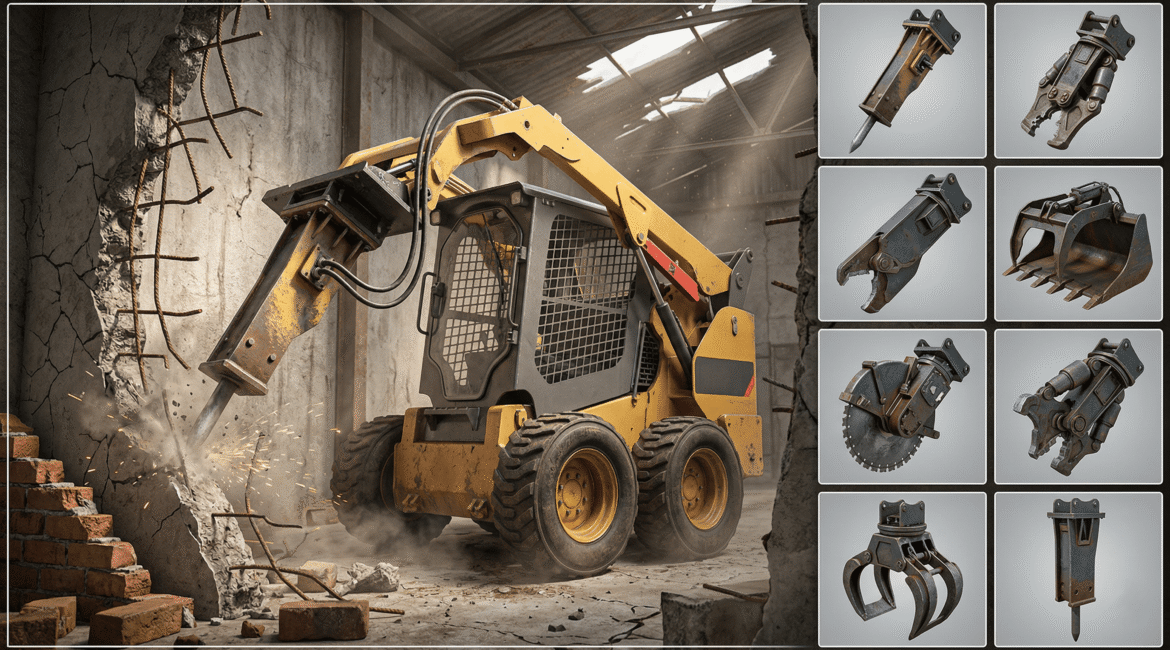
1. Hammers (Hydraulic Breakers)
There is no doubt that the hydraulic breaker is the best tool for primary demolition. When you need to break up reinforced concrete foundations, sidewalks, or stone retaining walls in a small space, a breaker gives you the high-impact force you need to do it quickly.
A skid steer-mounted breaker is better than a manual jackhammer because it makes the operator less tired and speeds up the project by a lot. Modern breakers have advanced internal damping that keeps the skid steer’s loader arms from vibrating too much. This makes sure that both the attachment and the machine last a long time.
- Impact Energy: Look for breakers that have a lot of joules of energy per blow so that they can easily break through concrete slabs that are 4 to 8 inches thick.
- Slim Design: There are “narrow-body” breakers made just for digging trenches or working next to basement walls where space is tight.
- Different Bits: Choose between moil points for general breaking, chisels for controlling direction, or blunt tools for breaking up big boulders.
2. Grapples for Demolition
After the building is down, the next step is to deal with the materials. You can’t use a standard bucket with a wide swing radius on tight sites. With a demolition grapple, you can grab, lift, and sort debris with great accuracy.
These attachments are made with strong steel tines and powerful hydraulic cylinders that can break through twisted rebar and rough wood. This makes it easier to sort at the source, which can save you a lot of money on disposal costs by keeping recyclable metal separate from regular trash.
- Two Independent Grapples: This feature lets the attachment hold uneven loads, like a pile with a heavy concrete block and a light wooden beam.
- High-Tensile Steel: Grade 80 or AR400 steel must be used to make demolition grapples so they can handle the rough edges of broken-up buildings.
- Bolt-on Sides: Some models have side plates that can be removed so you can carry longer logs or beams that would be too wide for the attachment itself.
3. Concrete pulverizers
A pulverizer is necessary if you need to recycle materials right away at your demolition site or if you need to separate rebar from concrete on-site to save money on transportation. Breakers break up concrete, but pulverizers “chew” it.
They break up concrete into small pieces that are easy to handle by using a mix of stationary and mobile jaws. They also cleanly remove the steel reinforcement from the inside. This is especially helpful in busy city areas where there isn’t enough space for a separate crushing plant. The skid steer does the processing right at the pile’s face.
- Rebar Cutting Blades: Good pulverizers come with replaceable blades at the throat of the jaw that are made just for cutting through heavy-gauge rebar.
- Mechanical vs. Hydraulic: Hydraulic versions have more “bite,” but mechanical pulverizers use the tilt cylinder of the skid steer to get the job done for less money.
- Power to Crush: High-performance units can put dozens of tons of pressure on a 12-inch thick slab, breaking it down into 2-inch minus aggregate in seconds.
4. Multi-processors and shears
A hydraulic shear or multi-processor is the best tool for professionals to use when they need to break down steel pipes, I-beams, or heavy-duty wire. These attachments are common on big excavators, but small versions for skid steers have changed the way “gut-outs” are done inside.
With just one hydraulic squeeze, they let an operator cut through HVAC ducting, steel framing, and plumbing lines. This gets rid of the need for dangerous manual torch-cutting in small, poorly ventilated areas, making the operation safer overall.
- 360-Degree Rotation: Many shears can rotate all the way around, so the operator can get to vertical or horizontal beams without having to move the whole skid steer.
- Interchangeable Jaws: Depending on what stage of the demolition you’re in, you can switch between shear jaws, cracker jaws, and pulverizer jaws.
- High Power-to-Weight Ratio: These tools are made to give the most cutting power without throwing off the balance of a compact track loader or skid steer.
5. Buckets for industrial scrap grapples
The scrap grapple bucket has a solid bottom, unlike the open-tine demolition grapple. This is a very important tool for the last “clean-sweep” phase of a demolition project on a small site.
The solid bucket picks up the small pieces of concrete, broken glass, and drywall screws that tined grapples miss when you need to leave a site “broom clean.”
The hydraulic grapples on top make sure that even heavy loads of light debris stay in place while they are being moved from the demolition face to the dump truck or roll-off container.
- Reinforced Floor: Look for buckets with extra wear bars on the bottom. These will keep the steel from “thinning” when it rubs against rough concrete surfaces.
- Cylinder Protection: Demolition sites are rough; make sure the hydraulic cylinders are protected by steel plates to keep them from getting damaged by falling debris.
- Dual Grapple Arms: Two separate arms make sure that a big piece of wood on one side doesn’t stop the bucket from grabbing smaller debris on the other side.
6. Cold Planers (Milling Attachments)
Taking down walls isn’t always what demolition is about; sometimes it’s about taking out the floor. A cold planer is the best tool for “selective demolition” when you need to fix roads in tight spaces or floors in warehouses. It lets you mill away a certain amount of asphalt or concrete without disturbing the base layer.
When you need to get ready for a new pour by removing a damaged top layer of concrete inside a building without damaging the structural slab below, this level of accuracy is very important.
- Side-Shift Capability: This lets the operator mill right up to a wall or curb, which is often necessary in urban areas with limited space.
- Depth Control: You can adjust the depth of the left and right sides of the skid steer separately, which lets you level it perfectly even if it’s on an uneven surface.
- Dust Control: High-end planers come with water kit attachments that help keep silica dust to a minimum, which is required by law in many places where demolition is done.
7. Drum Cutters (Rotary Cutters)
A rotary drum cutter is the best tool for the job when accuracy is the most important thing, like cutting out a piece of a concrete wall without shaking the whole building. These attachments have high-speed rotating drums with carbide teeth on the ends that grind away material.
They make a lot less noise and vibration than hydraulic breakers. This makes them the best tool for tearing down buildings in “sensitive” areas like hospitals, schools, or occupied office buildings where noise and vibration must be kept to a minimum.
- Low Vibration: This is great for keeping the walls next to it from falling down.
- Small Grain Size: The debris that comes out is a fine, uniform aggregate that is much easier to move and use again than big, sharp pieces.
- Ability to Work Underwater: Many rotary cutters can be used underwater, which makes them great for tearing down canals or docks in tight waterways.
8. Heavy-Duty Drop Hammers
The drop hammer is an underappreciated powerhouse for quickly tearing down thick horizontal concrete slabs on grade. It works on a simple idea: you pick up a heavy weight and drop it. It doesn’t rely on the high-frequency percussion of a breaker, so it doesn’t make much “noise” in terms of high-pitched ringing.
Instead, it sends out a lot of energy that can break floors. A drop hammer can break up thousands of square feet of concrete in a short amount of time in small outdoor spaces like parking lots or alleyways.
- Simplicity: Drop hammers usually cost less to maintain over time because they have fewer moving hydraulic parts than breakers.
- Safety: The design usually keeps the impact right below the attachment, which lowers the risk of flying “shrapnel” in close quarters.
- Speed: A drop hammer can often break a section with just one hit, while a small hydraulic hammer would need dozens of blows to do the same.
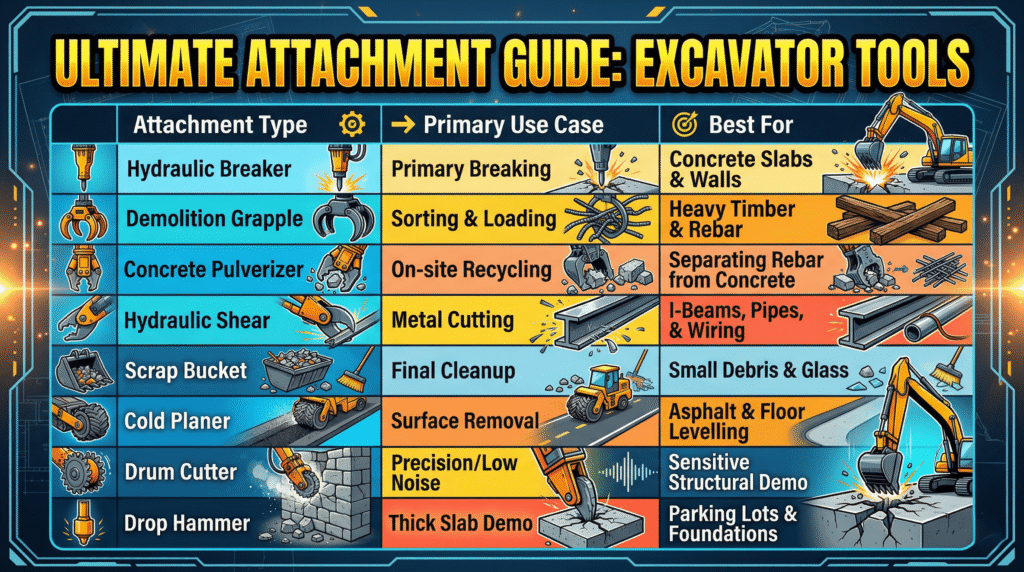
Table: Top 8 Skid Steer Attachments
| Attachment Type | Primary Use Case | Best For |
| Hydraulic Breaker | Primary Breaking | Concrete Slabs & Walls |
| Demolition Grapple | Sorting & Loading | Heavy Timber & Rebar |
| Concrete Pulverizer | On-site Recycling | Separating Rebar from Concrete |
| Hydraulic Shear | Metal Cutting | I-Beams, Pipes, & Wiring |
| Scrap Bucket | Final Cleanup | Small Debris & Glass |
| Cold Planer | Surface Removal | Asphalt & Floor Levelling |
| Drum Cutter | Precision/Low Noise | Sensitive Structural Demo |
| Drop Hammer | Thick Slab Demo | Parking Lots & Foundations |
FAQs – Top 8 Skid Steer Attachments
What is the best Skid Steer Attachments to break concrete?
Most people think that the hydraulic breaker (hammer) is the best tool for breaking concrete in general. But a drop hammer may be faster for thick slabs on grade, and a rotary drum cutter is better for areas that are sensitive to vibration.
Is a skid steer strong enough to do heavy demolition?
Yes, but only if you have a high-flow skid steer or a large-frame compact track loader. They can’t replace a 30-ton excavator, but they are very good at tearing down houses and small businesses because they can use shears, breakers, and grapples.
How do I pick between a demolition grapple and a grapple bucket?
If you mostly move big, odd pieces of debris like wood and rebar, you should get a demolition grapple (tined). If you need to pick up small trash, dirt, and fine rubble, get a scrap grapple bucket with a solid bottom.
Are hydraulic shears worth it for small sites?
Yes, they are. If the site has a lot of metal (HVAC, steel studs, or plumbing), a shear is much faster and safer than hand tools or saws. The operator can also stay inside the protected cab.
How much hydraulic flow do I need for attachments for demolition?
Most standard breakers and grapples work with standard flow. But high-performance tools like cold planers, big shears, and some rotary cutters often need “High Flow” hydraulics (usually 30–45 GPM) to work well.
Should you rent or buy attachments for demolition?
If you do demolition work every month, it’s cheaper to buy from SkidSteer.online. Renting might be the best short-term financial move for a one-time specialized job, like needing a cold planer.
How can I keep dust to a minimum during tight-site demolition?
Use Skid Steer attachments that come with built-in water spray kits, like cold planers or drum cutters. For breakers, the industry standard for OSHA silica dust compliance is to have a ground crew member use a misting hose.