

DIY Homesteading Projects Made Simple with a Mini Skid Steer for Homesteading: Pond Digging, Driveway Maintenance, and Land Clearing
Homesteading is more than a lifestyle choice; it is a commitment to self-sufficiency, land stewardship as well as continuous improvement of your property. Regardless of whether you are managing five acres or fifty, the list of projects always seems to go on. This can be solved by utilizing a mini skid steer for homesteading projects.
With establishing water sources and keeping access roads clear, the physical demands can be overwhelming for manual labor only. At this point, a mini skid steer for homesteading comes to the rescue as a real revolution.
These small but mighty machines have changed the game for DIY enthusiasts in managing land by giving an equipment of heavy-duty strength but with a residential and farm environment-friendly size.
By purchasing or renting a mini skid steer for homesteading, one gets access to the capability of doing professional-grade projects at any time saving thousands of dollars which would have been directed to the contractors while at the same time being in full control of the land’s vision.
The flexibility of a mini skid steer for homesteading is something that can hardly be exaggerated. Not like an excavator or a big farm tractor, this one is built as a power tool “Swiss Army Knife.” With a standard mounting plate, it is able to change rapidly between different attachments turning from a loader to a digger, a mower, or a grader.
In this way, the farmer has with him one motor to take care of and one machine to keep, but he is able to perform an unlimited work.
The hydraulic systems on the contemporary mini skid steer for homesteading are very strong since they deliver a high amount of hydraulic flow that is necessary for running the hardest farm spades like the trencher and soil cultivator.
The greatest advantage of these efficient hydraulic systems is that the machines can exert tremendous breakout force and digging strength while being very small and compact in size.
- Unrivaled Maneuverability: Thanks to the zero-turn feature, this compact machine can work even in tight spaces as if it were indoors, such as the inside of a barn or between garden beds, without hurting the surrounding earth.
- Easy Transport: Most mini skid steer for homesteading units weigh less than the legal load limit for a single-axle, open, landscape trailer, so you can tow one behind any vehicle equipped with a receiver hitch.
- Attachment Versatility: With the right attachment categories, a mini skid steer loader can be converted into a backhoe, a front-end loader, a trencher, or a broom.
- Lower Ground Pressure: Rubber tracks spread the weight of the machine so well that even the passage of a wild boar will leave less impression on the soil.
DIY Pond Digging: A Step-by-Step Guide
One of the most satisfying things a homesteader can do is dig a pond. It becomes a water source for livestock, a haven for wildlife, and a source of food if aquaculture is introduced later on.
While it is true that most of the time people think about big excavators when pond building is mentioned, a mini skid steer for homesteading is quite adequate for digging small to medium-sized livestock ponds or even ornamental water features. A couple of times the bigger machines come in handy is when there is a very limited timeline or when the pond is of significant size and depth.
Looks like you have a very informative tutorial on pond digging here. I love the division of stages into preparation, excavation, shaping, and compaction. The table with the recommended attachments is very helpful (and the pictures are great, too). I also like your mentioning that the mini skid steer for homesteading shouldn’t be used to dig the entire hole at one go – rather, the excavation layers should be peeled.
I once heard a very interesting explanation of the way the pond berm is created by the excavation. Usually, the excavated soil from one area gets dumped somewhere resulting in one temporally bigger pile. The soil from the base of the pond is used to make a berm on the leeward side of the pond at the same time. This has the effect of increasing the water capacity and the berm prevents the water runoff from escaping.
| Phase | Action Step | Recommended Attachment |
| Preparation | Mark perimeter, strip topsoil, and set aside for later use. | Standard Bucket / Dozer Blade |
| Excavation | Dig in 6-inch layers, creating a gradual slope (3:1 ratio). | Toothed Dirt Bucket |
| Shaping | Carve out shelves for plants and smooth the banks. | Grading Bucket |
| Compaction | Drive over the base and sides to seal the clay soil. | Tracks (Machine Weight) |
One of the important details you should also consider is that your access drive to the pond must be properly graded for drainage and stabilized pans of lands whether you want to harvest the fish from a pond or even just furnish the water to livestock easily.
- Layered Digging: It is critical to use the mini skid steer for homesteading to expose the pond bottom in layers thereby making it a gradual slope to prevent erosion.
- Building Berms: You should utilize all the soil you dug out to make a raised berm on the downhill side of the pond. This will enhance the water capacity and act as a barrier for water passing over the bank.
- The slope: Keep the slope gentle, at least 3:1 (horizontal:vertical) ratio. Since this is an area that will have animals coming in and out of the water, not only will the slope provide an easy and safe path, it will also minimize the chances of animals slipping or falling into the water.
Mastering Driveway Maintenance
Driveway maintenance is an ongoing challenge for any homesteader who owns a long gravel driveway. On top of this, potholes, washboarding, and improper drainage can ruin cars very fast. The ultimate recovery tool for the driveway is a mini skid steer for homesteading. Instead of paying for new materials every time a pothole gets patched, you simply use your machine to bring fresh stone to the surface of the existing aggregate and thus save money.
The error most made by people is that they only fill their potholes with loose gravel. This is a temporary solution because the water will still end up in that exact spot and the scattering of loose rock will be the result once again.
The new road surface after grading and compacting, however, will last for a much longer time and this is why one is better off using a mini skid steer for homesteading equipped with a land plane or box grader to level the road. In this way, the high spots are cut down to fill up the low spots, and thus the aggregate and fines are mixed to form a dense surface capable of sufficiently shedding water.
- Road Crowning: Use the tilt function of the attachment to create a “crown” in the middle of the driveway so the water will run off quite easily along the wheel tracks.
- Recovering Gravel: As the gravel slowly makes its way to the sides of the driveway, use your bucket to take this material back to the center before you start grading. By doing this, you will save on the cost of new material.
- Compaction is Key: Along the length of the driveway, take your bucket and continuously back-drag the surface until it is tightly packed.
- Drainage Ditches: Work on the ditches along the side of the driveway using your bucket or trencher attachment. Such water ways are essential to allow the water to run off.
Land Clearing and Brush Management
When a land that used to be a forest gets converted into a pasture, it isn’t exactly easy nor quick process. There also could be several tasks like clearing of fence line, timber stand improvement or preparing forest fire break, and all requires a lot of manual labor. But if you have a mini skid steer for homesteading in your arsenal, then after a cup of coffee and a check of your protective gear, throw some logs in the bucket and finally enjoy the fruits of your labor week-end project.
As you know, during land clearing work, debris can fly, branches can fall and hidden obstacles such as rocks and old wire fences can become a hazard to operator or machine. That is why a forestry package or just a protective cage is a must-have for mini skid steer for homesteading. The technique being used here is essentially “cut and mulch.” Instead of accumulating the brush and then burning it which takes away the nutrients from the land, the mulching head is capable of breaking down the vegetation to the point where it can decompose and fertilize the soil.
- Forestry Mulchers: These drum cutters are very fast and can turn into a pulp in no time trees with diameters of up to 4-6 inches. A carpet of mulch remains after their passage. Here are some of the using cases for these powerful machines: clearing of fence lines and firebreaks.
- Root Grapples: The tines are widely spaced so that the grip remains strong even when some dirt has sifted through. As such, this attachment is good after storms for cleaning up brush, logs, and rocks.
- Stump Grinders: It is quite difficult to remove a stump using your hand. However, with a mini skid steer for homesteading attachment in the form of a stump grinder, you can shave down the stump to below ground level in just a few minutes.
- Brush Hogs: If the grass and the brush are not very thick, a rotary mower (brush hog) is an efficient and low-cost way to keep the pastures manageable and reduce the habitat for ticks.
Essential Attachments for Every Homestead
In order to really make your mini skid steer for homesteading work for you, you need to build up a homebase collection of attachments. Starting with the bucket which is standard, expanding your toolset will give you so much more.
Over at skidsteer.online is a great selection of high-quality, durable, and hardy farm-application tools. What attachments you should be getting depends on your main jobs, hydraulic flow, and type of soil.
It is a good idea to find out the “tipping load” and “operating capacity” for the model you are using before purchasing large or heavy attachments. You might want to be able to safely lift and use the attachment without the risk of your machine going over. In case you have a pallet fork attachment, it is really excellent for moving feed bags, lumber, and various equipment but you must first acquaint yourself with the weight limits to avoid tipping forward.
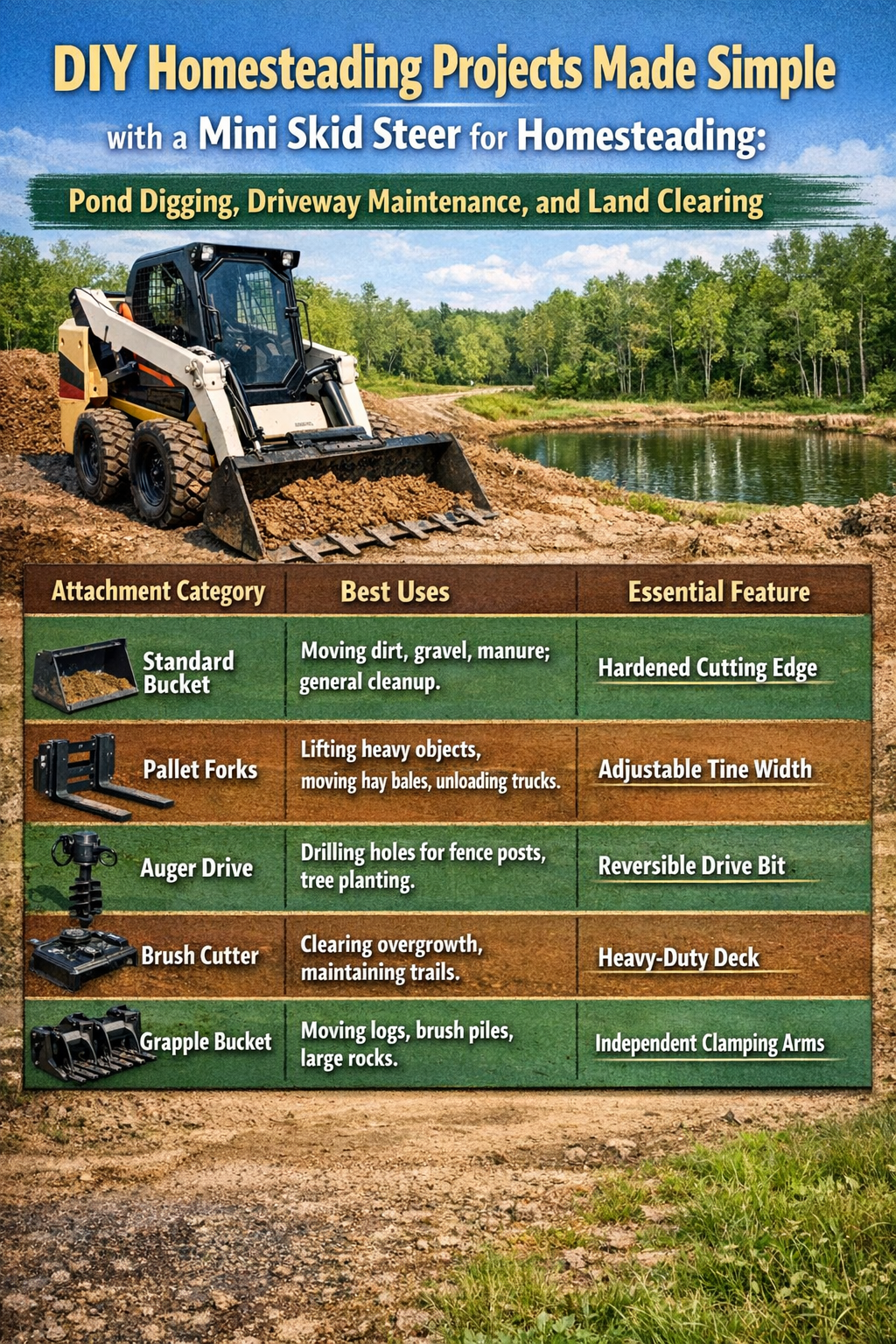
| Attachment Category | Best Uses | Essential Feature |
| Standard Bucket | Moving dirt, gravel, manure; general cleanup. | Hardened cutting edge |
| Pallet Forks | Lifting heavy objects, moving hay bales, unloading trucks. | Adjustable tine width |
| Auger Drive | Drilling holes for fence posts, tree planting. | Reversible drive bit |
| Brush Cutter | Clearing overgrowth, maintaining trails. | Heavy-duty deck |
| Grapple Bucket | Moving logs, brush piles, large rocks. | Independent clamping arms |
- Quick-Attach System: Your mini skid steer for homesteading should be equipped with a universal quick-attach plate. Doing so will make it possible for you to purchase or lease attachments from different brands without worrying about compatibility.
- Hydraulic Couplers: During attachment swaps, dirt from the coupler ends finding its way into the hydraulic system is the leading cause of failure and thus you need to make sure that your hydraulic couplers are always clean.
- Auger Bits: Have the drill bits in a variety of sizes (e.g., 9-inch for fence post, 18-inch for tree planting) so that your auger drive can be used to its full potential.
Safety First: Operating Your Machine
Although mini skid steers are smaller when compared to the larger counterparts, they are still quite powerful pieces of heavy equipment, so one has to be really careful and conscientious when working with them. Ignoring safety regulations can make accidents happen within seconds.
Most common grave injuries are due to tipping over on a hill and getting crushed by moving lift arms. You should read the manual and know the controls of your mini skid steer for homesteading model in the safest and most gigantic place before your first try.
Your main concern needs to be the stability of the machine. Due to the fact that the skid steer has a very short base, it can easily “tip” on the sides especially when carrying heavy loads and the worse part is when this load if far. Always transport the load or bucket as low as possible.
This will lower the center of mass and thus reduce the risk of your machine tipping over. Also, pay more attention to the environment. Since the engine noise can be louder than the sounds of people or animals coming towards you, always reveal your blind spots before you reverse your machine.
- Keep Buckets at Ground Level: You should never transport materials with the bucket lifted high but only keep it slightly off the ground while moving to dump or place it.
- Slope Safety: You should avoid crossing slopes sideways at all costs. Instead, try your best to drive up and down the slope in order not to roll over. However, if the slope is very steep, then it is better to back up it so the heavy part of the machine which is the engine will be on the uphill side.
- Three Points of Contact: Always maintain three points of contact (two hands and one foot, or two feet and one hand) when mounting or dismounting the platform. This is a very simple safety rule to follow that prevents one from slipping and falling down.
- Hydraulic Pressure: Be very careful not to put your hands where the hydraulic system is leaking. There is a possibility of the skin being injected by the liquid so one should use a piece of cardboard or something similar.
FAQs:
Are pond digging capabilities really included in a mini skid steer for homesteading?
One thing that the answer is clear on is that the mini skid steer for homesteading can be used to dig small and medium-sized ponds.
What is the optimal attachment if I want to clear heavy brush?
A forestry mulcher attachment is the best solution for heavy brush and small saplings (up to 3-4 inches in diameter). Not only does the mulcher shred the vegetation into small pieces, but it also helps the soil to absorb the mulch more quickly and thereby fertilizes it.
How do I use a skid steer to repair my gravel driveway?
The grading bucket or land plane can be used with a skid steer to repair a gravel driveway. It is not enough to just patch the potholes with gravel. Use the machine to loosen the existing surface to the depth of the potholes by scratching; then even out the material so that the crown in the center allowing water runoff; finally, compact the surface by dragging the bucket or rolling.
Is it difficult to operate a mini skid steer for homesteading?
Not really, they are among the easier machines to master in comparison to the large excavators and backhoes. The control joysticks are very straightforward such that one controls the drive with one and the other controls the loader arm. It takes some practice for the movements to become smooth. Hence, it is recommended that beginners start in a large, level area by doing simple moves like scooping and carrying a dirt pile. This will help them get a feel for the machine before doing more advanced work.
Final Verdict
You don’t need to be an ultra-marathon runner or machine to dance with the DIY homesteading spirit of the land around you. A mini skid steer for homesteading is an investing in empowerment of the first degree. You get to have the leverage and capacity of a professional in one neat little package that you can carry around from project to project.
The level of control and precision you get with a mini skid steer for homesteading makes it a perfect choice for pond works, a task normally requiring fine manual work, along with land clearing, which mostly calls for brute force.
Working with the capabilities the machine has, making a wise choice of attachments from a trusted store like skidsteer.online and following safety measures will allow your homesteading dreams unfold. No matter if you are leveling out the washboard gravel road or opening a passage for a new pasture, the mini skid steer for homesteading repeatedly proves that it is the biggest little machine. Begin your journey feeling confident that you have the right tool for the job.