

Fuel Efficiency Hacks for Skid Steers: Save 20% on Operating Costs
Managing your construction site, landscaping business, or farming operation is about keeping a close eye on the bottom line. Heavy equipment operation, among various other line items in your budget, usually requires the biggest financial outlay by analyzing fuel efficiency hacks for skid steers.
For a lot of fleet managers and independent contractors, fuel alone covers more than half (50-70%) of a machine’s total operating costs in its first few years of service. When diesel prices go up and down, it becomes a must to find a strategic way to optimize your business rather than just accepting the changes without doing anything.
Importance of fuel efficiency hacks for skid steers
Onsite fuel efficiency hacks for skid steers that work hard to save the environment and your money can actually lower your overall operating expenses by up to 20%. You don’t have to buy completely new equipment or negatively affect work productivity in order to get this amount of saving. In other words, improvements in operator skill, hydraulic adjustments, smart site layout, and rigorous maintenance programs cover the cost of the production changes fairly well.
Also, by starting to see fuel cost as a variable (something that can be controlled and changed) rather than a fixed one (which cannot be changed), you are in fact opening the door to the big profit margins which in turn will have positive impact on the financial health of your company.
Master the Art of Throttle Management and Operator Technique
The operator situated in front of the controls is actually the one whose fingers on the throttle determine the amount of fuel that the skid steer loader will consume per hour. One top hit and very expensive mistake quite frequently found in various jobsites is operating a skid steer loader at full engine speed (wide-open throttle) all the time.
It is true that highest revolutions per minute come handy to accomplish demanding tasks such as heavy digging, high-flow milling, or deep grading, but it is excessive and quite wasteful to use a maximum engine speed for simple material transport, cleanups, or machine repositioning.
Properly training your workforce to follow the engine speed quite tightly to the load demand will avoid them wasting fuel by a large magnitude. A foot throttle or just setting the hand lever down to the middle RPMs level during the light work is what makes the engine operate at its most efficient torque curve rather than at maximum effort.
Also, jerky, control inputs are very inefficient, cause unstable engine load levels and result in diesel being wasted. So very much smaller amount of fuel is used when joystick control inputs are smooth and gradual.
- Match RPM to Task Requirements: Train operators to lower engine speeds when handling light materials or when moving across flat, open areas.
- Incentivize Smooth Joystick Modulation: By giving control inputs in a progressive manner, it will prevent power spikes resulting in sharp fuel draws from the hydraulic pumps.
- Eliminate Aggressive Counter-Rotating Turns: Doing sharp, erratic counter-rotations will not only consume a lot of fuel but also result in the destruction of tires or undercarriage components; so, give priority to gradual three-point turns instead.
Reduce Idle Times Using Fleet Telematics and Strict On-Site Rules
Continuous idling without producing anything is one of those silent but very brutal drags on a business’s budget. For example, a skid-steer loader left running while operator is conversing with a supervisor, or waiting for a dump truck to show up, or taking a quick break uses a lot of fuel, in fact, power is being produced but no work is being done, totally zero output.
Apart from just wasting diesel, excessive idling leads to faster degradation of the engine oil, clogging of the exhaust filtration system, and artificially increasing the machine’s total service hours which have a negative impact on its resale value.
Zero tolerance for idling or severely limiting idling policy implementation throughout your work site can help you save immediately and in a measurable way. Needless to say that nowadays a significant number of skid steers already have automatic idle shutdown systems that can be programmed through the digital control panel which can be set to turn off the engine after a specified inactivity period.
Also, making use of the onboard telematics systems enables the business owners to get daily or weekly reports on idle time versus working time, which is really a very good way of seeing and correcting wasteful habits.
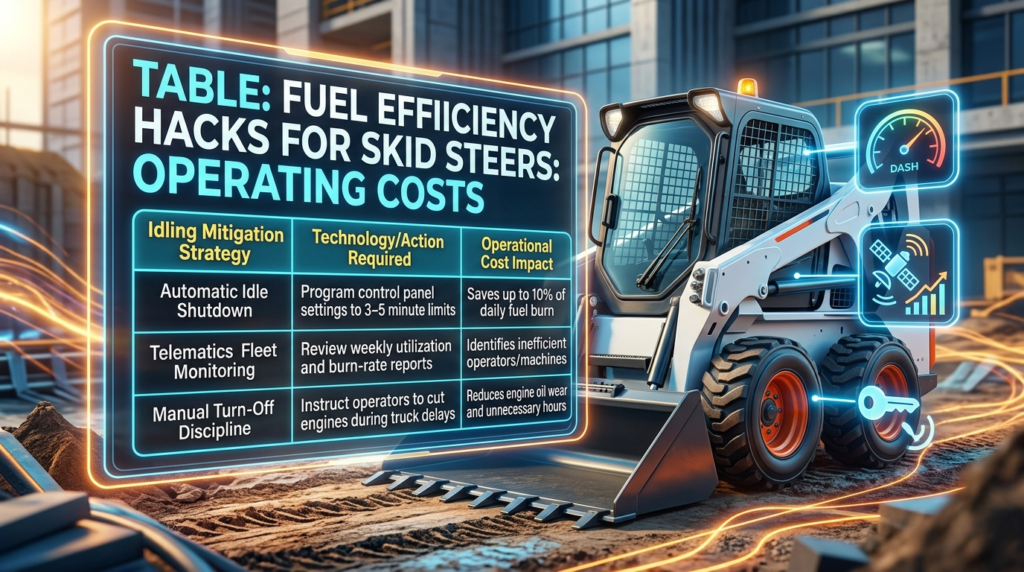
Table: Fuel Efficiency Hacks for Skid Steers: Operating Costs
| Idling Mitigation Strategy | Technology/Action Required | Operational Cost Impact |
| Automatic Idle Shutdown | Program control panel settings to 3–5 minute limits | Saves up to 10% of daily fuel burn |
| Telematics Fleet Monitoring | Review weekly utilization and burn-rate reports | Identifies inefficient operators/machines |
| Manual Turn-Off Discipline | Instruct operators to cut engines during truck delays | Reduces engine oil wear and unnecessary hours |
- Deploy Automatic Engine Shutdowns: Program the onboard electronics of the machine in such a way that power will be cut automatically 3-5 minutes after the period of continuous inactivity ends.
- Analyze Weekly Telematics Reports: actively watch operational data to find out machines or operators who have idle metrics disproportionally higher than others.
- Establish Site Communication Protocols: Train your operators to turn their equipment off completely if a logistics delay reaches or gets beyond 2 minutes.
Control hydraulic flow and use proper attachments with workloads
One of the main reasons a skid steer is so versatile is the fact that there are a great many different types of attachments to go with it. However, a badly matched or a wrong attachment can increase your energy consumption per hour dramatically. So, every attachment requires certain hydraulic pressure and flow rates to operate at maximum efficiency.
Forcing a standard-flow skid steer to run a tool designed exclusively for high-flow hydraulic systems won’t only starve the attachment of pressure, but it will also force the operator to perform more passes, causing extra wear and tear on the powertrain.
Moreover, sticking to the right tool size is extremely important. If you try to clean a massive commercial lot with a small bucket, the total number of cycles and machine operation times will increase.
Using an enormous attachment is also a mistake because it adds dead weight, lowers the machine’s center of gravity, and forces the engine to use a lot more energy just for getting around. So, your attachment strategy should be perfectly in line with your skid steer’s hydraulic capabilities.
- Align Hydraulic Flow Specifications: Make sure that an attachment’s required gallons per minute (GPM) matches your skid steer’s hydraulic output.
- Utilize Specialty Tools Over General Buckets: Timesaving and fewer movements are some of the benefits of a specialized grapple for demolition debris in contrast to a basic bucket.
- Check Auxiliary Hydraulic Quick-Couplers: Make sure hydraulic connections are clean and both locked to prevent restrictive fluid friction and energy loss.
Preventive Maintenance program and taking care of Tires/Tracks
The physical state of your skid steer is one of the biggest factors in determining how easily it can navigate different types of terrain. A poorly maintained machine with blocked air filters, stale oil, and ineffective parts will need a lot more horsepower to deliver the same output.
Take clean engine oil, for instance; it directly lowers the internal friction, while clean air filters assure the perfect air-to-fuel ratio for efficient combustion. If combustion is hampered by dirt or obstructions, the engine will consume a lot more fuel to make up for the lost power.
Concerning wheeled skid steers, it is absolutely crucial that the tire inflation pressure level is exactly kept at the right manufacturer-recommended PSI. Under-inflated tires have higher rolling resistance and will lead to the engine running harder.
In the case of compact track loaders (CTL), the undercarriage needs to be cleaned of packed mud, rocks, and debris in order to avoid heavy frictional loads. Besides that, dull bucket teeth or cutting edges will require more force to dig into the ground. This will also lead to longer cycle times and a heavy foot on the throttle.
Table: Fuel Efficiency Hacks for Skid Steers: Benefits
| Maintenance Variable | Optimal Condition | Direct Fuel Efficiency Benefit |
| Air Filtration System | Clean, unrestrictive, replaced regularly | Ensures optimal fuel-to-air combustion ratio |
| Tire Inflation Pressure | Kept strictly at manufacturer PSI specifications | Decreases rolling resistance and tire slippage |
| Cutting Edges & Teeth | Sharp, properly angled, un-rounded | Minimizes ground resistance during digging |
- Daily Machines Walk- around: Inspect track tensions, tire pressure, and check for hidden hydraulic fluid leaks before starting a shift
- Maintain sharp steel and teeth: Make it a priority to change old and dull bucket edges and teeth so the ground and the machine have less resistance
- Clean undercarriages completely: Make sure to remove mud, clay, and stones compacted on the tracks at the end of each day to avoid the mechanical drag on the tracks.
Streamline Jobsite Logistics and Material Distribution
Taking fuel efficiency hacks for skid steers further will mean not only the appliance of internal components attention but also a complete change of the jobsite layout planning. Inefficiently planned logistics often result in operators having to travel back and forth across a site for no good reason just to dump material or pick up loads. Every extra foot traveled leads to wastage of fuel, increases the wear and tear of tires or tracks, and decreases the overall productivity for the day.
By thinking first and mapping out transit paths on your jobsite, you will be able to create highly efficient, short, and direct paths for moving materials. Material stockpiles should be located as close as possible to the actual place of installation or excavation, but only as far as safety allows.
Besides that, do not forget to pay proper attention to correct load distribution when moving materials. Keeping the heaviest part of your load right over the machine’s axles in order to maximize stability and carry it as close to the ground as possible will not only eliminate rocking but also reduce the power input required from the powertrain.
- Plan Direct and Manoeuvrable Transit Paths: Design your site layout to provide heavy equipment with the absolute shortest routes between staging and dumping zones.
- Center and Stabilize Heavy Loads: Make sure heavy items are placed near the skid steer’s center of gravity to avoid engine stress during transport.
- Mitigate Extreme Temperature Impacts: By using block heaters in freezing weather to shorten warm-up times and scheduling heavy grader operations for cooler morning hours during extreme heat of summer, you help your machines function with less fuel consumption.
FAQs – Fuel Efficiency Hacks for Skid Steers
How much fuel does a skid steer use per hour?
Generally speaking, an average skid steer consumes fuel between 1.5 to 3.5 gallons per operating hour. A smaller model of 40–50 horsepower running lighter duties like grading and sweeping will be even closer to 1.5 to 2.0 gallons per hour. On the other hand, large/heavy-duty or high hydraulic-flow equipped machines doing heavy work can go easily above 3.0 to 3.5 gallons per hour.
What is the average operating cost per hour for a skid steer?
On average, the operating cost per hour ranges from $15 to $25 and depends mostly on the fuel price and machine size in your location. This average hourly cost is basically made up of the following three components: fuel consumption (typically $5 – $10/hr), maintenance of the machine (replacements for parts like tyres, filters and fluids, etc., comes at around $3 – $6/hr) and depreciation of the equipment (every hour that the machine is in use incurs a depreciation cost of $7 – $10/hr).
How can I accurately track fuel consumption in my heavy equipment?
The most efficient means of finding out an accurate fuelconsumption is the use of the onboard telematics systems provided by the manufacturers that will give you the digitized real time reports direct to your computer or phone about, among other things, fuel burn rates, idle times, power settings etc. Manual logbooks where engine hours and gallons refilled are recorded at each occasion can also be used.
Does operating a skid steer at full throttle damage the engine or use too much fuel?
Although the modern skid steer engines are mechanically designed to be able to run at full throttle, it is a known fact that a machine working at max throttle all the time without reason will use a lot of unnecessary fuel. Working at high RPMs consistently when not needed will increase fuel consumption by 25% to 40% and will produce extra heat that will cause the breakdown of hydraulic fluid and engine oils faster.
How often should I check the track tension or tire pressure to maintain fuel efficiency?
You should be checking both the track tension and tire pressure during your daily pre-operation walkaround inspection. Either come loose or low and both will cause high rolling resistance and mechanical drag which means that the engine will need to work hard to push the machine across even a flat surface and will use up a lot more diesel as well.
What size fuel tank does a standard skid steer have?
Average fuel tank size for skid steers is between 15 and 30 gallons and largely depends on the overall size of the machine frame. Light-duty compact models usually hold about 15–20 gallons, mid-size loaders carry roughly 20–25 gallons, and large-frame, high-horsepower machines feature tanks that hold 30 gallons or more to allow for extended shifts without frequent refueling breaks.
Can using the wrong attachment increase my operating costs?
Absolutely! Using the wrong size of attachment or one that is hydraulically incompatible will lead to a big increase in operating costs. Very often, if an attachment is oversized, the machine has to work very hard carrying the extra dead weight and, on the other hand, if it is hydraulically starved, then the operator will have to do twice the amount of passes to get the job done resulting in fuel burn going up along with component wear.
Major Takeaways for Long-Term Fleet Savings on fuel efficiency hacks for skid steers
Setting in place well-planned fuel efficiency hacks for skid steers as a fleet management strategy is the simplest and fastest way to get back in control of the daily overhead on your equipment. When you treat fuel as an adjustable variable, not a fixed cost, you effectively unlocked the potential to optimize each and every asset in your fleet.
A great deal of emphasis should be placed on keeping your operators trained continuously, smart telematics should be utilized to aggressively cut down all the unnecessary engine idling, make sure that attachments match exactly a machine’s hydraulic specifications, and finally maintain a strict schedule for preventive care.
If each one of us does these simple things consistently across our jobsites, we will nail that targeted 20% reduction in operating costs, extended equipment service life, and improved company profitability simultaneously.
Look through https://skidsteer.online for additional heavy machinery tips, parts guides, or equipment optimization strategies.