Ultimate Guide to Skid Steer Mulching Attachments for Land Clearing Pros
If you’re running a land management business, bidding on property development jobs, or handling heavy-duty forestry work, you already know that time is your most valuable asset. The old way of doing things—dragging multiple excavators and bulldozers out to a site, spending days knocking down trees, and then paying a small fortune to haul away or burn the leftover brush—is completely outdated this can be easily replaced with skid steer mulching attachments.
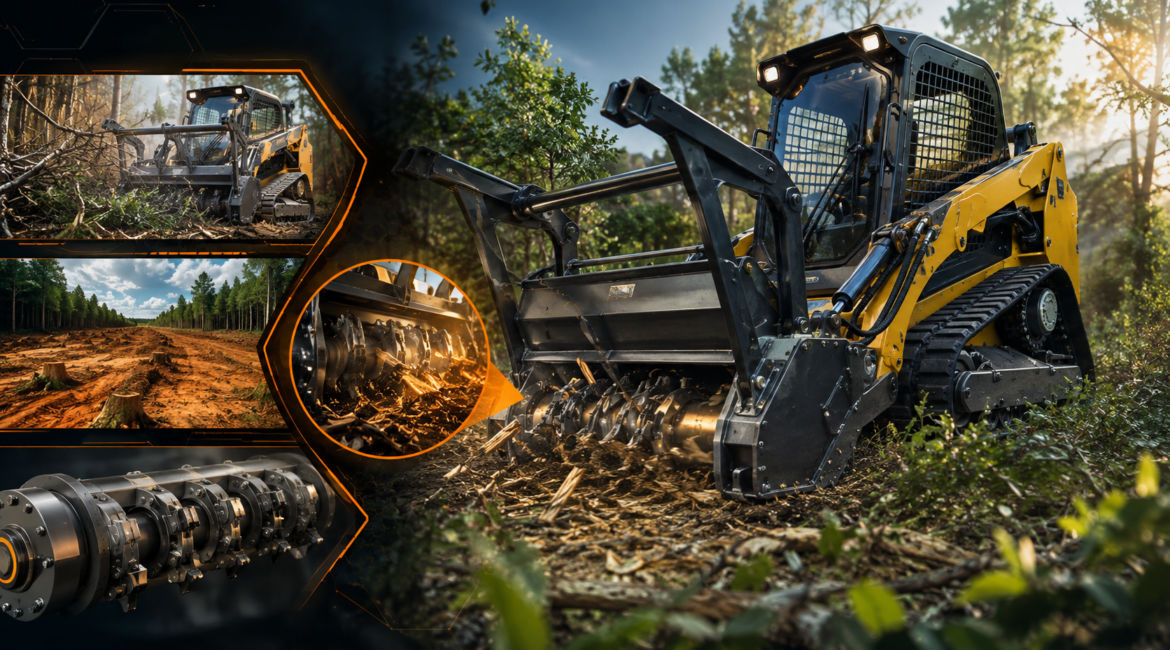
Today, anyone serious about this industry relies heavily on skid steer mulching attachments. These incredible pieces of engineering take a standard compact track loader and turn it into an absolute beast that shreds through vegetation in a single pass.
Instead of dealing with a chaotic, multi-step process, you can roll onto a lot, tear through invasive underbrush, and take down medium-sized trees while leaving behind a clean layer of mulch that benefits the soil. For land clearing pros who want to bid competitively, work faster, and leave clients thrilled with the results, mastering these tools isn’t just a good idea; it’s how you survive and grow in a tough market. Let’s break down exactly what you need to know to get the most out of your setup.
Why Modern Crews Rely on Skid Steer Mulching Attachments
Versatility is the name of the game out in the field. When you bring a skid steer equipped with a high-performance forestry mulcher onto a job site, you are essentially replacing an entire crew of guys with chainsaws, chippers, and hauling trucks. You’re cutting the vegetation, grinding it down, and spreading it as ground cover all at exactly the same time.
Inside the housing of the attachment, a heavy-duty rotor packed with carbide teeth spins at massive speeds, chewing through wood like it’s nothing. Because skid steers are so incredibly nimble compared to massive logging machines, you can weave through tight property lines or selectively clear specific areas without ripping up the root systems of the trees you actually want to keep.
Clients absolutely love the results. Instead of leaving a dirt lot that turns into a mud pit the second it rains, you leave behind a protective layer of mulch that prevents soil erosion and eventually breaks down into vital nutrients. It’s a win for your timeline, a win for the property owner, and a massive win for your profit margins since you aren’t paying hauling and disposal fees.
- You do three jobs at once: You cut, grind, and clear the land in one fluid motion, cutting your time on site by days.
- The environmental angle sells: Leaving a layer of mulch prevents erosion and eliminates the need for risky, heavily regulated controlled burns.
- You can get anywhere: A compact loader can maneuver through dense woods, residential backyards, and tight fence lines that a bulldozer simply can’t squeeze into.
Disc Mulchers vs Drum Mulchers: Which One Fits Your Business?
If you are getting ready to drop serious money on skid steer mulching attachments, you absolutely have to know the difference between the two main styles: drum mulchers and disc mulchers.
Getting this wrong can completely mess up your workflow. A drum mulcher uses a long, cylindrical rotor that spans the front of the unit. As it spins, it meticulously grinds everything in its path. These are fantastic because they can actually grind stumps slightly below the dirt, leaving the lot completely smooth and park-like. The tradeoff? They can be a bit slower when you’re dealing with massive volumes of standing timber.
On the flip side, a disc mulcher operates like a massive horizontal lawnmower blade made of heavy steel with teeth on the edges. If your only goal is to knock down thick brush and trees as fast as physically possible—like clearing miles of right-of-way under power lines—the disc mulcher is incredibly fast. It slices right through thick trunks.
However, it throws chunkier, uglier debris and isn’t great at below-ground stump grinding. You have to figure out what your clients actually care about: raw speed, or a beautiful final finish.
- The finish matters: Drum models leave a beautiful, fine mulch that residential and commercial developers prefer, while discs leave a rough, chunky mess.
- Need for speed: If you just need the vegetation on the ground and don’t care what it looks like, a disc mulcher will outpace a drum on taking down trees.
- Dealing with stumps: Only a drum mulcher will effectively chew stumps down below the soil line, saving you from having to bring in a dedicated stump grinder later.
The TYPHON Lineup at SkidSteer.Online
When you’re out there hitting hidden rocks, thick oak, and frozen ground, cheap metal is going to snap. You have to buy from suppliers who understand the abuse this equipment takes, which is why a lot of contractors source their gear from SkidSteer.Online.
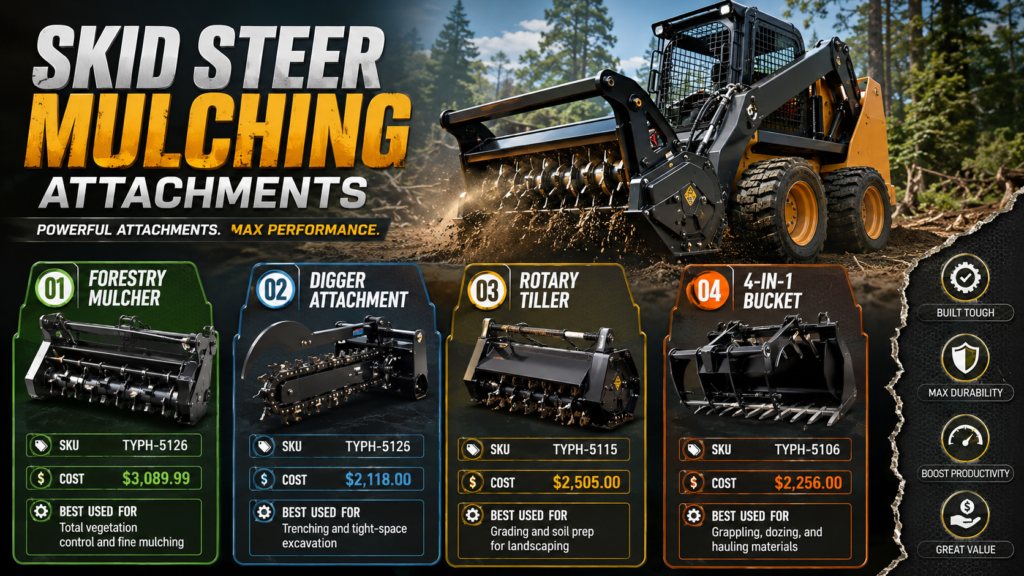
A perfect example of high-end value is the TYPHON Forestry Mulcher (SKU: TYPH-5126). Coming in at $3,089.99, it punches way above its weight class. It’s built to pair perfectly with foundation loaders like their STOMP series, utilizing advanced Italian HANSA closed-loop hydraulics to keep that rotor spinning aggressively even when you bog down in thick brush.
What operators really appreciate about the TYPHON setup is the internal cooling. It uses a separate hydraulic oil radiator. Anyone who has run a mulcher in July knows that heat is the enemy; if your hydraulics overheat, you’re sitting in the cab doing nothing while you wait for the machine to cool down.
TYPHON engineered this out of the equation. Combine that with a solid 1-year warranty and free shipping, and it’s easy to see why this is a staple piece of land clearing equipment.
Table: Skid Steer Mulching Attachments
| Attachment Model | SKU | Cost | Best Used For |
| Forestry Mulcher | TYPH-5126 | $3,089.99 | Total vegetation control and fine mulching |
| Digger Attachment | TYPH-5125 | $2,118.00 | Trenching and tight-space excavation |
| Rotary Tiller | TYPH-5115 | $2,505.00 | Grading and soil prep for landscaping |
| 4-in-1 Bucket | TYPH-5106 | $2,256.00 | Grappling, dozing, and hauling materials |
- Built for abuse: The TYPH-5126 uses premium European hydraulic pumps to ensure you don’t lose torque when hitting dense wood.
- Heat management: The independent cooling system means you can run the machine hard all day without the hydraulic oil melting down.
- Great ROI: At just over three grand, it pays for itself in the first couple of land-clearing contracts you book.
Real-World Operating Tips to Keep You Moving
You can’t just hook up a mulcher, put the pedal down, and hope for the best. There is a real rhythm and technique to doing this right without tearing up your machine. First, you have to match your machine’s hydraulic output to the attachment.
If you slap a high-flow mulcher on a standard-flow skid steer, it’s going to stall constantly, and you’ll spend all day frustrated. When you’re actually attacking a tree, the best guys raise the mulcher high, tilt it forward, and chew the canopy and branches as they drive into the trunk. This naturally pushes the tree forward and away from the cab. Once it falls, you back-drag the mulching head over the log to turn it into chips.
And look, we have to talk about safety. Do not even think about running one of these attachments with a standard glass door on your cab. These things throw chunks of wood and rocks at terrifying speeds. If a piece of oak kicks back, it will come right through standard glass. You absolutely must install a half-inch polycarbonate forestry door before you spin that rotor.
- Match your flow: Always check that your skid steer’s GPM (gallons per minute) and PSI match the specs of the mulcher, or you’re just wasting time.
- Work top-down: Grind the high branches first, push the tree over, and then reverse over the trunk to shred the remaining wood safely.
- Protect yourself: A reinforced, shatterproof forestry door is mandatory. Standard cab glass will fail, and the results are incredibly dangerous.
Maintenance Habits You Simply Can’t Ignore
Look, if you don’t take care of your skid steer mulching attachments, they are going to break down on you in the middle of a job, costing you thousands in downtime. The teeth on the rotor are the lifeblood of the machine. If you are running with dull, chipped, or missing carbide teeth, the rotor has to work twice as hard to cut the same amount of wood. That friction travels right up the hydraulic lines, causing the machine to overheat and guzzle diesel. Walk the head every single morning and swap out any teeth that are compromised.
You also have to become obsessed with the grease gun. Forestry mulching shakes the absolute hell out of your equipment. You need to grease every single pivot point and bearing at the start of the day and before you load it on the trailer to go home.
That grease forces the fine, abrasive wood dust out of the fittings. Finally, keep an air compressor handy and blow out your machine’s radiators twice a day. The amount of sawdust in the air will clog your coolers faster than you can imagine.
- Check your teeth: Inspect the carbide cutting teeth daily. Running dull teeth overheats your hydraulics and kills your fuel efficiency.
- Grease is cheap, steel is expensive: Pump grease into every fitting twice a day to push out the abrasive dust that ruins bearings.
- Let it breathe: You have to manually blow the sawdust and debris out of your skid steer’s radiator or you will inevitably overheat the engine.
FAQs – Skid Steer Mulching Attachments
What are skid steer mulching attachments actually used for?
They are heavy-duty tools that connect to a skid steer to aggressively cut, shred, and grind brush, trees, and stumps. Instead of hauling debris away, these attachments leave behind a fine mulch. They are standard issue for site prep, forestry management, and clearing right-of-ways.
Can I run a forestry mulcher on a standard-flow machine?
You can find light-duty brush cutters for standard flow, but if you want to do serious land clearing and grind actual trees, no. You really need a high-flow hydraulic system (usually pumping 30 to 45 GPM) to keep the rotor spinning aggressively under heavy loads.
How big of a tree can these attachments realistically take down?
With a good high-flow drum mulcher, you can continuously walk through 4 to 6-inch diameter trees without slowing down. If you know what you’re doing and use the right technique, you can intermittently process trees up to 10 inches thick, though it takes a bit more time.
Should I buy a disc mulcher or a drum mulcher?
If you are clearing rural land where nobody cares what it looks like and you just need extreme speed, buy a disc mulcher. If you are doing residential or commercial work where the client wants a smooth lot with ground-up stumps and nice-looking mulch, you have to go with a drum mulcher.
How much is this going to cost me?
The big brand names can easily push past $30,000 for a massive high-flow unit. However, if you are running a specific compact setup, you can get incredibly reliable, professional-grade gear like the TYPHON models at SkidSteer.Online starting right around $3,000.
Do I really need to replace my cab door?
Yes. 100%. Mulchers throw chunks of wood and hidden rocks at ballistic speeds directly at the cab. A standard glass door will shatter instantly. You must install a specialized, half-inch polycarbonate forestry door before you ever engage the hydraulics.
How long will a set of carbide teeth last me?
If you are working in clean woods with soft dirt, you might get 400 to 500 hours out of a set. But if you are grinding in rocky terrain, hitting old fence wire, or working in urban lots with hidden debris, you can easily chip and ruin a set of teeth in under 100 hours.