

Introducing a No Cost Skid Steer Operator Training Checklist for Your Staff
Heavy machinery operation requires a combination of skills, attention to detail, and a well-structured safety plan. Whether you are a construction site manager or a landscaper, having a skid steer operator training checklist is a major step towards creating a safe working environment.
At SkidSteer.Online, we recognize that powerful machines such as the TYPHON STOMP require equally skilled operators. This detailed manual features everything your team needs to know to operate a skid steer safely and efficiently.
Adopting a formal training system will help you minimize the occurrence of accidents, reduce your maintenance expenses, and keep your project on time. Here is an in-depth look at the vital elements that every training program should cover, starting from pre-operational checks up to handling complex attachments.
Knowing the Fundamentals of Skid Steer Operation
An operator should be well-versed with the inner workings of a machine even before they start it. The characteristics of the skid steer that set them apart from other machines are their zero-turn ability or that the tires can literally be skidded across the ground. This feature makes it highly maneuverable in tight spaces; however, the center of gravity also changes quite drastically with different loads.
- Machine Familiarization: Each operator has to read the specific operator’s manual for the model they will use, like TYPHON STOMP X1300 or the 509 series.
- Control Identification: Before starting the engine, the trainees must locate all joysticks, foot pedals, and auxiliary hydraulic controls.
- Safety Features: Understanding ROPS (Roll-Over Protective Structure), seatbelt interlocks, and emergency shut-off valves is a must.
The Indispensable Pre-Operational Inspection
On top of everything starting with safety, the daily walk-around inspection is your best protection against mechanical issues. Without the help of a skid steer operator training checklist, small leaks or loose bolts can easily escape your notice.
- Fluid Levels: Be sure to check engine oil, hydraulic fluid, coolant, and fuel levels to avoid breakdowns in the middle of work.
- Tire and Track Integrity: Besides punctures and excessive wear, improper track tension is also an important factor to check since it can lead to lost traction or thrown tracks.
- Hydraulic Hoses: Special attention should be given to signs of leaking, fraying, or kinking, especially close to the attachment points where the machine moves the most.
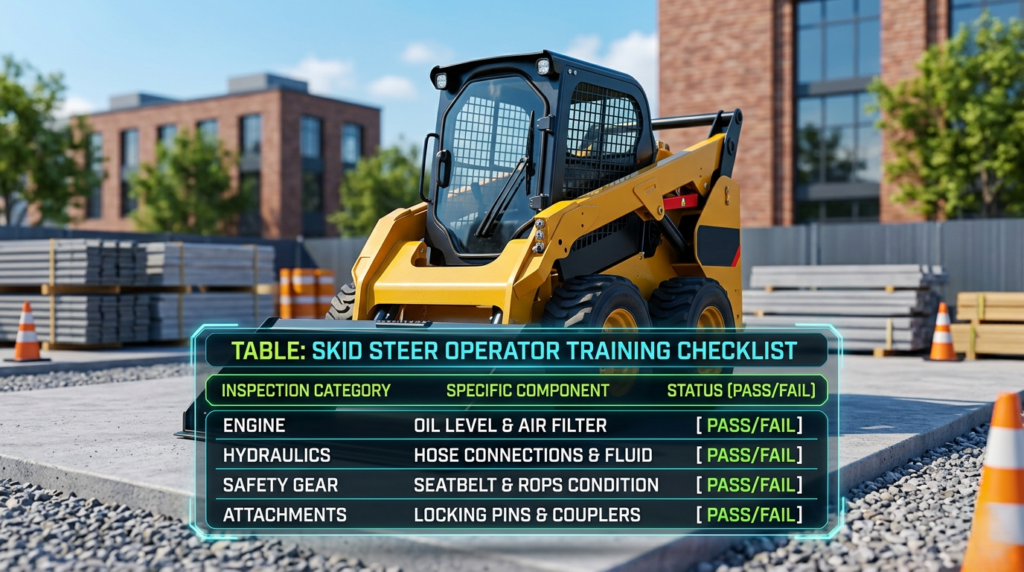
Table: Skid Steer Operator Training Checklist Inspection Category
| Inspection Category | Specific Component | Status (Pass/Fail) |
| Engine | Oil Level & Air Filter | [ Pass/Fail] |
| Hydraulics | Hose Connections & Fluid | [ Pass/Fail] |
| Safety Gear | Seatbelt & ROPS Condition | [ Pass/Fail] |
| Attachments | Locking Pins & Couplers | [ Pass/Fail] |
Safe Mounting and Dismounting Procedures
It really is just the basics, but getting on and off a machine incorrectly is the reason behind a lot of workplace injuries. Training operators to recognize the potential danger of the machine even when it is at a standstill is necessary.
- Three-Point Contact: Use three points of contact at all times when climbing into or out of the cab (two hands and one foot, or two feet and one hand).
- Clean Steps: Make sure the steps and grab handles are clear of mud, ice, or grease to eliminate slipping hazards.
- Engine Off: Do not leave the machine while the engine is running or the lift arms are raised without mechanical supports in place.
Load Handling and Stability Mastery
A skid steer’s stability fluctuates. The skid steer operator training checklist must concentrate on the “Stability Triangle” and show how the center of gravity moves when the bucket is raised.
- Load Center: During transportation, locate the heaviest part of the load as near the machine and as low to the ground as possible.
- Slope Safety: When operating on a slope, the heavy end should always be uphill (e.g., carry the load uphill; empty – drive backwards downhill).
- Smooth Movements: Do not make any sudden starts, stops or sharp turns especially when the lift arms are extended.
Attachment-Specific Training
The TYPHON equipment that we stock at SkidSteer.Online has a great feature, it can be used with different attachments. Yet, each new attachment changes the way your machine behaves, be it a Forestry Mulcher or an Auger.
- Coupling/Uncoupling: Staff should secure locking pins and attach they coupling securely after attachment locking has been confirmed.
- Auxiliary Hydraulics: The refresher includes proper use of hydraulic lines that keep contaminants out of the system.No one had seen green coming towards the house, almost like a flood, from the forestry mulcher.
- Specialized Operation: A 4-in-1 Bucket is operated in a different way than a Digger Attachment; neither one of these has one overall certification, but their operators are certified for each.
| Attachment Type | Primary Safety Focus | Recommended Training Time |
| Auger | Torque Reaction & Positioning | 2 Hours |
| Forestry Mulcher | Debris Zone & Cooling | 4 Hours |
| Rotary Tiller | Soil Depth & Ground Obstacles | 2 Hours |
| Hydraulic Grabber | Clamping Force & Balance | 3 Hours |
Being Aware of Your Operational Environment
Watching just the bucket is not enough for a skilled operator; the whole job site is under their surveillance. Situational awareness is a must when preparing a skid steer operator training checklist.
- Bystander Safety: Keep the “danger zone” radius for the machine set and no one should be allowed inside while the engine is running.
- Utility Awareness: Make sure to identify the locations of power lines, water, and gas pipes before operating Ripper or Digger.
- Overhead Obstructions: Watch out for low branches and wires especially if working with raised lift arms.
Post-Operation and Shutdown Procedures
Deciding how to store a machine at the end of the day will determine whether it will be ready for use the next morning. To prevent “creep” and make sure the machine is safe for the next person, proper shutdown must be done.
- Bucket Lowering: Make sure to always place the bucket or the intention of the equipment flat to the ground before you shut down the engine.
- Cool-Down Period: The engine is to be idled for a few minutes after heavy use, to allow the turbocharger and hydraulic system to cool gradually.
- Daily Cleaning: To prevent overheating and fire hazards, clean off the radiator and undercarriage everyday.
FAQ’s for Skid Steer Operator Training Checklist
Do you have to get a license to operate a skid steer?
A majority of areas in the US have no requirement for a specific “driver’s license” for a skid steer, but OSHA along with other safety agencies will require that a person operating a skid steer be “competent” and “trained”. Usually, this is a combination of classroom based learning and hands-on testing.
What is the main cause of accidents with skid steers?
Most of the accidents are due to operators being caught or crushed under the lift arms or the bucket while the roll-overs follow in second place being caused by uneven terrain or carrying loads too high.
How often should a skid steer operator training checklist be revised?
It should be done once a year or when new attachments such as a TYPHON Forestry Mulcher addition in your fleet, as different tools can change operational hazards.
Are skid steers allowed on public roads?
In principle, skid steers are not street-legal except that they are equipped with specific lights, have proper registration and are marked with “Slow Moving Vehicle” (SMV) signs. Please consult your local municipal regulations.
How to prevent tipping over of a skid steer?
The tips are always to keep the load carried low, to go straight up and down slopes but not across them and to never exceed the Rated Operating Capacity (ROC) of the machine.
What are ROPS and FOPS in skid steers?
ROPS means Roll-Over Protective Structure, and FOPS is Falling Object Protective Structure. These are the protective cages that enclose the operator to provide protection in roll-over or from falling objects.
What are the safety tips when performing maintenance on a skid steer?
You are required to keep up with a maintenance plan that includes daily fluids check, weekly greasing of the pivot points, and that all safety decals and lights are in top condition, clean, and visible.
Wrap Up – Skid Steer Operator Training Checklist
Safety cannot be bought with a few dollars alone; it is a wise investment. By applying a skid steer operator training checklist, you are equipping your team to perform their tasks effectively at the same time minimizing the potential dangers involved in the operation of heavy machinery.
Regardless if you are using the STOMP X1300 for excavation purposes or the TYPHON 509 for landscaping, the operator who is trained is your most valuable resource).
Visit SkidSteer.Online to see our complete selection of professional attachments and high-performance loaders that will help make your next job safer and more productive.