

10 Essential Skid Steer Maintenance Tips to Avoid Costly Repairs
Maintaining your heavy machinery will determine if you have a profitable business day or an expensive afternoon with the mechanic. You can trust that when you buy a durable machine like the TYPHON STOMP X1300 and STOMP 509 from SkidSteer.online, they will most likely withstand the test of time. Still, even the toughest Kubota-powered loaders need to be followed the skid steer maintenance tips schedule for the best running.
You will be able to maximize your uptime and protect your investment by implementing these 10 Essential Skid Steer Maintenance Tips to Avoid Costly Repairs.
Among all the features, the greatest one is the versatility of a skid steer. It can change from being a Forestry Mulcher to a Hydraulic Earth Auger within minutes. On the other hand, this versatility poses a huge challenge to the various components.
Every time a tool is changed, there are potential points of failure if the connections are not cleaned or the fluid levels are not checked. The main purpose of this document is to take you through the measures that operators should use to keep their machines in proper working condition and that the loaders as well as their specialized attachments are in good mechanical condition.
10 Essential Skid Steer Maintenance Tips
1. Perform Daily Pre-Operation Walkarounds
If you want to make your TYPHON machinery operational, you first should perform a visual check on it. This is the most effective way to make sure that there are no leaks, bolts not being tightly secured or tracks being violated in the hazardous way.
Furthermore, closely inspect the undercarriage and the mounting plates your attachments, like the 4-in-1 Bucket Combo. In a very brief time, a five-minute inspection each morning will help you to save thousands of dollars in emergency repair costs and also you will avoid onsite accidents.
- Look for Signs of Fluid Leaks: Any leaks of oil, coolant, or hydraulic liquid should be immediately noticed and reported.
- Examine the Condition of Your Tires or Tracks: A visual check will reveal any cuts, cracks, or worn out parts that could lead to a blowout or de-tracking.
- Check Attachment Couplers: Make sure locking pins and hydraulic couplers are clean and working well.
2. Monitor Hydraulic Fluid Levels and Quality
The hydraulic system is an essential part of a skid steer’s life, especially when using high-demand attachments like a Forestry Mulcher. Your equipment was manufactured with an Italian HANSA closed-loop hydraulic system equipped with dedicated pumps for driving and auxiliary functions.
Heat buildup due to contaminated or insufficient fluid can damage Taifeng plunger pump or IMPRO motors. Make sure it’s always replenished and checked by looking at the sight glass or dipstick when the arms are down and the bucket is on the ground.
- Check Fluid Levels daily: Operating with low levels can cause aeration and cavitation, which will damage hydraulic pumps irreversibly.
- Detect Contamination: When the fluid appears milky or smells burnt, a flush and filter replacement is necessary immediately.
- Keep Hydraulic Couplers Clean: Wipe off the hydraulic nipples before connecting the attachments to avoid the introduction of dirt into the system.
3. Grease All Pivot Points Consistently
One of the main causes of wear is metal-on-metal friction. Your skid steer is fitted with grease zerts at the pivots of the lift arms, cylinders, and attachment mounting points. By sticking to a strict greasing schedule, you make sure these joints will move smoothly even under heavy loads, as is usual in construction and landscaping.
In the case of the use of machines in very harsh environments—e.g., machines fitted with a3-Tooth Ripper for rocky ground—greasing must be done at least every 8 to 10 hours of operation.
- Apply Grease Until Visible: Give the fitting a good pump of grease until a little bit of new grease is seen oozing out of the joint.
- Give Special Attention to the High-Pressure Locations: The tilt cylinders and loader arm pins are the parts of the machine that get worked the most and therefore need the greater amount of attention.
- Use High-Quality Lubricants: Always go with the manufacturer’s recommended grease to ensure you get the right viscosity and the heat resistance.
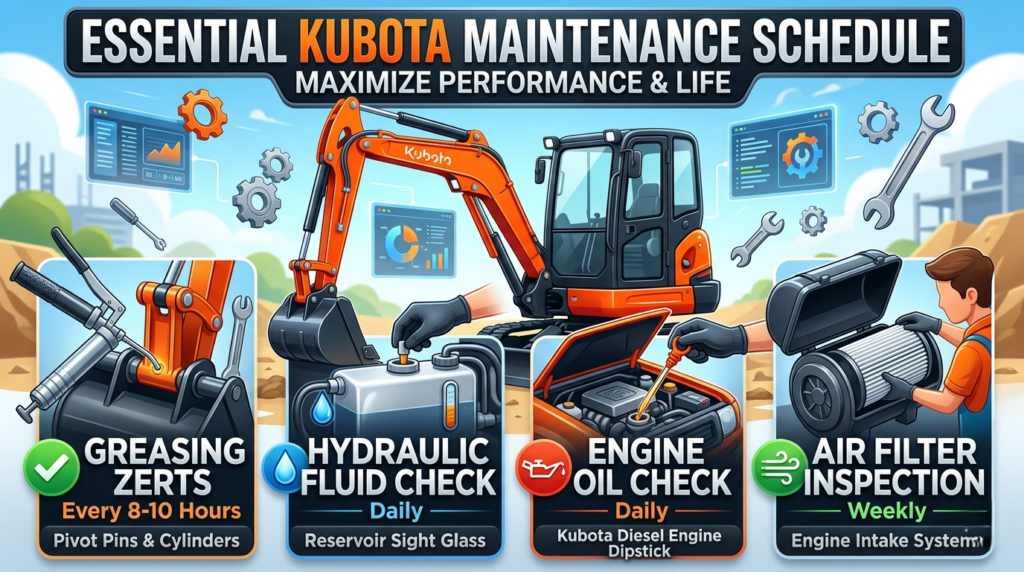
Table: Essential Skid Steer Maintenance Tips
| Maintenance Task | Frequency | Target Component |
| Greasing Zerts | Every 8-10 Hours | Pivot Pins & Cylinders |
| Hydraulic Fluid Check | Daily | Reservoir Sight Glass |
| Engine Oil Check | Daily | Kubota Diesel Engine Dipstick |
| Air Filter Inspection | Weekly | Engine Intake System |
4. Service the Engine Air Filters
Skid steers are usually operating in areas which are literally “dust bowls”—filled with dirt particles, debris, and even microscopic ones. The Kubota D1105 engine that is installed in the STOMP X1300 needs to breathe in a considerable amount of clean air.
The engine will be deprived of air when the filter gets completely clogged causing it to increase fuel consumption, lose power resulting in the damage of the internal components. Do not use compressed air to clean the filter as it will create small holes that will allow dirt to enter the cylinders.
- Check the Indicator: In order to alert the operator, most modern skid steers are equipped with a restriction indicator that turns red once the filter needs to be changed.
- Inspect Primary and Secondary Filters: Make sure even the inner safety filter is untouched apart from looking at the surface one only.
- Right Replacement: Shaking a dusty filter might be tempting, but meiosis the only way to ensure the safety of your engine.
5. Keep the Cooling System Clean
The STOMP models are equipped with an intelligent cooling system where the hydraulic oil radiator is separate to prevent heat transfer. Yet, a clogged radiator is just as bad as none at all. When working with a rotary tiller or a scarifier for the lawn, dirt and other organic matter are deposited on the cooling fins.
Overheating is one of the main factors of failure of the engine and the degradation of the hydraulic seals.
- Clear the Radiator Fins: Loosen debris trapped in the radiator with a low pressure water jet or blow it out with air.
- Check Coolant Levels: Make sure the level of the engine coolant is adequate and the mixture is correct for the environment you are in.
- Inspect Hoses: Check whether any of the hoses are swollen or cracked and could rupture when the engine is hot and under pressure.
6. Maintain Proper Track or Tire Tension
Regardless of whether you operate the dynamic Storm or the Prestige that has an enclosed cabin, your drivetrain will be constantly stressed. One of the leading causes of improper track tension is premature wear, especially if you are running a model with tracks.
When the tracks are too tight, they generate unnecessary loading on the bearings and drive motors. Alternatively, if they are too loose, there is the risk of “throwing a track” which can cause significant undercarriage damage and also result in several hours of downtime.
- Measure Track Sag: Determine the “sag” between the rollers as per the manual instructions.
- Undercarriage Cleaning: Mud and rocks trapped in the tracks will literally act like sandpaper, slowly wearing down the rollers and idlers.
- Wheel Nut Torque Check: Wheeled skid steers require that all lug nuts are tightened to specified torque values.
7. Inspect Attachment Wear Parts
Without the right ancillary equipment, a skid steer is worthless. Consider, for instance, that a Digger Attachment or a Single-arm Backhoe come with teeth and cutting edges designed to wear down over time.
If you allow these wear parts to disappear completely, there will be structural damage for the actual attachment. This is one of the most important 10 Essential Skid Steer Maintenance Tips to Avoid Costly Repairs because it helps you to retain the value of your auxiliary equipment.
- Rotate or Replace Cutting Edges: In case of buckets, make sure that the bolt-on edges are replaced before they wear into the bucket shell.
- Check Ripper Teeth: Make sure that the teeth on your 3-Tooth Ripper are sharp and properly fastened.
- Inspect Auger Flights: Examine the flights of your 200mm Hydraulic Drilling Auger for cracks or bends.
8. Test the Safety Interlock System
There is indeed a link between safety and maintenance. Equipped with interlock systems, skid steers make it impossible for a machine to move or the hydraulics to activate without the operator being in the seat with the safety bar down.
It is because of these sensor failures that unintended movements or inability to operate the machine at all are some of the consequences very often seen.
- Test Seat Sensors: Check if the machine shuts down or locks out when the operator leaves the seat.
- Check Safety Bars: When the lap bar is raised, the hydraulic lock should engage right away.
- Inspect Backup Alarms: Check that workers on site can hear you when the machine is backing up.
9. Battery and Electrical System Care
Today’s loaders that belong to the TYPHON series are dependent on advanced electrical systems for joystick controls from Lufthansa as well as electronic monitoring systems.
In a battery terminal corroded situation or a frayed wire there will be power outages or difficulties in starting the engine. Batteries are different, overheating is the worst thing that can be done to them so you better make sure your charging system is in its best working condition before the onset of the winter season.
- Clear Terminals: Use a wire brush to remove corrosion and finally, apply a protective spray.
- Check Battery Voltage: When the engine is off, a viable battery should read approximately 12.6 volts.
- Inspect Wiring Harnesses: Pay close attention to signs of rubbing or “chafing” in the places where wires have contact with the frame.
10. Record Keeping and Scheduled Overhauls
The final tip in our 10 essential skid steer maintenance tips to avoid costly repairs is to look at your maintenance logbook as if it is a legally binding document. By writing down every oil change, filter replacement, and repair, you will be able to forecast when parts need replacing.
Also, it raises the resale price of your machine significantly since buyers desire evidence that the unit was well cared for.
- Note Each Maintenance: Record the date, hour meter reading, and the work done in detail.
- Arrange for Regular Inspections by Professionals: Engage a qualified technician to carry out in-depth inspection once each year.
- Keep Manual on the Side of You: If extreme heat or dusty conditions are part of your operation, then perform oil and filter changes 25% sooner than the manual indicates.
Frequently Asked Questions – 10 Essential Skid Steer Maintenance Tips to Avoid Costly Repairs
When is a good time to grease my skid steer?
Generally, it is suggested that you grease all pivot points after every 8 to 10 hours of machine usage. If you are operating your equipment in wet, sandy, or highly abrasive conditions, you might have to grease it twice a day to push out any contaminants from the pins and bushings.
What typically causes skid steer hydraulic failures?
Fluid contamination is usually the main reason. Tiny particles of dirt or metal can get into the system through dirty couplers or worn-out seals, resulting in internal damages of the pumps and valves. The best way to prevent a costly $5,000+ repair bill is by regularly maintaining your hydraulic fluid in a clean and cool state.
Can I use any diesel engine oil in my TYPHON skid steer?
Make sure to use the particular grade of oil that your Kubota engine manual specifies which is usually a top-notch 15W-40 or 10W-30 API CJ-4 or higher diesel oil. If you use a wrong kind of oil, this may cause soot formation and early wear of your engine.
How can I tell if my tracks are too tight?
If your tracks have excessive tightness, the machine will emit a “groan” sound when making turns and the drive motors may overheat. Over-tension will also lead to very fast wearing of the drive sprockets and front idlers. Use the “three fingers” method or refer to the exact measurement in your STOMP series manual before proceeding.
What would cause my skid steer to lose power when loaded?
Shortage of power is mainly related to either a blocked air intake or a dirty fuel filter. Look at your air filter indicator and also verify if the fuel filters have been changed as per the service time chart. If nothing else fixes it, then a broken hydraulic pump is likely.
Do I have to warm my skid steer up before operation?
Warming up is essential. In fact, the engine and hydraulic oil should be left running for 5-10 minutes so that they can reach the right temperature level for work, especially in cold places. This way, the oil will be fluid enough to smoothly flow in the small clearances of the Italian HANSA hydraulic system.
When do I need to change my hydraulic filters?
Although it depends on the machine, on average hydraulic filter replacements are made after 500 hours of use. Also, the initial “break-in” change occurs at 50 hours for new machines, just to catch any manufacturing particulates.