What is the Skid Steer Lift Capacity?
Knowing the physical limits of your tools is the most important thing you can do to make sure your job site is safe and productive when you start any heavy-duty project. For contractors, landscapers, and construction workers, knowing how much weight your skid steer lift can handle is more than just following the manufacturer’s instructions. It’s also about making sure it works well and protecting your investment.
Skid steers are known for being very versatile and powerful for their size, but pushing them past their design limits can cause equipment to break down, dangerous tipping situations, and costly project delays. Knowing exactly how much weight your machine can handle is important for the speed and success of your work, whether you’re doing heavy earthmoving, precise material handling, or routine site maintenance.
To find the right skid steer for your job, you need to look closely at its operating specifications. This will make sure that the machine you choose can handle the job without going over its limits while still providing the power you need for tough jobs. You not only make your skid steer loader last longer by maximizing skid steer lift capacity, but you also make the work area much safer for everyone on your crew.
- Making sure the skid steer lift has the most power possible makes sure it works at its best and stops expensive mechanical failures during heavy-duty work.
- Knowing the limits of your equipment is important for keeping safety standards high and avoiding dangerous tipping accidents on the job site.
- Proper weight management has a direct effect on how much fuel the machine uses and how long its complex hydraulic systems last.
Understanding Rated Operating Capacity (ROC) and Tipping Load
Operators need to understand the technical terms that manufacturers use to rate their machines, like Rated Operating Capacity (ROC) and tipping load, in order to fully understand how much weight a skid steer can lift. The tipping load is the most weight that the skid steer can hold in its bucket before the back wheels lift off the ground, which makes the machine very unstable.
The industry uses the Rated Operating Capacity instead of the absolute limit because working at that level is very dangerous. For wheeled skid steers, this is usually 50% of the tipping load, and for compact track loaders, it is about 35%. This built-in safety margin makes sure that operators can easily move, lift, and carry heavy things without always being on the edge of disaster.
When you see a machine advertised with a certain skid steer lift capacity, you are looking at the ROC, which is the maximum amount of weight you can safely lift every day. If you push the machine past this number, it will change the center of gravity a lot, which will put too much stress on the hydraulic cylinders, lift arms, and structural frame. This will put both the equipment and the operator’s safety at risk.
- The Rated Operating Capacity (ROC) is the most important safety standard because it clearly shows the maximum weight for moving things around every day.
- The tipping load is the point at which the machine loses its balance. This is a limit that operators should never try to reach on purpose while working.
- To make sure that your wheeled loader is stable on different types of job sites, you need to use the 50% rule when figuring out your safe working load.
Important Things That Affect Your Skid Steer Lift Capacity
The manufacturer’s spec sheet gives a good starting point, but a lot of mechanical and environmental factors on the job site can change the real-world skid steer lift capacity. The overall weight of a machine and its specific hydraulic power, which is measured in gallons per minute (GPM) and pounds per square inch (PSI), are what make it able to lift things.
A heavier machine naturally gives the load at the front a stronger counterweight, which stops the back end from lifting when you scoop or hoist aggressively. Also, the condition of the surface you are working on is very important.
For example, lifting heavy pallets on smooth, level concrete is very different from doing the same lift on soft, muddy, or very sloped ground where the center of gravity is always moving.
Things like tire pressure, track tension, and the planned addition of rear counterweights can slightly raise or severely lower your practical lifting limits. Operators need to always be aware of these factors and be able to change how they operate to keep up with the changing true skid steer lift capacity.
- The speed and strength of the lifting arms are strictly controlled by the system’s overall pressure and hydraulic flow rates.
- Uneven or sloped ground makes it much harder to lift things because it changes the machine’s center of gravity in ways that are hard to predict.
- Using OEM-approved counterweights in the right way can make things seem more stable and raise your safe lifting limit by a small amount.
Vertical Lift vs. Radial Lift Settings
The way the lift arms are built is another important factor that affects how your skid steer lift capacity works at different heights and extensions. The industry splits these designs into two main groups:
vertical lift and radial lift configurations. Each is made to meet very specific operational needs. When a radial lift machine works, the bucket moves along a curved path as it rises. This gives it the best reach and breakout force at lower or mid-range heights. This is why radial designs are so great for digging, grading, excavating, and other tasks that are done at or below eye level.
On the other hand, vertical lift skid steers have a more complicated linkage system that lets the load move straight up and down, keeping the weight closer to the machine’s center of gravity during the whole lift cycle. This vertical path is the best way to load high-sided dump trucks, stack heavy pallets in warehouses, or lift heavy materials to high platforms. It stays very stable and gives the skid steer lift its most power at the highest points.
- Radial lift configurations give you an amazing breakout force for tough work on the ground, like digging and heavy grading.
- Vertical lift designs keep machines more stable when they lift loads to their highest points for stacking or loading onto trucks.
- Choosing the right arm linkage has a direct effect on how useful your skid steer lift capacity is for the jobs you do every day.
How to Pick the Right Size for Your Job
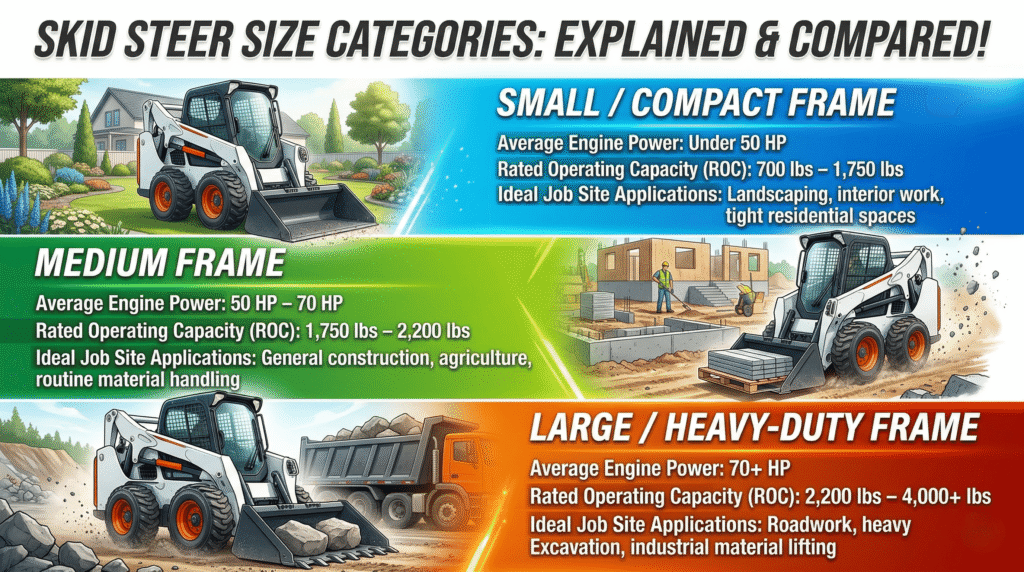
To find the right skid steer lift capacity for your job, you need to carefully look at the heaviest materials you usually work with and the limited space in your usual work areas. The market divides these machines into small, medium, and large frames, each with its own lifting power and operational footprint.
Small-frame skid steers, which usually have a ROC of less than 1,750 pounds, are the best choice for tight residential spaces, interior demolition, and complicated landscaping tasks where maneuverability is more important than raw power.
Medium-frame loaders are even better, with a ROC of 1,750 to 2,200 pounds. They are the flexible backbone of general construction, large-scale property maintenance, and agricultural work.
Large-frame skid steers are the best for the toughest jobs, like heavy highway construction, moving a lot of materials, and working in the woods for long periods of time. Their ROC ratings are well over 2,200 pounds.
When you pick the right size, you buy a little more capacity than you think you need. This creates an important buffer that keeps your equipment from overworking and lets you handle unexpected heavy loads without having to rent bigger machinery.
| Skid Steer Size Category | Average Engine Power | Rated Operating Capacity (ROC) | Ideal Job Site Applications |
| Small / Compact Frame | Under 50 HP | 700 lbs – 1,750 lbs | Landscaping, interior work, tight residential spaces |
| Medium Frame | 50 HP – 70 HP | 1,750 lbs – 2,200 lbs | General construction, agriculture, routine material handling |
| Large / Heavy-Duty Frame | 70+ HP | 2,200 lbs – 4,000+ lbs | Roadwork, heavy Excavation, industrial material lifting |
- Small-frame loaders are the most agile in tight spaces and can still lift light materials.
- Medium-frame models are the best choice because they can lift heavy things and move around on the job site as needed.
- Large-frame machines are built to have the highest skid steer lift capacity possible, so they can handle the heaviest jobs in construction and industry.
How Skid Steer Attachments Affect Payload Limits
One thing that people often forget to do when managing the lift capacity of their skid steer is to accurately figure out how much heavy, specialized attachments will affect it. To find out how much weight your machine can actually lift, you need to take away the weight of each pound of your bucket, grapple, trenching tool, or specialized scissor attachment from the Rated Operating Capacity.
If you attach a huge 600-pound forestry mulcher to a machine with a 2,500-pound ROC, for instance, your safe lifting capacity drops to only 1,900 pounds. Also, the attachment’s length and shape can move the load’s center of gravity much farther away from the machine, giving it more leverage against the chassis and making it less stable even before the weight limit is reached.
Operators need to make it a habit to check the attachment data plates, do the necessary payload math, and always be on the lookout for how different tools change the way their skid steer lifts. If you don’t pay attention to how heavy an attachment is, you can be sure to overload the hydraulic systems and cause terrible tipping accidents.
- The weight of any mounted attachment directly lowers the amount of payload you can safely lift.
- Long or heavy attachments push the center of gravity forward, which makes the risk of tipping higher and gives you more leverage.
- To find their safe, real-world lifting limits, operators must always subtract the weights of attachments from the ROC.
FAQs Skid Steer Lift Capacity
When it comes to heavy machinery specifications, it’s only natural that both new and experienced operators will have a lot of questions. To make the details of skid steer lift capacity even clearer, we’ve put together and answered the most important and frequently asked questions in the construction and landscaping fields.
These insights are meant to give you quick, reliable answers that will help you understand safe operating parameters right away. Taking care of these common worries, like figuring out exact weight limits and knowing the physical differences between tracks and tires, will make sure you get into the cab with complete confidence.
Knowing the answers to these common questions will not only make your daily work easier, but it will also help you build a reputation as a very knowledgeable and safety-conscious equipment operator.
- Quickly going over these top industry questions helps you understand the basic details of complicated heavy machinery.
- These exact answers give you useful safety tips that you can use right away on the job site.
- Learning more about load limits is a direct way to help create a culture of safety and care for equipment at work.
What is the difference between the ROC and the tipping load?
The tipping load is the heaviest weight that can make the back wheels of the machine lift off the ground, which makes it unstable. To avoid accidents, the Rated Operating Capacity (ROC) is set at 50% of the tipping load for wheeled skid steers.
How much weight can a regular skid steer lift?
A standard mid-size skid steer usually has a rated operating capacity of between 1,750 and 2,200 pounds, but this can vary a lot depending on the frame size. Heavy-duty models can easily lift more than 3,500 pounds safely.
Will adding counterweights to my skid steer make it able to lift more?
Yes, adding counterweights that the manufacturer approves of to the back of the machine can slightly raise the ROC by making it easier to balance heavy loads in the front. However, this must be done strictly according to OEM guidelines.
Do tracks or tires have a higher lifting capacity?
Compact track loaders usually have better stability on soft or uneven ground because they have a bigger ground footprint. This can make lifting easier and more stable than wheeled models in bad weather.
What does an attachment do to my lifting limit?
You need to take the attachment’s empty weight away from the machine’s ROC. You can only lift 1,600 lbs with your skid steer if your ROC is 2,000 lbs and your bucket weighs 400 lbs.
Is vertical or radial lift better for lifting heavy things?
When it comes to heavy lifting at the highest levels, like loading dump trucks, vertical lift machines are better. When it comes to low-level lifting tasks, like heavy earthmoving and grading, radial lift machines are better.
How do I get the ROC for my machine?
You can always find the exact Rated Operating Capacity on the manufacturer’s data plate, which is securely riveted inside the cab, in the operator’s manual, or on the manufacturer’s official website’s specifications page.