
Top 7 Ways on Maximizing Efficiency: How to Reduce Skid Steer Fuel Consumption!
Fuel is often the largest operating cost for fleet operators and independents. No matter if you are operating a compact TYPHON STOMP for residential landscaping or a bigger machine for a heavy construction site, learning how to reduce skid steer fuel consumption is vital to keep business profitability intact.
Simply by changing your habits when working more cleverly and taking good care of the vehicle, you can significantly decrease your hourly running cost without the help of loss of output.
Fuel management effectively not only limits the spending but it is an extension of the machine’s engine that also contributes to lowering the CO2 emissions of the environment. We have covered several ways to improve your fuel economy in this report to show your skid steer a very cost-effective and the most versatile tool keeps working.
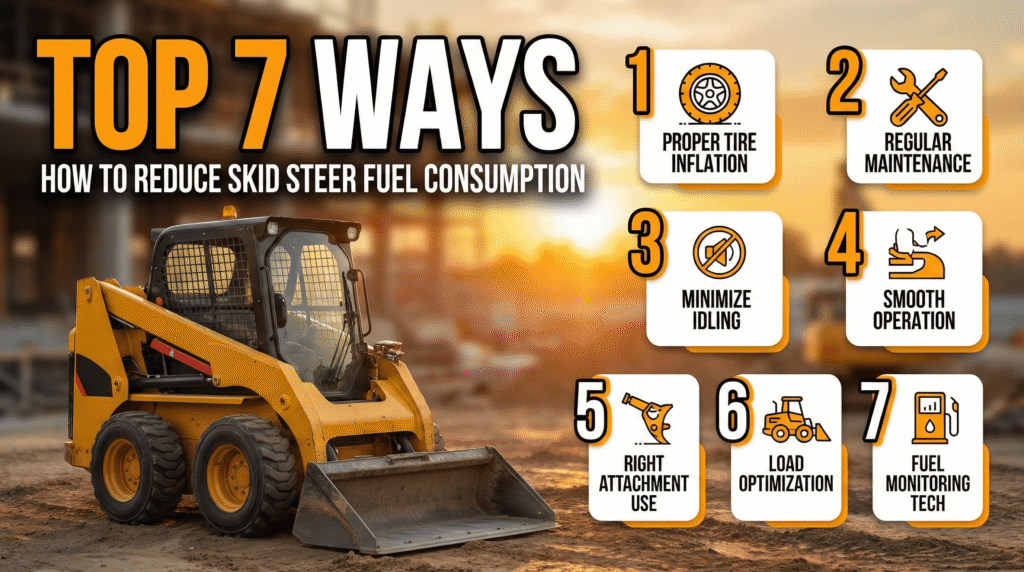
Top 7 Ways – How to Reduce Skid Steer Fuel Consumption:
1. Optimize Engine Performance Through Proper Maintenance
Among several methods, the quickest way to stop your machine from burning fuel excessively is to keep it in good running condition. An engine that is not routinely serviced struggles more to deliver output similar to that of a freshly serviced one resulting in higher fuel bill.
- Change Air Filters on Time: Dirty air filters make it hard for the engine to “breathe” and thus, more fuel is consumed in order to drive the power.
- Check Tread and Pressure on Tires and Tracks: For wheeled skid steers, low tire pressure means more rolling resistance, therefore more energy for the machine to be moved.
- Keep Fuel System Clean: Regularly use quality fuel and change fuel filters according to the manufacturer’s schedule so injectors don’t get blocked.
| Maintenance Item | Recommended Frequency | Impact on Fuel |
| Air Filter Inspection | Weekly / Daily in dusty sites | High |
| Tire/Track Tension | Weekly | Medium |
| Fuel Filter Change | Every 250-500 Hours | High |
- Stop Unnecessary Idling
Excessive idling is one of the biggest culprits for fuel waste in the construction sector. A lot of the time, operators leave running their machines when they are talking with colleagues or waiting for the delivery. One of the easiest ways of How to Reduce Skid Steer Fuel Consumption is cutting down the idling time.
- Observe the 5-Minute Rule: Switch off the motor if you are going to be stationary for more than five minutes.
- Make use of Auto-Idle Features: In case your device is fitted with modern electronics, make sure the auto-idle function is turned on to lower the RPMs when controls are not being used.
- Don’t overheat: Modern engines such as the ones found in TYPHON STOMP models do not require long warm-up periods like in the case of Honda or Briggs & Stratton units. A couple of minutes are usually adequate.
- Select the Right Attachment
The job gets done at a higher engine efficiency and with lesser fuel usage if the equipment matched the task requirements perfectly. When the machine capacity falls short of the tool that you have selected, the hydraulic system will be under maximum pressure all the time.
- Adjust Your Bucket Size: Choose a bucket size appropriate to the material density otherwise you may experience wheel slip or engine lugging.
- Keep the Cutting Edges Sharp: Whether you are using a TYPHON Skid Steer Loader Trencher Attachment or just a bucket, blades that have lost their sharpness demand exertion of more power to break the soil.
- Utilize Specific Instruments: Instead of only relying on a general-purpose bucket, handle various jobs by Lawn Scarifier or Rotary Plow to complete the work quicker and easier on the engine.
- Master Efficient Operating Techniques
It has often been observed that the operator’s consistency is the element impacting fuel usage the most. Two different operators can create a difference of 20% in the amount of fuel consumed by operating the machinery in two distinct ways.
- Don’t use the “Full Throttle” as a default: You can perform many of your tasks at 3/4 throttle. The major source of wastage is WOT (wide-open throttle) running when it is not required.
- Perform smooth joystick movements: Making jerky or quick movements with the joysticks causes pressure spikes in the hydraulic system which in return demands more power from the engine.
- Strategize Your Route: Save up on the time it takes to travel by mapping out where to dump materials or to access a trench etc thereby cutting down on your “roving” time.
- Handle Equipment Load and Weight Distribution Properly
First of all, more fuel is essential for moving heavier loads. It is, however, not only the weight of the load that matters, but also the way the load is handled.
- Drop the Load a Bit: An elevated bucket disrupts the center of gravity thus rendering the machine unstable which means more energy will be wasted in “correction” movements.
- Don’t Overcome your Wheels to Force: Rotating your wheels or tracks doesn’t mean that more dirt is shifted but your fuel is burnt and your tires wear off. Therefore, when you are losing traction, reduce the throttle.
- Stay within the Machine’s Limit: Pushing your machine over its tipping point consistently will lead to the engine operating on high-load fuel maps which are the least efficient ones.
- Track Fuel Data and Machine Health
Your fuel consumption will go up unnoticed, and you won’t know why, until you have been patient enough to take several measurements and decades of data analysis. You will be able to notice that a certain unit is not performing well simply by having a history of its fuel consumption.
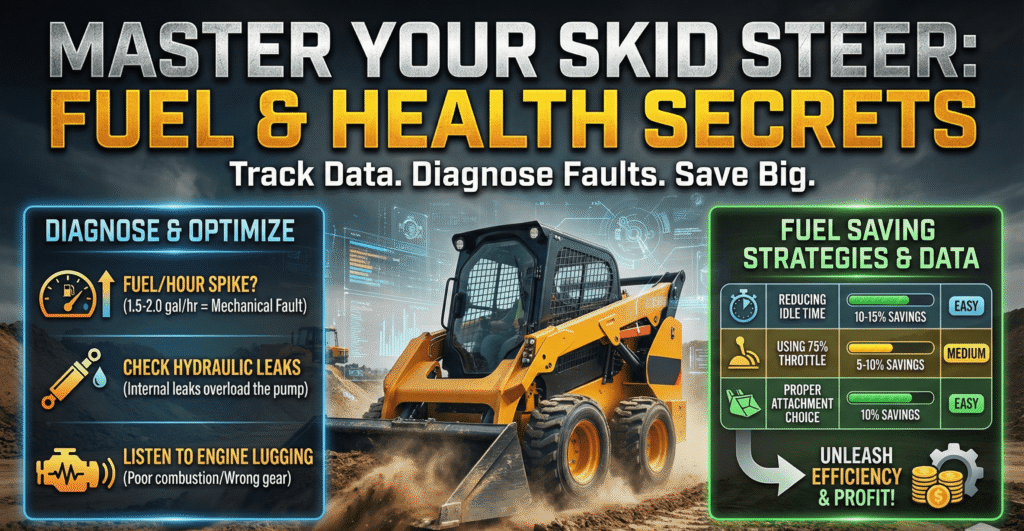
- Note consumption per hour: It is quite common that if a unit is working harder for the same output and thus burning from 1.5 to 2.0 gallons per hour, there is a mechanical fault.
- Look for leaks in the hydraulics: Besides diminutive external drops, it is quite possible that there could be a little internal leak in the hydraulic valves, which could cause the pump to work extra load.
- Listen to the engine when a lugging: If you detect a significant drop in the sound of the engine while under load, you should realize that you are pushing too hard or shifted to the wrong gear hence resulting in poor combustion.
| Operating Strategy | Fuel Saving Potential | Difficulty |
| Reducing Idle Time | 10-15% | Easy |
| Using 75% Throttle | 5-10% | Medium |
| Proper Attachment Choice | 10% | Easy |
- Environmental Considerations and Job Site Setup
Nonetheless, the job site layout can significantly influence the fuel economy in a silent way. More fuel is wasted on a poorly planned site due to the longer roads.
- Go with the gravity: You may save some energy if you will find a way to utilize the energy of falling by taking the load downhill.
- Fastest ways to drain tank: Pretend that you are a turtle when going up a hill: Going uphill too often is one of the fastest ways to drain the litre tank.
- Decrease the Terrain Resistance: Do not allow your main paths for hauling to be cluttered with garbage or rocks; make it easier for your skid steer to get around.
FAQ’s: How To Reduce Skid Steer Fuel Consumption
Can reducing the engine speed really help save fuel in a skid steer?
Definitely, by a big margin. It is a rare moment when a skid steer task requires the engine to be run at full throttle. If you can hold back the engine revs to somewhere at 75 – 80%, then you will be using almost the same hydraulic flow, but the fuel cost will be less by about 10%.
What is the normal amount of fuel a skid steer consumes in an hour?
Typically, a small to medium size skid steer consumes around 1.0 to 3.0 gallons of diesel per hour which mainly depends on the load. Units such as the TYPHON STOMP series are generally very efficient and may even consume only about 1 gallon of diesel per hour during light landscaping tasks.
Will my fuel consumption go up if my hydraulic oil gets dirty?
Yes, it definitely will. When the hydraulic oil gets dirty or is old then internal friction and heat rise. This leads to the hydraulic pump having to work harder which means that the engine will have to give out more power which in turn leads to more fuel being consumed.
If I stop, should I leave the skid steer engine idling, or should I turn it off?
If your stoppage is going to last for more than 2 to 3 minutes then it is generally considered that turning off the engine would be more fuel-efficient. Modern starters and batteries are designed for frequent cycles, and the fuel saved from not idling far outweighs the fuel used to restart.
How do attachments have an impact on fuel consumption?
Heavy or high-flow attachments (like cold planers or large brush cutters) require significant hydraulic horsepower, which increases fuel demand. The use of an attachment that is too big for the machine will result in the engine “lugging,” which means that your fuel efficiency will be poor.
Can the pressure in tires really affect the amount of fuel I will be consuming?
Surely it does. When tires are flat, the “footprint” and kinetic resistance of the vehicle will increase. The engine will be required to produce more torque just to overcome the friction of the machine moving over the ground. This, in turn, will lead to fuel being wasted unnecessarily.
Does fuel economy depend on the machine’s age?
Generally, old machines do not have the features of electronic fuel injection and advanced hydraulic sensing that are present in the newer models. While older machines are reliable, getting a modern machine like the TYPHON series means that you get to enjoy the latest technologies that help save fuel.
A Verdict on How to Reduce the Fuel Consumption of a Skid Steer
Figuring out How to Reduce Skid Steer Fuel Consumption is really about proper maintenance, healthy work habits, and the right choice of tools for the job. You will be able to get at the highest performance of your skid steer without excessive fuel consumption by following the tips we proposed i.e. limiting idle time, keeping your air filter in good condition, and choosing the best-suited attachments.
And if you are after a great combination of versatile and efficient, the TYPHON STOMP series is a powerful compact without a fuel-heavy conscience, the perfect companion for any job site.