
The Complete Guide to Mini Track Loaders: The Small Machine with the Big Impact
If you have spent any time on a modern job site, you have probably noticed a shift. The massive, roaring yellow iron is still there for the big digs, but for everything else? The machines are shrinking.
Enter the Mini Track Loader (MTL).
You might know it as a “mini skid steer,” a “stand-on loader,” or simply by the brand names that made it famous, like “Dingo” or “Bobcat.” Whatever you call it, this compact powerhouse has quietly become the most essential tool for landscapers, arborists, fence builders, and utility contractors.
But why the sudden takeover? And if you are thinking about adding one to your fleet (or renting one for the weekend), how do you know which one to choose?
In this 1,800-word guide, we are going to strip away the brochure-talk and get down to the dirt. We’ll cover what these machines are, why they are worth the investment, how to operate them safely, and how to pick the right model without suffering buyer’s remorse.
What is a Mini Track Loader and Why Do You Need One?
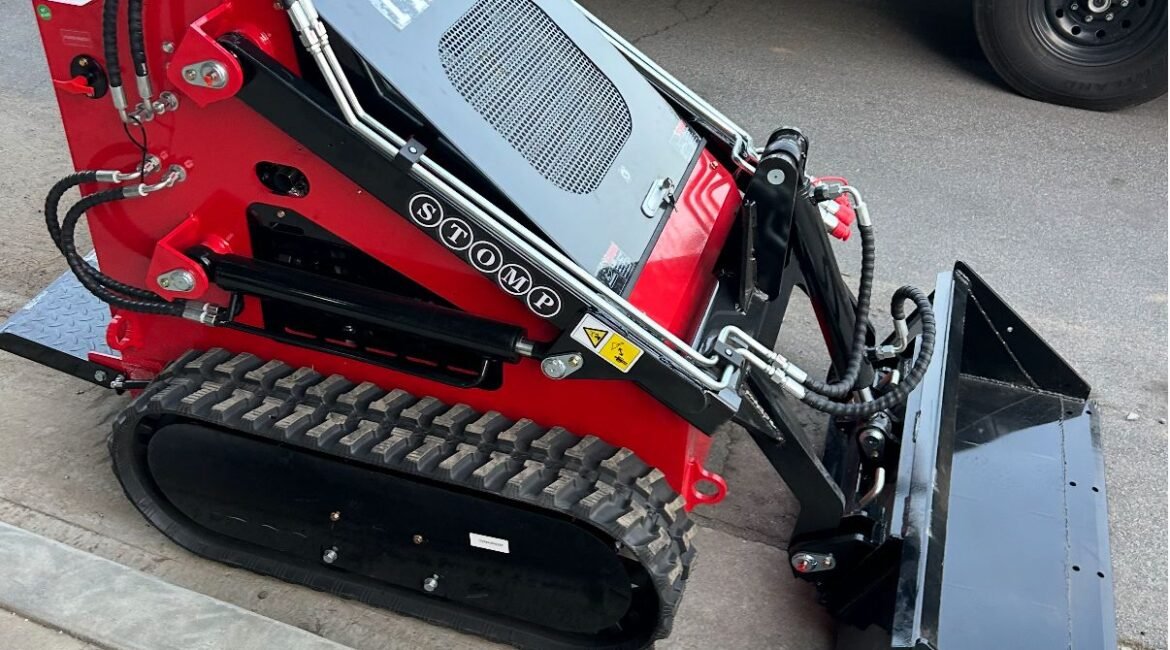
At its core, a mini track loader is a compact utility machine that rides on rubber tracks. Unlike a standard skid steer where you sit inside a cab, the operator of an MTL stands on a platform at the rear (or walks behind it, in older models).
It sounds simple, but the design solves a very specific, very annoying problem in the construction world: The Narrow Gate Problem.
The Backyard Access Revolution
For decades, if a homeowner wanted a pool dug, a patio laid, or a tree removed in their fenced-in backyard, contractors had two bad options:
-
Tear down the fence: This costs time, money, and risks damaging the property.
-
The “Wheelbarrow Parade”: Hire three guys to manually haul tons of material back and forth. It’s slow, it kills morale, and it leads to injuries.
The Mini Track Loader changed the math. Most models are designed to be between 34 and 42 inches wide. They slip right through a standard pedestrian gate, bringing hydraulic lifting power directly to the work zone without removing a single fence picket.
Tracks vs. Wheels: The Turf War
Why tracks? Why not just use a small wheeled loader? It comes down to Ground Pressure.
-
Wheels: Point-load the weight. On wet grass or soft soil, tires leave ruts. If you turn sharply, you tear up the turf.
-
Tracks: Disperse the weight. An MTL often exerts only 4 to 6 PSI (pounds per square inch) on the ground. That is lighter than a human footstep. You can drive a 3,000-lb machine over a client’s lawn and, with careful driving, leave it looking untouched.
The ROI Calculation “Making the Math Work”
This is the part that matters most to business owners. These machines aren’t cheap—new models can range from $30,000 to $55,000. So, how does it pay for itself?
1. Labor Substitution
Let’s look at a real-world scenario: Moving 10 yards of mulch.
-
Manual Crew: Two laborers with wheelbarrows might take 4–5 hours to move and spread that pile. They will be exhausted afterwards, meaning the rest of the day is slower.
-
Mini Track Loader: One operator can move that same pile in 45 minutes. The machine doesn’t get tired, it doesn’t need a water break, and it doesn’t hurt its back.
The Bottom Line: The machine replaces the grunt work of 2-3 laborers. In a labor market where good help is hard to find, the MTL is the employee that shows up every day.
2. Speed of Completion
If you finish a 2-day patio prep in 1 day because of the machine, you can fit more jobs into your month. More jobs = more revenue. The “velocity” of your business increases.
3. Versatility (The Swiss Army Knife Factor)
An MTL isn’t just a bucket. It uses a universal mounting plate (often called the CII or Mini-Bobtach) that lets you swap tools in seconds.
-
The Auger: Digs fence posts in rocky soil in minutes.
-
The Trencher: Buries irrigation lines 24″ deep effortlessly.
-
The Grapple: The ultimate tool for tree guys. It grabs brush, logs, and debris like a giant robotic hand.
-
The Soil Conditioner (Harley Rake): Turns a lumpy, rocky yard into a perfect seedbed in one pass.
The Big Three Specs You Must Check
When you walk into the dealership, the salesperson will throw a lot of numbers at you. Ignore the fluff. Focus on these three specs.
1. Rated Operating Capacity (ROC)
This is the most critical number. It tells you how much weight the machine can lift safely (usually 35% of the tipping load).
-
Small (approx. 500 lbs): Good for mulch, light soil, and DIY projects.
-
Medium (approx. 800 lbs): The sweet spot for most landscapers.
-
Large (1,000 lbs+): Essential if you move pallets of sod, pavers, or wet concrete. Pro Tip: If you work with hardscaping pallets, verify the machine can actually lift them. Many “1,000 lb” machines struggle with a heavy pallet of pavers.
2. Hinge Pin Height
This is the maximum height the bucket pivot point reaches. Why does it matter? Dumpsters and Trucks. If you are loading debris into a high-sided dump truck or a roll-off dumpster, you need a machine that can reach over the side. Look for a hinge pin height of 80 inches or more. If it’s too short, you’ll be building dirt ramps just to load your truck.
3. Control Style (Try Before You Buy)
Manufacturers use different control schemes, and this is highly personal.
-
Joystick (ISO): One hand drives, one hand operates the loader arm. (Common on newer Kubotas and Bobcats). Very intuitive, like a video game.
-
Dual Lever (Tank Style): Two levers to drive (left/right tracks). (Common on older Bobcats).
-
T-Handle: A unique bar that you tilt to drive. (Classic Toro Dingo style).
-
The Advice: Do not buy a machine from a brochure. Stand on it. Drive it. If the controls feel awkward in the parking lot, they will feel miserable after 8 hours on a job site.
Operating Like a Pro (Safety & Efficiency)
Driving an MTL looks easy, but it has a learning curve. Because you are standing on the back, you are part of the machine’s physics. Here is how to stay safe and efficient.
The “Catapult Effect”
This is the #1 danger. Because the machine has a short wheelbase, it tends to “hobby horse” or rock back and forth over bumps.
-
The Risk: If you are driving fast and hit a hidden root, the machine stops instantly, but your body keeps moving forward. Operators have been thrown over the handlebars.
-
The Fix: Keep your knees bent (you are the suspension). Keep the bucket low to the ground while traveling to keep the center of gravity stable. And simply slow down on uneven terrain.
Slope Safety
MTLs are narrow. That means they can tip sideways easier than a wide skid steer.
-
Rule 1: Always travel straight up and down slopes, not across them.
-
Rule 2: Keep the heavy end uphill. If the bucket is full, drive forward up the hill and back down the hill.
Hydraulic Hygiene
The hydraulic system is the veins of your machine. Dirt is the cholesterol that kills it.
-
The Habit: Before you connect an attachment hoses, wipe the couplers clean. Every single time. One grain of gritty sand forced into the hydraulic pump can cause thousands of dollars in damage. Keep a rag in your pocket—it’s the cheapest insurance you can buy.
Maintenance Realities
You bought it. Now you have to keep it alive. Mini track loaders live in the dirt, so maintenance is non-negotiable.
Daily: The “Walk-Around”
-
Check the Air Filter: These machines sit low, right in the dust cloud. The air filters clog fast. Tap it out daily; replace it often.
-
Clean the Radiator: If the machine overheats, 90% of the time it’s because the radiator screen is plugged with dandelion fluff or mulch dust. Blow it out with compressed air.
-
Grease the Pivots: The loader arms have grease zerks. Give them a pump or two. If they sound squeaky, you are grinding metal on metal.
Weekly: Track Tension
Rubber tracks stretch as they break in.
-
The Danger: If a track is too loose, it will “de-track” (pop off the rollers) when you turn. Putting a track back on in the mud is a nightmare scenario that involves pry bars, sweat, and swearing.
-
The Fix: Check the tension weekly. Tighten it to the manufacturer’s spec (usually allowing for about 1 inch of sag).
The Major Players (Brand Breakdown)
Who makes the best one? It depends on what you value.
1. TYPHON Machinery (The Value Disruptor)
TYPHON has shaken up the market by offering pro-level specs without the massive dealer markup. They are becoming a favorite for owner-operators who want the component quality of the big boys but have a tighter budget.
-
The Star Model: The TYPHON STOMP 509.
-
Why it Wins: It runs on a Kubota D1105 Diesel engine—the exact same engine found in machines that cost twice as much. It boasts an 840lb Rated Operating Capacity and fits through tight 42-inch gates.
-
The “Human” Take: If you want a machine that uses industry-standard parts (like Kubota engines and Eaton hydraulics) but you don’t want to pay for the fancy dealership lobby, TYPHON is the smart money choice.
2. Toro Dingo (The OG) Toro practically invented this category.
-
Pros: Incredible dealer support, massive range of attachments, very user-friendly controls (especially the TX1000).
-
Cons: Some models can be pricey.
3. Bobcat (The Heavyweight)
-
Pros: The MT100 is a current market favorite. It has huge lift capacity for its size and requires no DEF fluid. The parts network is everywhere.
-
Cons: The ride can be a bit rougher than others on bumpy terrain.
4. Kubota (The Comfort King)
-
Pros: The SCL1000 is known for comfort. It has a cushioned ride plate and a very quiet, smooth engine. It feels like the “luxury car” of the MTL world.
-
Cons: It’s slightly wider than some competitors, so measure your gates carefully.
5. Vermeer (The Tree Guy’s Choice)
-
Pros: Built like tanks. Very high hinge pins on some models, making them great for loading chipper trucks. Rugged and simple.
-
Cons: The controls can feel “heavy” to some operators compared to the joystick ease of Kubota.
Conclusion: The Future is Compact
The construction industry is trending smaller. Backyards are getting tighter, labor is getting more expensive, and efficiency is the only way to survive.
The Mini Track Loader isn’t just a trend; it’s a solution. It allows a two-person crew to do the work of a five-person crew. It turns a back-breaking weekend project into a fun Saturday morning.
Whether you are a seasoned contractor looking to boost productivity or a homeowner with a mountain of mulch to move, the MTL is likely the answer. Just remember: measure your gate, respect the slopes, and keep those grease fittings lube. Do that, and this little machine will be the biggest asset you own.