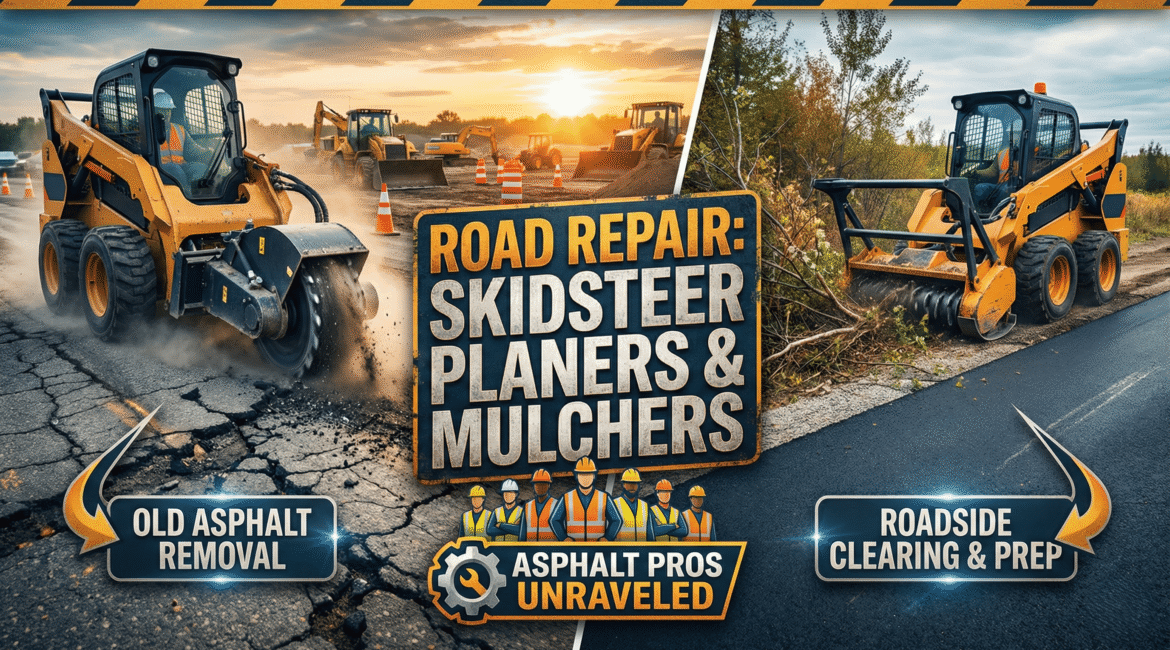
Road Repair with Skid Steer Planers and Mulchers: Asphalt Pros Unraveled
Efficiency in maintenance tools is the main factor that keeps our infrastructure reliable. In fact, a modern road repair contractor will rarely rely on huge and heavy paving trains just for the few local repairs. Instead of such traditional methods, the industry has turned to the highly maneuverable TYPHON STOMP skid steer planers and mulchers line of compact machines coupled with the use of specialized attachments.
The use of skid steers planers and mulchers in road repair has set a new standard that is recognized and accepted by both municipalities and private contractors who seek high accuracy, low cost, and fast execution.
By combining among each other a high performance cold planer and a highly maneuverable mulching head, asphalt professionals can satisfactorily resolve any issue from the patching a pothole on the road surface through to cutting the overgrown roadside shoulders all by a single unit of the power source.
The switch from traditional to using skid steers in asphalt work mainly contributes to the demand for a vehicle that is easy to maneuver. In a restricted urban setting or in a small country road, bringing in a giant milling machine would not only be an overkill but, in many cases, it would be almost impossible from a logistic point of view.
This is exactly where the skid steer cold planer would do the trick—stripping out layers of damaged asphalt in such a way that a clean textured base is created ready for new bonding. At the same time, having mulchers in the road repair fleet helps make sure that the surrounding environment is also taken care of by preventing root intrusion and improving line-of-sight for drivers, among others.
The Power of Precision: Skid Steer Cold Planers in Asphalt Repair
Cold planers, also known as “milling attachments,” are the backbone of the asphalt industry. When these tools are installed on a high-flow skid steer like the ones available at Skidsteer.Online, they employ a turning drum fitted with carbide-tipped bits to mill the surface of the road.
This process is highly necessary in that it gives the possibility of removing the raising, rutting, and “shoving” of the asphalt without totally digging up the pavement. It is kind of a precision operation of road maintenance that brings significant savings in terms of materials.
- Depth Control: Innovative planers are equipped with independent left and right depth adjustments so that the operator is able to level the surface to the grade of the existing road without any problem.
- Surface Preparation: The gritty characteristic of the surface left behind by a skid steer planer effectively makes a large surface area “key” which is the main cause of new hot-mix asphalt being able to bond very tightly thus the delamination cannot happen in future.
- Debris Management: Several planers are capable of piling the milled material in such a manner that collecting it is made very easy and it may be recycled as Reclaimed Asphalt Pavement (RAP).
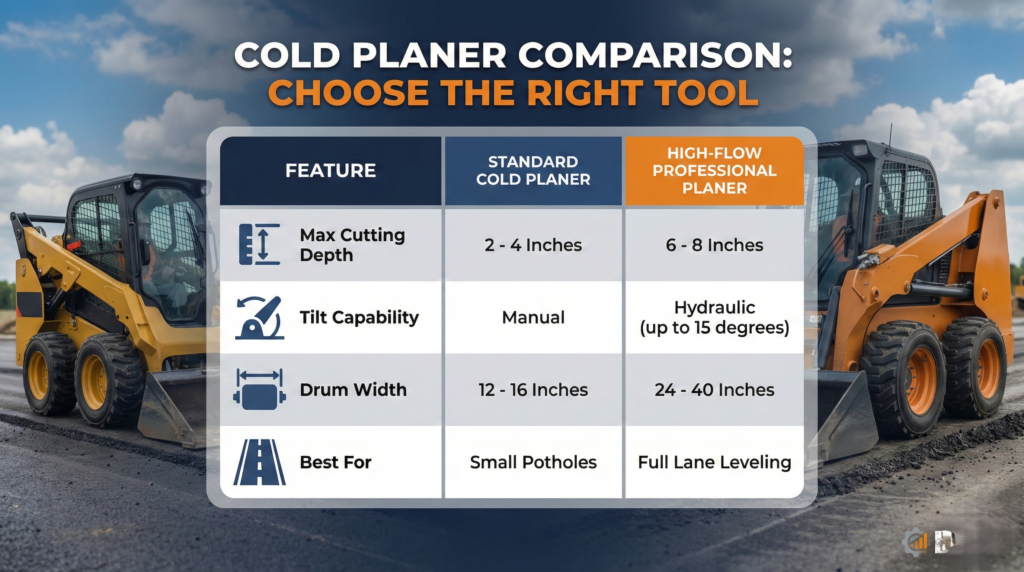
| Feature | Standard Cold Planer | High-Flow Professional Planer |
| Max Cutting Depth | 2 – 4 Inches | 6 – 8 Inches |
| Tilt Capability | Manual | Hydraulic (up to 15 degrees) |
| Drum Width | 12 – 16 Inches | 24 – 40 Inches |
| Best For | Small Potholes | Full Lane Leveling |
Integrating Mulchers for Comprehensive Roadside Maintenance
The asphalt top layer is undoubtedly a major element of road repair, but the surrounding area should not be neglected either. Road repair with skid steer planers and mulchers is based on a sound understanding of the clear zone concept.
If vegetation grows too thick, it will keep the moisture from drying at the road edge and thus cause the shoulder to fail quicker and the asphalt to crumble. Using a mulching attachment of heavy-duty type, a contractor can get rid of the brush and small trees and also even the roots of the invasive species that threaten the pavement structurally.
- Shoulder Stabilization: Elimination of deep-rooted woody plants helps in preventing the so- called “jacking” where roots lift the edge of the asphalt.
- Drainage Improvement: Mulchers remove the obstacles in the swales and ditches so that the water can be drained properly and thus the potholes are avoided.
- Safety Clearances: The operating speed of a mulcher is very high so clearing sightlines at intersections and curves can be done very quickly, which is one of the main requirements of the road safety contracts.
The Asphalt Pro’s Workflow: A Step-by-Step Guide
Going for a professional level finish means sticking to a systematic workflow. The Asphalt Pros method basically refers to the three-stage process of cleaning, milling, and filling. An operator having at his disposal the flexible TYPHON STOMP can smoothly and effortlessly go from one assignment to the next simply by changing the tool through the use of a universal quick-attach system.
This is the reason why the skid steer has been able to eliminate on the site the need for numerous specialized machines.
- Initial Clearing: With a mulcher or a sweeper attachment clear away vegetation and loose debris in the area that is to be repaired.
- Milling the Section: Drop down the cold planer and grind off the top of the damaged asphalt until a uniform depth is achieved so that even the cracks are totally “milled out.”
- Edge Cutting: Employ the accuracy feature of a skid steer to cut out vertical edges on the patch which will prevent the newly laid asphalt from featheredging and breaking off.
Why TYPHON STOMP is the Preferred Choice for Road Repair
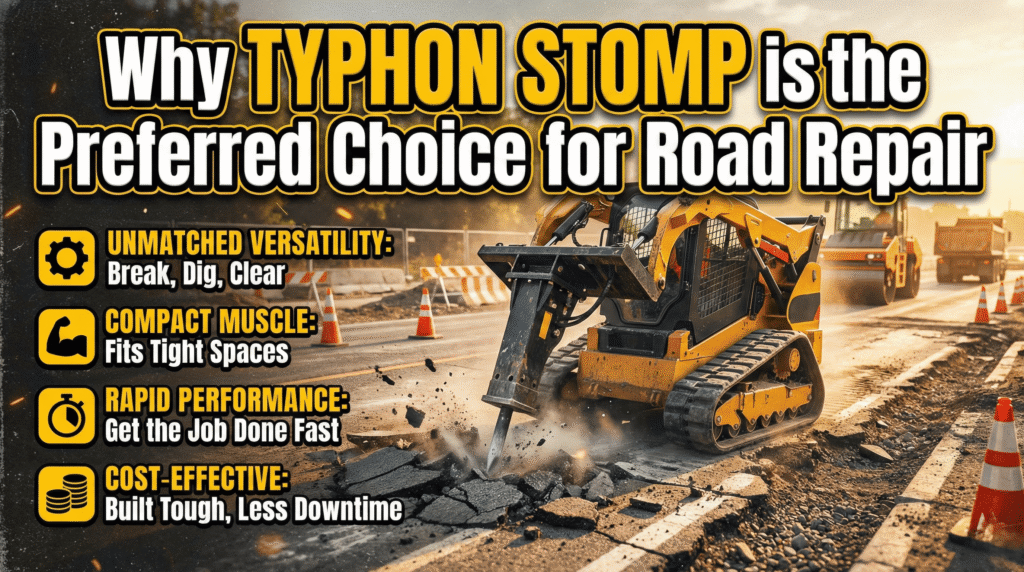
Our machinery at Skidsteer.Online is purposely designed to be rugged for construction work kind of environment. Since road repair generates a high level of vibration and heat, it is essential to have a robust chassis and a cooling system capable of handling high-flow hydraulics without being turned off due to overheating.
The TYPHON STOMP series has enough hydraulic horsepower (GPM) to run very large diameter planers even without stalling, thus your production rates will not drop.
- Engine Reliability: We have installed only top-level machines like Honda and Briggs & Stratton in our loaders that can provide steady torque during the dense asphalt grinding.
- Compact Maneuverability: You can count on our mini skid steers to do their operation within a single traffic lane, thus in most cases, it will be unnecessary to close down the traffic flow completely and put in place detours.
- Attachment Versatility: Planers and mulchers are just two examples among many such as sweepers, trenchers, and hammers which we offer and are compatible with our units thus essentially turning them into a Swiss-army knife of road workers.
Cost-Benefit Analysis of Skid Steer Road Repair
The idea of road repair is a different one nowadays as it involves smaller and more efficient crews. Before, a road repair project would have required a backhoe, a dump truck, a hand-crew with jackhammers, and so on, while now a single operator can perform the work of four men in half the time if the road repair is done with skid steer planers and mulchers.
Such a drop in labor and overhead results in a direct increase in the profit margin of the contractor.
- Reduced Material Waste: Planer-assisted removal means you only take away the broken part, hence the amount of new asphalt for filling is less.
- Lower Transport Costs: A skid steer loader together with its tools can be carried on a single trailer whereas heavy milling machines require special permits for oversized loads.
- Increased Job Speed: The fact that you can remove, sweep, and prepare a site for the next day’s work all in one afternoon, means that the paving crew can come right after you and complete the task within a single shift.
Safety and Maintenance Tips for Asphalt Attachments
Working on asphalt with heavy equipment necessitates observing a number of safety measures. Since cold planers produce flying particles at a very high rate of speed the use of a polycarbonate “shatterproof” door on the skid steer is compulsory. Moreover, the carbide bits on the planer and the blades on the mulcher are consumable parts that must be checked every day to make sure the machine is running at its peak and to avoid wasting fuel.
- Tooth Inspection: The operator should be looking for any broken or dull carbide tips and replace them if necessary every 4 hours of functioning; a tooth that is dull will cause the machine to burn more fuel and it puts a lot of unnecessary stress on the hydraulic system.
- Hydraulic Heat Management: This should be done by cleaning the cooling radiator of the skid steer free from the accumulation of asphalt dust which can clog the radiator’s fins and thus lead to overheating of the hydraulic system.
- Operator Training: Operators have to be taught what is meant by “ground speed vs. drum speed” so that they do not stall the attachment in deep cuts.
Frequently Asked Questions (FAQ) – Road Repair with Skid steer Planers and Mulchers
Can a skid steer cold planer cut through concrete?
You will find that the large majority of professional-grade cold planers that are fitted with carbide teeth can mill concrete even though the wear on the teeth will be more than double compared to when you mill asphalt. It is very useful for dealing with sidewalk heaves or bridge decks that need to be leveled.
How deep can a skid steer planer go in one pass?
A typical high-flow skid steer planer is capable of cutting a depth ranging from 0 to 8 inches. However, in order to get the best finish and at the same time preserve the life of the attachment most, professionals take multiple passes of 2-3 inches each time.
Do I need high-flow hydraulics to run a mulcher or planer?
There are some very small planers that will operate on the standard flow but for any road repair work where a mulcher and planer are to be run, high-flow hydraulics (25-40 GPM) will be strongly recommended. The reason is that high flow can supply the torque required to keep the drum turning fast when it is heavily laden.
What happens to the old asphalt that is milled up?
The material that is milled up, which goes by the name of RAP (Reclaimed Asphalt Pavement), is fully recyclable. It can be used as a base fill for new roads or it can be transported to an asphalt plant to be recycled into new hot-mix.
How does a mulcher help with road longevity?
Without a mulcher on your side, roots would grow under the pavement and drain water would have a hard time getting away, both of these factors leading to cracks in the asphalt. So by clearing vegetation from the roadside, the mulcher not only prevents the roots from growing but also helps the water drainage, thereby increasing the road longevity.
Is it better to drum mulch or disc mulch for road shoulders?
For road repair and roadside maintenance, drum mulchers are generally preferred as they produce a finer mulch and offer better control in confined spaces near traffic.
Can I use a mini skid steer for road repair?
Of course, yes. The TYPHON STOMP mini skid steers are specifically designed for small-scale road repairs, patching, and utility work where a full-sized loader would be too wide or heavy.