

How You Can Safely and Legally Transport a Skid Steer Loader
Transport a skid steer loader safely is an important operation that combines several factors including knowledge of the mechanics, following safety protocols strictly, and a good grasp of the legal rules governing this type of activity.
Transport a skid steer loader or any other machine from one site to another or even taking it back to a rental place is not just a matter of driving the equipment onto a trailer. Transporting it wrongly may result in serious accidents, large fines, and damage to the equipment and the transport vehicle.
A properly executed step (from choosing the correct trailer to securing the last tie-down) is the difference between an amateur and a professional operator.
Points to Remember to Transport a Skid Steer Loader Safely and Legally
First and foremost, before choosing to transport a skid steer loader, remember that a skid steer is a heavy, compact piece of equipment with a specific balance point. Unlike a regular vehicle, the weight of a skid steer can change drastically depending on what attachments or tools are fixed at any given time.
That is why safety begins with proper preparation, which basically means carrying out a thorough inspection of your transportation vehicle and knowing the maximum weight your truck and trailer can handle.
By loading and securing in accordance with the standard operating procedures, you will both reduce the likelihood of accidents and guarantee that your activities are in line with the Department of Transportation (DOT) requirements.
Choosing the Right Vehicle and Trailer to Transport a Skid Steer Loader Safely
Safe transport starts on the ground with picking a vehicle and trailer that can handle the load easily. You have to add up the weight of the skid steer, its attachments, and any fuel or additional tools being moved.
Going over the Gross Vehicle Weight Rating (GVWR) of your trailer is not only against the law but also very hazardous as it can cause the brakes to fail or the trailer to collapse while in transit.
- Confirm the Weight Capacities: In order to ascertain that the payload capacity of your truck and trailer is sufficient for the weight of the skid steer, do not only rely on the visual inspection but consult the data plates as well.
- Assess Deck Condition: Apart from looking for signs of deterioration like rotting or cracking, a well-maintained deck is one that is clean of oil, mud and other debris which can make the surface slippery and result in an accident during loading.
- Evaluate Tire Pressure: If tires of both the towing unit and trailer are inflated to the recommended levels, this will go a long way towards ensuring vehicle stability and will also help in preventing blowouts even when heavy loads are being carried.
Table:
| Trailer Type | Typical Capacity | Best For |
| Flatbed Trailer | 7,000 – 14,000 lbs | Standard Skid Steer Models |
| Tilt-Deck Trailer | 10,000 – 16,000 lbs | Easy Loading without Ramps |
| Lowboy Trailer | 20,000+ lbs | Large Compact Track Loaders |
Preparation to Transport a Skid Steer Loader
Get the machine ready for the trip way ahead of time. When you prepare your skid steer for transport, you start with a clean unit as that helps prevent spreading debris onto the highway.
Besides, you will also want to secure skid steer attachments so that your skid steer is balanced during transport. Apart from that, spotting issues like hydraulic leaks and minor structural damages which may get worsened by the vibrations of travel is made easier by a clean machine.
- Clean the Chassis: Apart from general cleaning, special attention should be directed to the parts of the machine that come in contact with the ground like the tracks or tires and the bucket or other implements in order to avoid these becoming hazards on the road.
- Secure Attachments: Detach and transport separately, if possible, while lowering and securing on the trailer deck are the main ways to deal with attachments staying put during transit.
- Center the Load: Try to load the skid steer in such a way that about 60% of the weight. will be ahead of the trailer axle so as to achieve the right tongue weight.
Safe Loading Procedures and Ramp Safety
Loading is a stage to transport a skid steer loader which carries more risk than others. A significant number of accidents relate to a machine slipping out of the ramp or a trailer tipping due to lack of support.
It is recommended to have a spotter who will assist in guiding the operator and checking the alignment of the tires or tracks with the ramps. The best approach is to be consistent and go slow doing only what is absolutely necessary without any sudden movements.
- Drive On Low Speed: Switching to the lowest speed range and/or throttle control ensures the smoothest ride and makes it possible to prevent sudden jerks on the way up the ramps.
- Use the Three-Points Contact Method: It is a good habit to maintain three points of contact with the machine (handholds and the step) at all times during in and out of the cab movements.
- Support the Rear: Place the jack stands or blocks beneath the rear of the trailer to avoid the “teeter-totter” effect, which is the rear wheels of the truck getting lifted off the ground.
Securing the Machine: Tie-Down Requirements
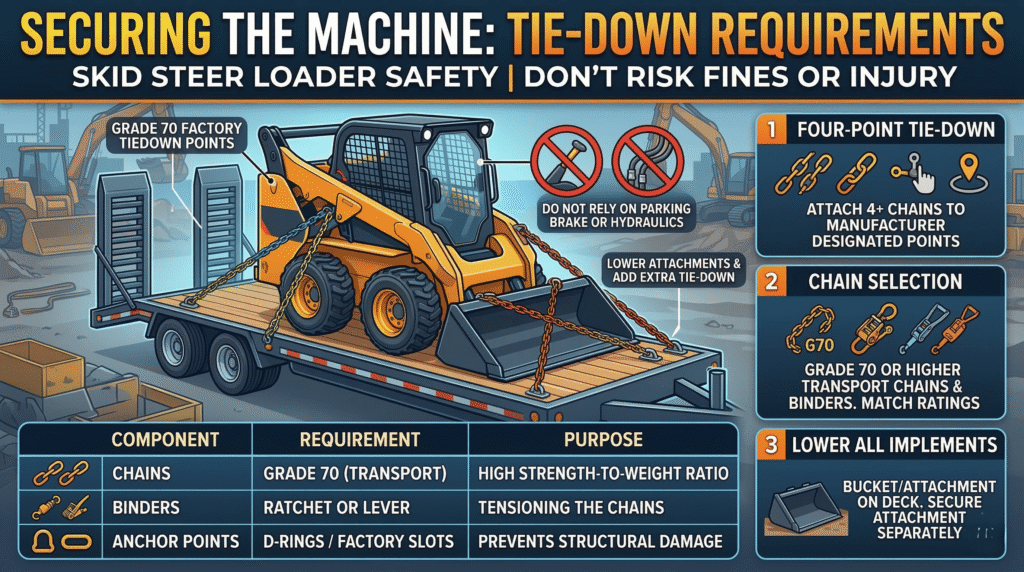
Still on the trailer, a skid steer loader must be completely immobilized. In terms of safety, you must not depend on the equipment’s parking brake or its hydraulic system to hold it in place. To quote the regulations, operation with the wrong type of chains and binders is not only unsafe but illegal as well.
-
- Four-Point Tie-Down: Achieve this by attaching at least four separate tie-downs (chains) to the connecting points designated by the skid steer’s manufacturer.
- Chain Selection: Make sure you are dealing with Grade 70 or higher transport chains and binders which have weight ratings matching those of the machines.
- Lower All Implements: The bucket or attachment should be placed on the floor or the deck, and then an additional tie-down used to secure the attachment.
| Component | Requirement | Purpose |
| Chains | Grade 70 (Transport) | High strength-to-weight ratio |
| Binders | Ratchet or Lever | Tensioning the chains |
| Anchor Points | D-Rings / Factory Slots | Prevents structural damage |
Legal Compliance and Road Safety
The mindset will have to be modified when heavy loads are involved. Height clearances, wider turning radiuses, and substantially longer braking distances, all have to be taken into account.
Also, legally, the load has to be within the width restrictions, which is usually 8.5 feet without a special permit. Compliance keeps you from going through the costly process of dealing with the DOT after they intervene and it also makes the roads safer for the rest of the public.
- Size Limits: The general rule to avoid overhead obstruction is not to exceed a loaded trailer height of 13 feet 6 inches.
- Make Safety Stops for Chain Re-tightening: The rig shifting during transport means the chains can slacken, so the first stop after the change of driver is most appropriate to do the chain adjustment.
- Check Your Vehicle Lights: Apart from the rear red ones, looking over the trailer’s running lights and side marker lamps is essential for laying out a fully functional lighting system.
Essential Equipment Maintenance Post-Transport
Upon arrival, one should not just unload and leave it at that. It is very important to look over the machine and the transport equipment to ensure that nothing has become loose due to vibrations and shocks of the road.
While the tightening of any loose bolts or pins may be that simple, the minor hydraulic seeps becoming major leaks may necessitate the immediate bringing of the skid steer in for servicing maintenance.
- Check Tie-Down Gear: Look for visible signs of wear or damage that may have occurred during the transport such as bent or cracked links in chains or damage to binders.
- Inspect Fluid Levels: Most important fluids in the system are engine oil, transmission oil, and hydraulic oil.
- Record the Transport: Keeping a proper record is necessary for both maintenance and compliance purposes, especially when you have noted the issues during the trip.
In Conclusion:
To conclude, the safe and legal transport of a skid steer loader is not just a matter of convenience; it is a critical aspect of protecting your investment and ensuring the safety of yourself and others. By following the recommended regulations and best practices, you can minimize risks and contribute to a smoother transportation process.
Always prioritize the proper loading techniques and vehicle preparation, as these factors greatly influence your travel experience. It’s also wise to stay informed about any changes in local laws that may affect how you transport heavy equipment. Don’t wait until the last minute; start organizing your transport strategy today to ensure safe and compliant operations!
Frequently Asked Questions (FAQ) – How to Transport a Skid Steer Loader Safely?
Do I need a CDL to transport a skid steer?
In general, if the total weight of the truck and trailer combination is 26,001 pounds or more, then a CDL is a must. State laws may be different, so make sure you check first.
How many chains are required to secure a skid steer?
Depending on the weight (over 10,000 lbs., the rule is a minimum of four independent tie-downs. Besides, any projections like buckets or backhoes have to be locked down with an extra chain.
Can I use nylon straps instead of chains?
Chains are a much better choice for heavy and bulky machinery like the skid steer, especially given their sharp metal edges, which could easily cut through a synthetic webbing if the load shifts.
What is the best way to distribute weight on the trailer?
One basic way is to follow the 60/40 ratio. Allocating 60% of the load’s weight may be ahead of the trailer’s center axle. This will make sure that there is sufficient tongue weight on the towing vehicle which will make swaying less likely even at high speeds.
How often should I check my load during transport?
After the first 50 miles, federal law expects a driver to make an inspection of the cargo. The follow-up checks are a great idea as part of regular practice and should be done approximately every 150 miles or every 3 hours of driving.
Do I need “Oversize Load” signs for a skid steer?
Since most skid steers fit comfortably within the 8.5 feet width limitation, this is not something you are going to have to worry about very often. Only machines/attachments that exceed this width will require an over-width permit and accompanying “Oversize Load” banners.
Should the skid steer face forward or backward on the trailer?
The heaviest part (usually engine and rear) of the skid steer is over trailer axles if you load the machine facing forward. This is why the majority of users like this way. However, the most important job factor is to figure out the tongue weight for your specific truck and trailer combo.