
Top 6 Tips on How to Spot a Bad Used Skid Steer Before Buying
Going for a used skid steer can be a great way for a contractor or a property owner to save money—only if you choose smartly. On the other hand, the second-hand market is teeming with “lemon” machines that are shiny and attractive on the outside but secretly are riddled with serious mechanical problems. Hence, it is necessary to understand how to spot a bad used skid steer before buying.
At SkidSteer.online, we think that the only way to protect your investment is to be equipped with the right knowledge.
In this detailed article, we are going to reveal to you the main warning signs that will show you a bad used skid steer, what points you should be checking during an inspection and which items are absolute no-go’s. If you carry out a check like this one, you will be safe from the “money pit” and will get a dependable machine for your fleet.
Top 6 Tips on How to Spot a Bad Used Skid Steer Before Buying
1. The Exterior: More Than Just A Few Scratches
The outside body of a skid steer is like a book that tells the story about its past. Sure, a few marks are to be expected on any construction equipment but, in case of some issues, you just can’t give in to the temptation which is why they are called non-negotiable red flags.
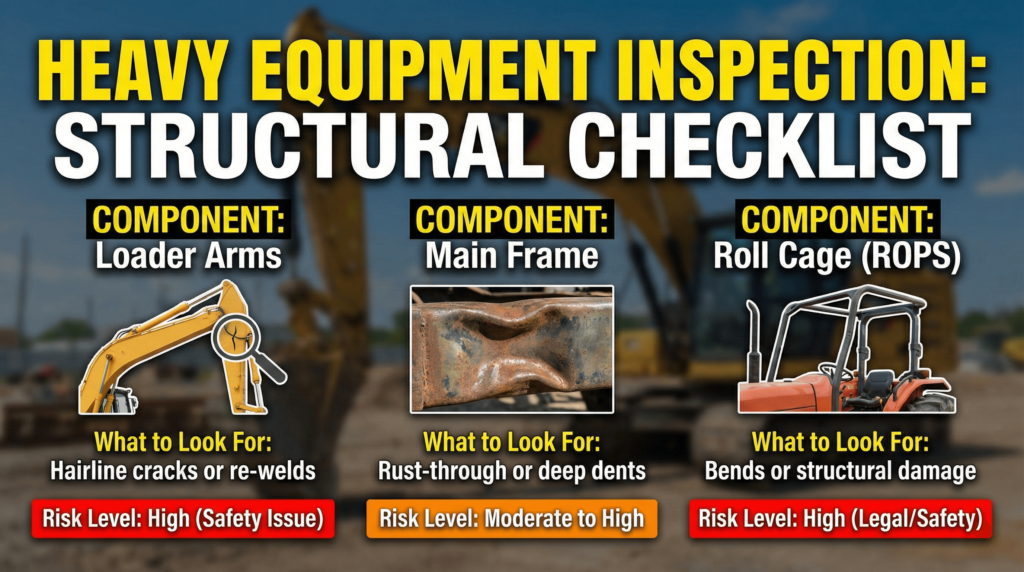
- Look for Stress Cracks and Welds: Check especially the loader arms and the main frame for cracks and welds: A fresh weld or a hairline crack most definitely means that the skid steer has been pushed to its limits and tortured.
- Beware of “Auction Paint”: A new paint job on a 10-year-old machine is probably an “Auction Paint” and as such, it is a disguise for rust, deep gouges, or structural repairs.
- Fasten awhile on the Quick Attach: The mounting plate should be flat and straight. If it is twisted, you would have a very hard time swapping attachments and safety could also be an issue.
Table: Features
| Structural Component | What to Look For | Risk Level |
| Loader Arms | Hairline cracks or re-welds | High (Safety Issue) |
| Main Frame | Rust-through or deep dents | Moderate to High |
| Roll Cage (ROPS) | Bends or structural damage | High (Legal/Safety) |
2. The Engine: The Soul of The Machine
Nothing but the engine can beat a failing engine in being a used skid steer “bad trait” that is “expensive” to fix. To get a genuine idea of the engine’s health, you should, without any doubt, conduct a cold start.
- Exhaust Smoke Colors: Smoke coming out of the exhaust pipe is of different colors. Blue color indicates oil burning; coolant leakage or faulty injectors bring out white smoke; fuel system problems cause black smoke which is the thickest one.
- Detect “Blow-By” Sound: While the engine is running, remove the oil fill cap with caution. When a great amount of smoke or pressure suddenly rushes out, piston rings are expected to be worn out.
- Check the Condition of All Fluids: Take the dipsticks out. If the oil has the consistency of chocolate milk, then water/coolant is mixed in. If the hydraulic fluid is burnt smelling, it means that the system was overheated.
3. Hydraulics: The Invisible Profit Eater
If you want to know the answer to how to spot a bad used skid steer before you buy, then testing the machine’s hydraulics under load is a must. A machine with weak hydraulics will not only be slow but you will also have to spend a lot of money on replacing the pump.
- The “sinking boom” experiment: Halfway to the top, raise the loader arms and shut off the engine. The arms will visibly creep down if the lift cylinders or control valves are leaking internally.
- “Sweating” hoses: You can spot a “sweating” hydraulic hose simply by the wet spots on the hydraulic lines. Of course, a single hose can be easily replaced and thus, only a machine where every fitting is “sweating” is a definite sign of the neglect of the whole system.
- Hydraulic Whining: When giving commands to the joystick, high-pitched screaming or grinding noises often indicate cavitation of the hydraulic pump or pump failure.
4. Undercarriage and Drive System
Whether the skid steer in question runs on tracks or is fitted with tires, if the “feet” of the machine have been worn out, then, it is going to be a maintenance nightmare very soon.
- Checking tup tire/track wear: Firstly, with tracks, keep an eye out for “chunking” and exposed steel cords. Secondly, in the case of wheeled units, if the wear pattern is uneven, it is either an alignment issue or damaged final drive.
- Spotting Final Drive Leaks: If you find leaks of gear oil, there is no coming back for the seals, and the gears inside are likely to be worn out.
- Drive Response: During the test drive, keep an eye on how the skid steer tracks. Skid steer that keeps pulling strongly towards one side means one drive motor is weaker than the other.
Table: Component Features
| Drive Component | Replacement Cost | Lifecycle Indicator |
| Rubber Tracks | $2,000 – $4,500 | Replace at 20% tread |
| Final Drive Motor | $3,500 – $6,000 | Listen for grinding |
| Pneumatic Tires | $800 – $1,500 | Check for sidewall dry rot |
5. The Operator Station and Safety
More than anything else, a bad used skid steer will show a neglected cab. This is not only a matter of operator comfort but also a matter of his or her safety.
- Safety Interlocks which Function: The machine must be disabled to start or move when the seatbelt is not fastened or the lap bar is not down. If these have been bypassed, you will be liable.
- Control Responsiveness: The sticks should give a good tactile response. If there is too much “play” or “slop” in the controls, then the linkages or the sensors are not quite up to scratch.
- Glass and Visibility: Besides being an eyesore, a cracked window is unsafe. Check if the wiper works and the heater/AC (if equipped) is in good order, to keep the windows clear of condensation.
6. Hours vs. Maintenance Records
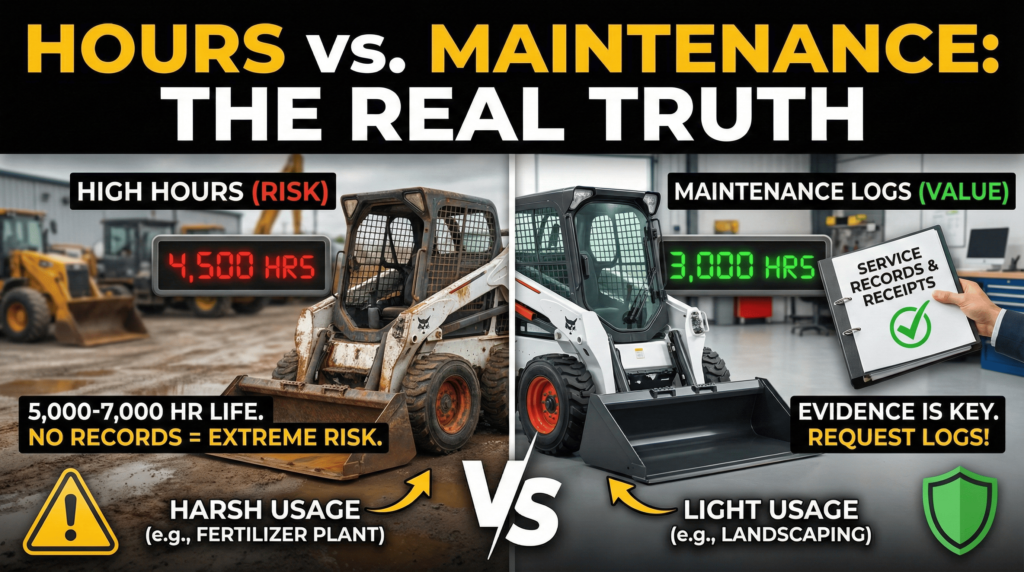
Hours are not the whole truth but they do give you a very good indication of the machine’s remaining life.
- The 5,000-hour rule: Skid steers typically have a service life of 5,000 to 7,000 hours. The risk involved when buying a machine with 4,500 hours and without any records is extremely high.
- Type of usage: 1,000 hours in a fertilizer plant would be quite corrosive and harsh on a machine, whereas 3,000 hours of light landscaping would not be that hard-on the same machine.
- Service evidence: Request to see the service log always. If an owner is unable to bring a single receipt, he /she probably neglected other important maintenance as well.
FAQs – How to Spot a Bad Used Skid Steer Before Buying
What is the maximum number of hours that a used skid steer should have been in use?
As a general rule, a skid steer that has clocked more than 5,000 hours is regarded as “high hour”. On the other hand, a machine that has been well looked after can go on for 10,000 hours, whereas a poorly maintained one might already be “bad” at merely 2,000 hours.
Should I buy a used tracked loader or a wheeled skid steer?
Wheeled machines are cheaper to maintain but they get stuck in mud more easily. On the other hand, tracked loaders (CTLs) have greater stability and lifting capacity but the price for undercarriage replacement is significantly higher than that of wheeled loaders.
Which is the most-costly component in a skid steer to repair?
Both the hydraulic pump and the engine rank high among the most costly components. In case of a total hydraulic system failure, the repair bill can often be more than half of the value of the second-hand machine.
What does it mean when I smell burning during a test drive of a used skid steer?
The smell of burning is generally related to the following three causes: a slipping belt, an electrical short, or leaking hydraulic fluid dripping onto a hot engine component. All of the above are serious warning signs.
Should I be concerned about rust on a used skid steer?
These days, almost every old metal item in the world has some sort of surface rust but “scaling” rust on the frame or loader arms is an indicator of weakening of the machine’s structure and in this case, you should steer clear from such a machine that has been exposed to salt or fertilizer in the environment for its whole life.
Is it OK to buy a skid steer that has just been repainted?
Go ahead with great care. While some skid steer sellers just want their fleet to look professional, most sellers use fresh paint to hide cracks, welds, or deep corrosion. Do a hose overspray check if you want to be sure.
Is hiring a mechanic to inspect a used machine worth it?
Absolutely. The $200-$400 you pay for professional inspection can spare you $10,000 in unexpected repairs. Professionals can Perform a “flow test” on hydraulics, something that cannot be done during a simple visual check.
Wrapping Up – How to Spot a Bad Used Skid Steer Before Buying
Knowing how to spot a bad used skid steer before you buy is simply about having patience and taking things slowly. Don’t ever succumb to the temptation of rushing into a deal simply because the price seems to be “too good to be true”—which it is, most of the time. By looking at smoke, structural welds, hydraulic “creep,” and maintenance history, your choice will be between a treasure and junk.
For professional advice and the suitable equipment for your next project, please visit the SkidSteer.online