

Snow Removal Made Easy: Complete Guide to Skid Steer Snow Blower Attachment – Winter preparation and equipment selection
Winter adorns the landscape with a beautiful white snow cover, but for property managers, farmers, and construction professionals, it usually means the onset of a relentless struggle with the elements to maintain driveways, parking lots, and walkways clear and safe. Although manual shoveling or small walk-behind units are the traditional methods, they might be good enough only for residential walkways and are completely inefficient for larger commercial needs or heavy snowfall, thus the skid steer snow blower attachment has become an essential tool in the modern snow removal arsenal.
A skid steer snow blower attachment is a great way to get your loader ready for winter work as it can allow you to displace huge volumes of snow much faster than by plowing or using a bucket alone. Plus if you plough, the snow gets packed, frozen, and turned into immovable obstacles but with a snow blower, snow is actively picked up and thrown away from the cleared path leaving your workspace free and wide during whole winter.
In this article, you will find extensive information on how these less-known but highly efficient tools work, what benefits they bring to the table, and how to get the most out of your snow blower attachment TYPHON Skid Steer Loader Snow Blower Attachment sold at Skidsteer.online.
Why Choose a Skid Steer Snow Blower attachment Over a Plow?
The biggest dilemma when choosing a snow blade or a skid steer snow blower attachment is usually how much snow there will be and the room available for the snow piles as blowers are really good at not letting the snow be dumped just anywhere.
A plow is great for covering ground fast during light snow, but the snow must be stacked somehow and that means you have to have some extra space on the edges of the lot, once used up, you have no more parking or driving space. On the other hand, a skid steer snow blower gets rid of the problem by hurling the snow 30 to 40 feet away, spreading it along fences or onto the non-traffic areas.
Moreover, a skid steer snow blower is definitely the right tool if you have to clear a thick layer, drift, or compacted snow that would make a plow slip or struggle for traction. The blower’s hydraulic power is enough to easily “cut” through icy walls while a blade would just “ride” over such a heavy finish pushed right to the pavement.
- Efficient Space Management: Snow is thrown far away from the clearing surface, thereby reducing the formation of high snow banks that obstruct views and decrease parking space.
- Superior Cutting Action: An auger mechanism breaks through ice and hard-packed drifts that usually stop a regular snow plow dead in its tracks.
- Reduced Follow-Up Work: It gives a cleaner surface in one single pass, hence less salting or sanding is needed, as compared to the tracks left by plows.
Understanding Hydraulic Flow and Machine Compatibility
The efficiency of your skid steer snow blower attachment will be largely dependent on the hydraulic system of your machine which means you should really know what the relationship between Gallons Per Minute (GPM) and blower performance is, before you get one.
Each skid steer loader generates a particular hydraulic flow rate which is usually figured as “Standard Flow” or “High Flow,” and the difference between a snow blower that tosses snow 40 feet and one that only cleans out the chute is literally a matter of whether or not you have properly matched the attachment to this output.
A skid steer snow blower attachment needs a steady and strong flow of hydraulic fluid to keep the auger and impeller fan rotating; if your machine does not deliver enough power, the blower will stall in heavy wet snow and this will be both frustrating and potentially damaging to the equipment.
On the other hand, if you use a standard flow model with a high-flow machine and no proper regulation, you risk overpressurizing the motors which can lead to serious and expensive damage.
- Flow Rate Matching: Before using a snow blower attachment, always check if your skid steer’s GPM output is within the operational range of the attachment.
- Pressure Settings: Make sure your machine’s maximum PSI compatibility matches the attachment’s hydraulic motors so as to avoid seal failures or motor damages.
- Auxiliary Hydraulics: If necessary, find out whether your loader needs a distinct case drain line or an electrical harness to operate the functions of chute rotation and deflection before purchase.
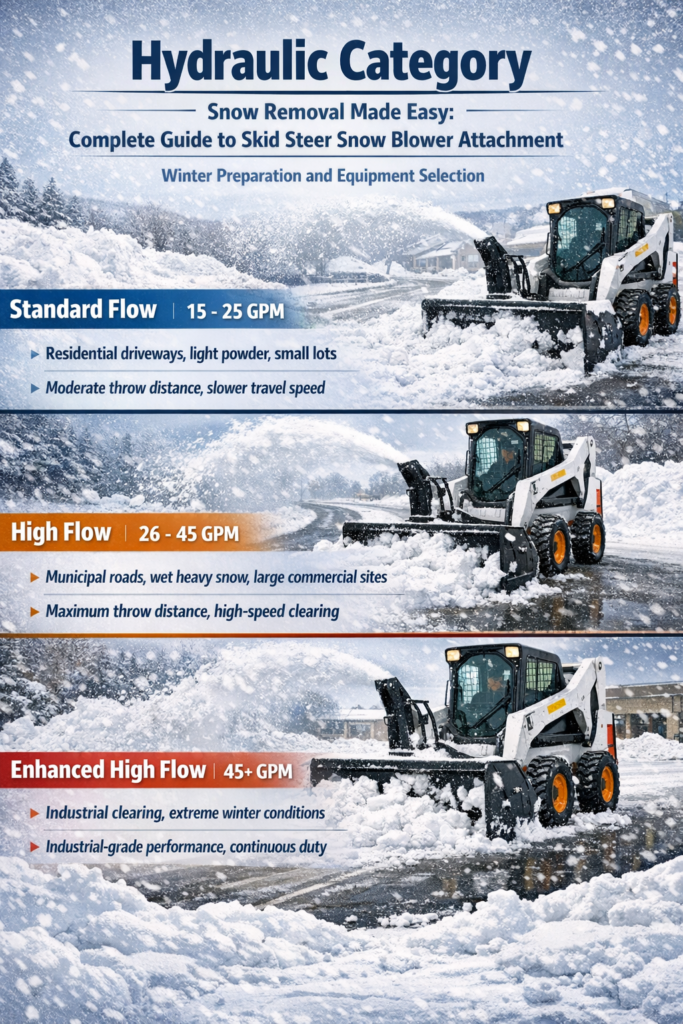
| Hydraulic Category | Typical Flow (GPM) | Best Use Case | Blower Performance |
| Standard Flow | 15 – 25 GPM | Residential driveways, light powder, small lots | Moderate throw distance, slower travel speed |
| High Flow | 26 – 45 GPM | Municipal roads, wet heavy snow, large commercial sites | Maximum throw distance, high-speed clearing |
| Enhanced High Flow | 45+ GPM | Industrial clearing, extreme winter conditions | Industrial-grade performance, continuous duty |
The Power of TYPHON Skid Steer Snow Blowers
The TYPHON Skid Steer Snow Blower Attachment, found at Skidsteer.online, is a piece of equipment that can easily and aggressively chew up both loose and packed snow, making it one of the best in the market for demanding users.
TYPHON STOMP Mini Skid Steer-compatible blowers have been developed to grant even the smallest equipment industrial-grade snow clearing capabilities thus operators can now get sidewalks and very tighten farm yards cleaned that the big municipal equipment just can’t.
The TYPHON skid steer snow blower attachment has ergonomic features and “ruggedness” built into its DNA, which means the equipment won’t break down halfway through a job once it has been “mugged” by a hidden chunk of ice or debris.
Moving to a hydraulic drive system, these blowers significantly reduce the maintenance problems usually associated with separate gas engines seen on traditional blowers, as all their power is drawn from the trustworthy engine of the skid steer itself.
- Versatile Application: Equally adept at clearing parking lots, highways, farm yards and sidewalks.
- Compact Accessibility: Specifically built to be operated in the tight spaces where standard large-scale snow removal equipment never fits.
- Robust Construction: Manufactured to endure winter work pace, “munching” through compacted snow without hesitation.
Operational Techniques for Maximum Efficiency
Simply turning on the hydraulics for a skid steer snow blower will only get you so far; to really master the attachment, you need to think strategically about how you approach the snow, so that you get maximum output and minimum wear and tear on your machine at the same time.
One of the major operational mistakes is that of new users who charge too fast into deep snow and thereby overwhelm the intake auger clogging the chute; what you should do is keep a steady pace that is consistent with the blower being able to get rid of the snow at the same rate that it is coming into the housing.
Using the skid steer’s agility to do a “cut and turn” operation is a very good idea as well, where you first clear a path in the middle and then effectively widen it, or you can use the “windrowing” method in an open space. Chute handling is a crucial part of a job as well, as you must always be changing the discharge angle so as to be able to use the wind, thus the blown snow does not drift back into the surface that you have just cleaned.
- Speed Control: The speed at which you travel must be such that the impeller is neither allowed to clog nor the engine bog down due to the density and depth of the snow.
- Wind Awareness: To prevent the snow from blowing back into the operator’s view or landing on the cleared surfaces, the discharge chute must always be pointed downwind.
- Skid Shoe Adjustment: For gravel surfaces, the adjustable skid shoes can be set to leave a thin layer of snow so that rocks are not picked up, whereas they can be lowered for pavement.
Essential Maintenance for Winter Reliability
No matter how great your skid steer snow blower is, it will be very disappointing and inconvenient to find it out of order when you are expecting the worst winter storm. Thus, with the cold climate and the harshness of the snow and ice, it is very important that you have a good maintenance schedule in place to protect the parts that move and are prone to wear out.
Going for the machine without a check is leaving yourself open to unnecessary trouble as these small things and can turn into massive breakdowns that come the time when you most need the machine.
As the auger and impeller bearings are very heavily loaded, it is especially important to lubricate them often in order to keep water out and freezing away, which might otherwise cause the whole mechanism to seize. Besides, it is a major concern to keep an eye on the condition of hydraulic hoses as rubber tends to become brittle in cold weather thus it is more likely to crack or burst when under pressure.”
- Daily Lubrication: Before and after use, grease all zerks on the auger bearings, chute rotation mechanism, and impeller shaft to expel any moisture.
- Hydraulic Inspection: Visually check the condition of hoses for signs of wear or damage and make sure that quick-couplers are clean and free of ice before connecting to the machine.
- Wear Part Replacement: Carefully monitor the wear of the cutting edge and skid shoes, and replace them when they are worn down to the level of the housing to avoid further damage.
FAQs – Skid Steer Snow Blower Attachment
What is the difference between a single-stage and two-stage skid steer snow blower?
The auger of a single-stage skid steer snow blower serves two purposes: to break the snow and to eject it through the chute. This works well for light, fluffy snow but limits the distance of the throw. Two-stage model, however, is way more powerful; it uses its auger to break the snow and then feeds it into a separate high-speed impeller fan that throws the snow. The two-stage models are what you get with skid steers nowadays because they can chew through the wet, heavy snow and throw it way out.
How much hydraulic flow (GPM) do I need for a skid steer snow blower?
The GPM you need is a function of the blower’s width and class. As a rule of thumb, a standard flow skid steer snow blower (usually 60-72 inches wide) will need a GPM of between 15 and 25. The high-flow species (72-84+ inches wide) that give you the longest throw and the greatest torque, however, are in the 26-45 GPM range. To avoid performance issues or damage, always make sure to check the specs of both your skid steer and the attachment to ensure that they are compatible.
Can I use a skid steer snow blower on a gravel driveway?
Definitely, a skid steer snow blower can be used on a gravel driveway but you need to make sure the skid shoes are adjusted accordingly. When you lower the skid shoes, the blower’s cutting edge is slightly raised (about an inch or two). This way the auger will not be able to scoop up the rocks and the gravel, which could get thrown dangerously or even damage the impeller. However, you will still get the snow packed down in a thin layer, which is good both for the equipment and the driveway.
Why is my skid steer snow blower clogging with wet snow?
The three main reasons people experience the clogging issue are: going too fast, low engine RPM, or a rusty chute. When it comes to wet and heavy snow, you should slow down to let the blower finish clearing the material. Also, while it is certainly beneficial to keep the engine RPM up to full throttle in order to provide the optimum hydraulic flow for the blower, you might find that the chute gets covered with snow sticking to the metal. If this is the case, you should consider applying a non-stick spray or wax on the inside so that the wet snow can slide off easily rather than sticking.
How do I maintain my skid steer snow blower during the off-season?
Do not underestimate the power of proper storage to the life of the equipment. Take off all the salt and dirt to avoid corrosion. Fix any paint scratches with rust-preventive paint. Thoroughly grease all the bearings and moving parts. Place the skid steer snow blower in a dry, covered space and if possible elevate it with a pallet. Protect hydraulic couplers from being covered with dust by capping them.
Is a high-flow skid steer snow blower worth the extra cost?
If you are working as a commercial contractor or you are living in a place with heavy, wet snowfall, then a high-flow skid steer snow blower is definitely a wise purchase. A high-flow unit will significantly increase the torque going to the auger and the speed going to the impeller, which means that you get to work faster and also snow gets thrown a lot further (often more than 40 feet!) The additional productivity translates into fewer billable hours for the same job and less wear on the machine because it does not have to struggle against heavy drifts.
How do I choose the right width for my skid steer snow blower?
As a rule of thumb, pick out a skid steer snow blower that can just about cover the width of your skid steer loader’s tires or tracks. The problem with the blower being narrower than your machine is that you end up constantly having fresh snow under your wheels after each pass, which not only means compaction but also makes it harder to remove the snow later on. For a regular mid-size skid steer, going with a 72-inch blower is pretty standard while small mini skid steers such as the TYPHON STOMP might opt for a 48-inch or 60-inch model.
Final Share
Getting a good-quality skid steer snow blower attachment such as the TYPHON model featured at Skidsteer.online will make your winter service operations so much more efficient. It far exceeds the simple limits of plowing by offering a high-capacity professional solution that ensures the continued comfort and safety of your property even after a really severe winter.
When you know your machine’s hydraulic compatibility, make the right size decision, and follow a good maintenance schedule, then snow removal ceases to be a boring, tedious, and exhausting chore, it becomes fast, efficient, and even fun. Provide your fleet with the correct tools this winter season, and you will see the difference that “compact power” and “ruggedness” make in your operations.