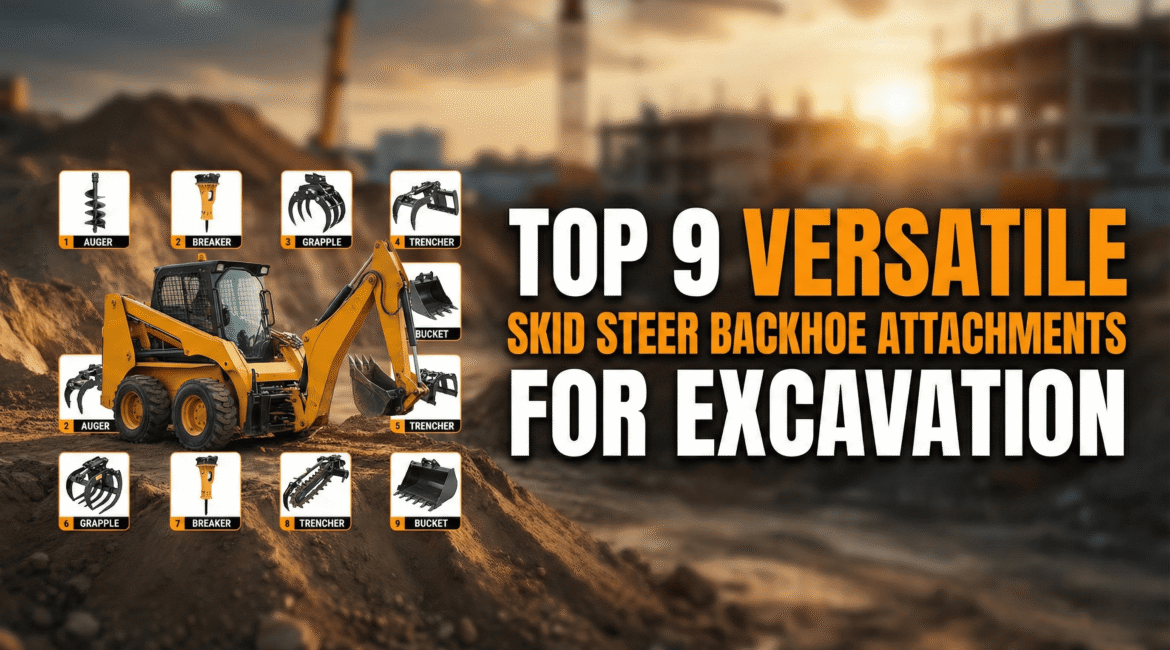
Top 9 Versatile Skid Steer Backhoe Attachments for Excavation
Your earthmoving work can be supercharged simply based on the strength of the tools that you pin to your skid steer. It is most common for operators to grab the standard bucket initially, but the transition into specialized digging is when the real magic happens. Your compact loader can be turned into a surgical digging machine capable of deep utility trenches and delicate landscape shaping if you use the 9 Versatile Skid Steer Backhoe Attachments for Excavation.
The Evolution of Excavation: Why Use Skid Steer Backhoe Attachments?
Traditional backhoe loaders are large investments and are usually too large for residential backyards or urban jobsites. Adding a backhoe attachment to your machine means that you can excavate to the depth and precision of an excavator without spending the price of an expensive machine. The use of the skid steer’s high-flow hydraulics for backhoe attachments results in great breakout force allowing you to quickly break through hard clay and rocky soil.
- Cost Efficiency: Keep the overhead of running a separate engine and chassis low by making the best use of your skid steer power unit.
- Space Management: Be able to get through narrow alleys and gated properties that full-sized backhoes don’t have access to.
- Hydraulic Synergy: Backhoe attachments of today are designed to match your GPM (gallons per minute) so that you have smooth and responsive controls.
Top 9 Versatile Skid Steer Backhoe Attachments for Excavation
1. Swing-Arm Backhoe Attachments
The swing-arm setup is the “gold standard” for versatility and is actually a huge plus in terms of flexibility. Fixed models only allow the boom to pivot at the limit whereas the swing-arm can usually pivot an entire 180 degrees, enabling you to dump the spoil off to the side most easily without having to move the entire skid steer. This is particularly helpful in working in very narrow corridors where it is impossible to turn the machine’s body.
- Dual-Cylinder Swing: Equal power along the entire swing arc is delivered thus eliminating the “dead spots” tendency of single-cylinder swings.
- Side-Spoil Advantage: Greatly decreases the wear and tear of tracks or tires as you don’t have to keep turning the machine in the opposite direction to throw the soil.
- Operator Visibility: The bucket teeth are clearly visible from the cab in many cases because design features an offset or clear-view frame.
2. Fixed-Boom Backhoe (The “Dig-and-Dump”)
If you are on a budget, a fixed-boom backhoe is a great piece of equipment. Usually, the operator has to drive the loader to dump the material, but the simplicity of the product also means that it comes with fewer moving parts and lower maintenance costs. The product is unparallel for “line-and-sink” utility work.
- High Breakout Force: Being a rigid frame, most of the hydraulic pressure is directly applied to the bucket teeth through the frame.
- Simplified Maintenance: There are fewer hydraulic cylinders and pivot pins hence reducing the chance of mechanical breakdown during long working schedules.
- Affordable Entry Point: Perfect for contractors at a small scale or farm owners who only require a few deep digging jobs in a year.
3. Vertical-Dig “Smart” Backhoes
Nowadays, the smart backhoe attachments of the 9 Versatile Skid Steer Backhoe Attachments for Excavation list are almost compulsory. This equipment is capable of digging perfectly vertical trenches, which is very useful when it comes to pouring footings or installing septic tanks and precision is absolute.
- Precision Footings: The cleaner the corners (90-degrees), the less concrete will be needed for structural pours.
- Reduced Over-Dig: The specialized linkage makes sure that only necessary soil is moved, thus saving time during backfilling.
- Self-Leveling Features: Among the high-end models, some account for operator assistance in maintaining a level trench floor.
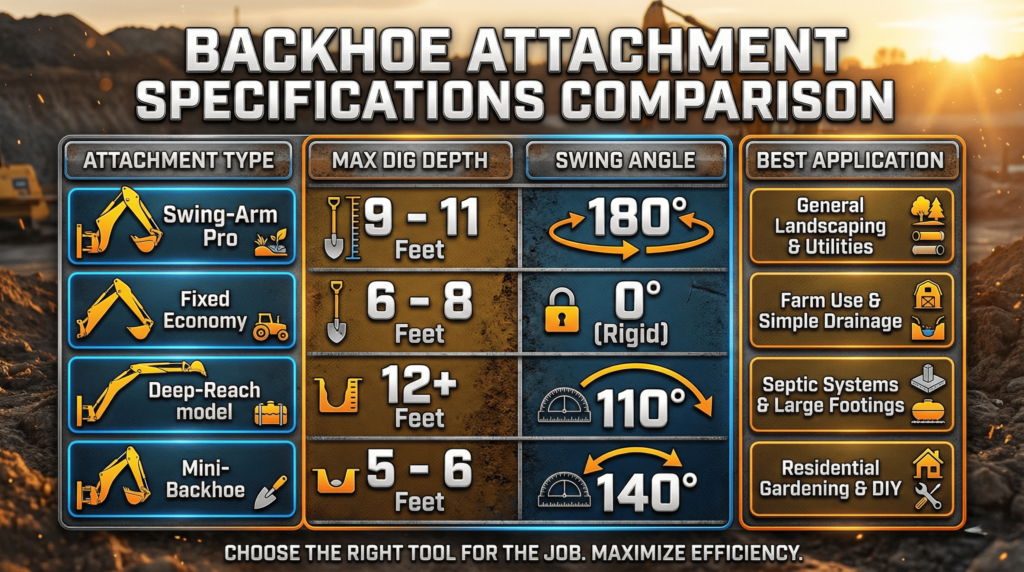
Skid Steer Backhoe Attachments Specifications Comparison
| Attachment Type | Max Dig Depth | Swing Angle | Best Application |
| Swing-Arm Pro | 9 – 11 Feet | 180° | General Landscaping & Utilities |
| Fixed Economy | 6 – 8 Feet | 0° (Rigid) | Farm Use & Simple Drainage |
| Deep-Reach model | 12+ Feet | 110° | Septic Systems & Large Footings |
| Mini-Backhoe | 5 – 6 Feet | 140° | Residential Gardening & DIY |
4. Extendable-Arm (Extendahoe) Attachments
Though 8 feet is plenty, sometimes, just isn’t enough. Extendable-arm backhoes give you 2-4 more feet of reach than standard models, which can be a real lifesaver if you have to dig over a fence or reach a line down deep without driving over unstable ground.
- Deeper Reach Capability: You can choose to get the machine further from the trench edge and still have enough length to reach the bottom of the trench.
- Variable Depth: Changes in arm length can be used to deal with different elevations within the same job site.
- Enhanced Loading: The great arm length also helps you load bigger sized dump trucks or trailers easily.
5. Thumb-Equipped Backhoes
Where you are clearing more than just soil you need a backhoe with thumb. Removal of old concrete, pulling out stumps, or shifting rocks can be done easily if a thumb is attached to the bucket. It basically turns the bucket into a grapple, “pinching” the items which are being moved between the bucket teeth and the thumb.
- Material Handling: Pick up and relocate heavy logs, stones, or demolition debris with ease.
- Mechanical vs. Hydraulic: You can get a manual thumb for a more inexpensive grip or a hydraulic thumb for “on-the-fly” adjustments.
- Precision Placement: With the help of the thumb, you can move boulders or place landscape timbers accurately and aesthetically.
6. Heavy-Duty Rock Backhoes
Standard buckets are incapable of coping with frost or shelf-rock. Heavy duty rock backhoes are equipped with reinforced side cutters and high carbon steel teeth that are capable of withstanding the shock loads when breaking ledge or frozen ground.
- Reinforced Stress Points: Additional plating at the “ears” and bottom sections of the bucket helps prevent warping when subjected to extreme pressure.
- Aggressive Tooth Pattern: The so-called “tiger teeth” of these mouthpieces are highly specialized to concentrate the machine’s force in small points for better penetration.
- Wear-Resistant Lips: The cutting edges are thicker and sharper for longer periods even after constant rubbing with abrasive substances.
7. Narrow-Trenching Backhoes
When it comes to fiber optic installation, electrical conduits, or irrigation pipes, you don’t lean against the inertia of the former which requires moving 3 feet of soil for a 4-inch pipe. Narrow trenching attachments, in contrast, feature buckets of extremely small width (down to only 6 inches) to make the slits in the ground that are like surgical cuts.
- Minimal Surface Disruption: By keeping the surrounding lawn or pavement intact, you significantly reduce the cost of restoration.
- Speed of Operation: It is less material that needs to be moved and so you have more speed.
- Backfill Savings: The trench being narrow helps you save money on sand, gravel, or topsoil during the finishing phase.
8. Stabilizer-Equipped Backhoes
Just like in skiing where you are not able to improvise the balance when you have a long protractor without support, the skid steer lacks stability when the boom is extended. Skid Steer Backhoe attachments that are equipped with stabilizers have hydraulic “legs” (outriggers) that are grounded for more stability, and thus the vehicle, is slightly raised to avoid it from rocking or tipping over during the heavy lifting process.
- Increased Safety: The risk of the skid steer tipping forward when pulling a heavy stump or prying a large rock is nearly zero with stabilizers.
- Leveling Capability: Independent stabilizers permit machine leveling even if it is on a side slope.
- Machine Protection: By transferring the digging force to the outriggers, you lessen the wear on your skid steer’s axles and tires.
9. Multi-Purpose Combination Backhoes
If a single unit must serve the purpose of everything a professional can expect, then combination units are great as they allow for buckets of different sizes to be interchanged or the addition of secondary tools like rippers or augers on the same arm. The utility of a single hydraulic setup is thus maximized.
- Interchangeable Buckets: You can change a 12-inch trenching bucket to a 24-inch grading bucket in a matter of minutes with a mini quick attach system.
- Integrated Rippers: A few models offer an option for you to reverse the bucket or include a ripper tooth that can aid in breaking hardpan before your digging session.
- Versatile Plumbing: Often come with auxiliary hydraulic lines already run down the boom for future tool additions.
FAQ’s – Skid Steer Backhoe Attachment
Can a skid steer backhoe attachment really replace a mini excavator?
A mini excavator is able to rotate 360 degrees while a skid steer backhoe is merely a lower-cost option that can carry out roughly 80% of common digging tasks. For trenching, footings, and stump removal, a backhoe attachment provides similar power at a fraction of the rental or purchase cost.
What hydraulic flow is required for a backhoe attachment?
Usually, standard-duty backhoe attachments will ask for flow rates between 15 and 22 GPM. Heavy-duty or extendable models may have a preference for high-flow hydraulics. In any case, refer to your machine’s PSI and GPM ratings before purchase.
Is it hard to learn how to operate a skid steer backhoe?
Those who know how to operate their skid steers well don’t have to be put under any pressure at all in the process of learning how to use backhoe attachments. Two-stick or joystick, these are the same kinds of controls utilized by standard excavators. Within a few hours, some of the operators who practice reach proficiency in the use of the attachments.
How deep can a skid steer backhoe attachment dig?
The depth to which skid steer backhoe attachments can dig varies between models. Standard attachments generally allow 6 to 8 feet digging whereas professional-grade “long-reach” or “extendahoe” models can reach depths of 10 to 12 feet which makes them ideal for residential utility and septic jobs.
Do I need stabilizers for my skid steer backhoe?
If you want to go down to the deepest levels or if you are dealing with soils that have naturally been very compacted, then, stabilizers are almost necessary. Stabilizers, apart from protecting your chassis, allow for a much smoother, more precise, and enjoyable digging experience by preventing the machine from bucking or rocking.
Can I use a backhoe attachment on a tracked skid steer (CTL)?
Yes, you can. The fact is that Compact Track Loaders (CTLs) are often considered more stable than wheeled skid steers for backhoe work due to their larger footprint. The extra weight of the tracks acts as a counterbalance for the boom, however, you still need to be cautious of your machine’s Rated Operating Capacity (ROC).
How do I maintain my backhoe attachment for a long lifespan?
The maintenance that your backhoe attachment requires is not complicated at all. It would be best if you greased all the pivot pins every 8-10 hours of operation, checked the hydraulic hoses that are prone to abrasion every day, and always inspect the bucket teeth for wear. As simple as it may sound, dirt left in the quick-connect couplers can also lead to contamination of the hydraulic system.