Top 7 Features – How Compact Equipment Boosts Productivity of Small Contractors!
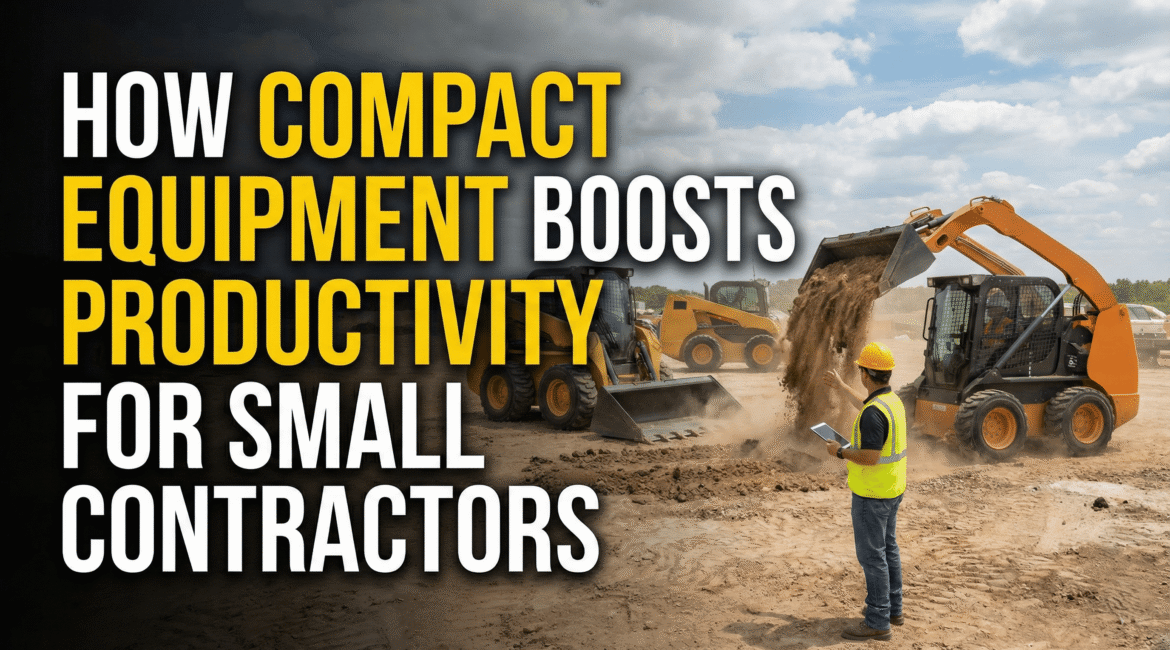
Traditionally, the construction and landscaping industry has been dominated by the notion of “bigger is better”, but today it is increasingly recognized that “smaller is smarter”. Small contractors are those who are capable of delivering great results under tight deadlines and even stricter budgets – this is what makes them so great.
The range of compact equipment, which includes mini excavators and skid steer loaders, has entirely changed the operating methods of small contractors. When these devices are incorporated into their machinery fleets, these companies experience an increase in efficiency that only traditionally large ones had. This article looks at how using compact equipment from a site like skidsteer.online can increase your productivity and help you get an exclusive competitive advantage.
Top 7 Features of Compact Equipment to Boosts Productivity of Small Contractors
1. Maximum Maneuverability in Restricted Spaces
The biggest problem for small contractors is working in places that are so small like urban areas and residential backyards that heavy machines cannot enter at all. The compact equipment is made in such a way that the user can take it for a walk in a “tight spot” without losing the power of the machine to do the job. So if you are digging a pool behind the fence or laying down the wires in a narrow alley, the small size of this machine will always allow you to move freely and make the work very safe.
- Zero Tail Swing: Certain compact excavators have the zero tail swing feature, so the operator can turn the cabin within the track width without damaging the nearby structures, thus eliminating the possibility of accidents.
- Gate Access: A mini skid steer is usually so thin that it can pass a regular 36-inch backyard gate thus, making it unnecessary to remove the fence panels.
- Precision Handling: The advanced hydraulics allow the level of precision required for working in existing utility lines or around delicate landscaping features.
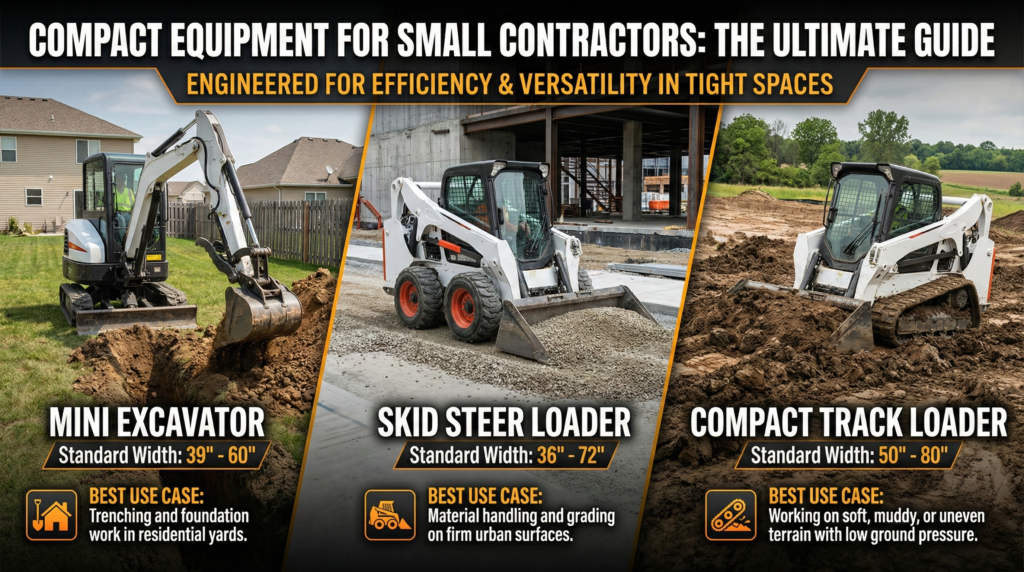
Table: Compact Equipment for Small Contractors
| Machine Type | Standard Width | Best Use Case |
| Mini Excavator | 39″ – 60″ | Trenching and foundation work in residential yards. |
| Skid Steer Loader | 36″ – 72″ | Material handling and grading on firm urban surfaces. |
| Compact Track Loader | 50″ – 80″ | Working on soft, muddy, or uneven terrain with low ground pressure. |
Preparation of the land before trenching and the foundation is dug in the residential yards. Material handling and grading on firm urban surfaces. Soft, muddy, or uneven terrain with low ground pressure areas work.
2. Versatility Through Multi-Functional Attachments
High productivity ultimately depends on how versatile a machine is. Instead of having five different specialized machines, a small contractor can have one compact loader with a bunch of attachments. Such a “Swiss Army Knife” strategy not only decreases capital expenditure but also allows the contractor to take on various types of jobs. From skidsteer.online’s point of view, the quickest way to increase the number of jobs done per hour is to have the suitable tool for the job.
- Rapid Change Systems: The quick-attach systems of today enable the operator to change the attachments from a bucket to an auger or a grapple in less than two minutes.
- Diverse Applications: With the right attachment changes, a skid steer can perform multiple operations such as clearing snow with a blower, grinding stumps, and mixing concrete without many problems.
- Reduced Fleet Overhead: Having less number of machines helps save on insurance, storage, and transport trailer costs.
3. Significant Time Savings and Reduced Labor Costs
Small contractors usually find that labor costs are a major expense. Literally equipment is a force multiplier” in the sense that it enables an operator to do a five-man job in the fraction of time of a five-man crew working without it. The cost benefit from labor saving is just one side of the coin, the efficient one, that is, the quicker completion of one job and starting the other is the actual means of increasing the yearly turnover.
- Faster Cycle Times: The compact machines’ design enables them to move quickly which means faster completion of loading trucks or backfilling trenches, the tasks that are repetitive.
- Reduced Manual Digging: Contractors improve their health as they are less fatigued and there is a reduction in accidents when they stop shoveling in tiny places.
- On-Site Material Processing: By making use of attachments such as small crushers or vibratory rollers, contractors can do on-site processing of material rather than waiting for delivery or disposal trucks to come around.
4. Lower Operating Costs and Improved ROI
Operations of full-size machines compared to that of compact ones can be extremely cheap. Small contractors are so eager to increase their profit margins that even the extra maintenance time and every gallon of fuel saved directly translates into more money in their pockets. They tend to be high uptime and low maintenance machinery with the obvious implication that this type of business investment is the perfect fit for a company on an upward trajectory.
- Fuel Efficiency: Due to the fact that smaller engines use a lot less diesel it becomes a major plus when the fuel prices are volatile.
- Ease of Transport: Normally, the transport of compact machines can be accomplished by using a heavy-duty pickup truck and a utility trailer, thus avoiding the costs of commercial hauling permits.
- Simplified Maintenance: The lower number of complex systems and the more accessible enging components make it possible for the routine maintenance to be carried out by the contractor themselves in most cases.
5. Gaining a Competitive Advantage in Bidding
When the bidding comes to an end, the winning contractor is the one who offers the highest value by completing the work in the shortest time while charging the least. Compact equipment gives the small firms leverage to bid lower than big companies which have the heavy machinery overhead while at the same time, they can be better than small “manual-only” crews. This technological advancement gives a small business the appearance of really being professional and capable in the eyes of the client.
- Professionalism: The use of state-of-the-art, well-maintained compact equipment can show high trust and the commitment to a certain company quality.
- Sustainable Practices: Compared with the traditional machines, the new ones consume less energy, cause less pollution, and the ground is not disturbed so much as the result; it leads to an eco-friendly solution, a major concern of homeowners.
- Market Expansion: Having the compact equipment as your partner, you will be able to do interior demolition or hillside landscaping, therefore, entering the market of specialized jobs, which competitors will not handle because of lack of proper equipment.
6. Enhanced Operator Comfort and Safety
An efficient job site is also a safe one. The modern compact equipment from skidsteer.online is designed with the operator’s experience as the foremost consideration. The guardian of a machine who is comfortable is not only going to be alert but also able to maintain high productivity during the whole shift. The built-in safety measures protect a contractor from loss of productivity due to injury downtime, something that costs a lot.
- Ergonomic Cabins: Temperature-controlled cabs with adjustable seating and joystick controls help to keep the operator’s body in good condition.
- Superior Visibility: Owing to its compactness a design comes with 360-degree visibility which is very helpful when working in residential areas that are crowded or close to pedestrian traffic.
- Integrated Technology: Tech features such as telematics and grade control enable operators with less experience to achieve the results they want in their first attempt, thus lowering the number of times they have to redo the work.
7. Long-Term Value and Resale Potential
The purchase of compact equipment is not only related to the present project; it is also a long-term asset. In fact, these kinds of equipment have an excellent resale value. Due to their wide application (construction, farming, landscaping, etc.), the demand for them is always high, so a contractor does not have to worry about the safety of his/her investment.
- High Resale Value: The top brands such as Bobcat, Cat and Kubota that are kept in good condition usually sell for quite a high percentage of the original price.
- Rental Marketability: In the event of a lull in a contractor’s business, compact equipment is quite easy to rent to other nearby businesses, and so a second source of income is created.
- Scalability: When the business expands, a compact fleet serves as a strong base from which to add larger machines.
FAQs – Compact Equipment for Small Contractors
What are the best compact machines for small landscaping businesses?
Most small landscaping companies would pick the “Big Three” which are the mini excavator, the skid steer loader, and the compact track loader. The miniexcavator is the one you cannot do without if you want to dig and plant while the skid steer/track loader is the one to be blamed for taking care of the materials and grading.
Is it better to rent or buy compact equipment for a small contractor?
If the machine is used more than 60% of the time, then buying is generally more economical as there are tax benefits while the machine is readily available. Instead of one-off, special tasks, renting from a reputable company is the best way to keep the overhead low.
How much weight can a typical mini skid steer lift?
Depending on the model, a mini skid steer will usually have a rated operating capacity (ROC) in the range of 500 to 1,500 pounds. You should, therefore, check with the specific manufacturer’s specs at skidsteer.online to be sure that the machine is capable of handling the load of the material you wish to use.
Do I need a special license to operate compact construction equipment?
In most areas, a regular driver’s license suffices for the operation of compact equipment on private sites. However, for commercial work, OSHA certification or “competent person” training is often required and highly recommended for safety.
How do compact track loaders compare to wheeled skid steers?
Compact track loaders (CTLs) have an advantage of offering better traction as well as lower ground pressure than wheeled skid steers, so the use of wheeled skid steers is mostly limited to hard surfaces such as asphalt or concrete and the maintenance cost of skid steer tires is generally lower than that of tracks.
What is the average lifespan of a compact excavator?
High-grade compact excavators can be operated 8,000 to 10,000 hours if properly maintained. One can hope that frequent oil changing and lubrication of the grease points will keep the engine and the hydraulics in good condition until the milestone is reached.
Can compact equipment be used for interior demolition?
Indeed, most compact equipment has been made in such a way that they can be fitted for indoor work with hydraulic breakers or grapples and they are small enough to be taken through standard doors. Also, some electric models for even zero-emission operation can be used in enclosed spaces.