
First-Time Hydraulic System Operator’s Guide: Mastering Hydraulic Four-Wheel Drive Controls – Safety and Efficiency Tips
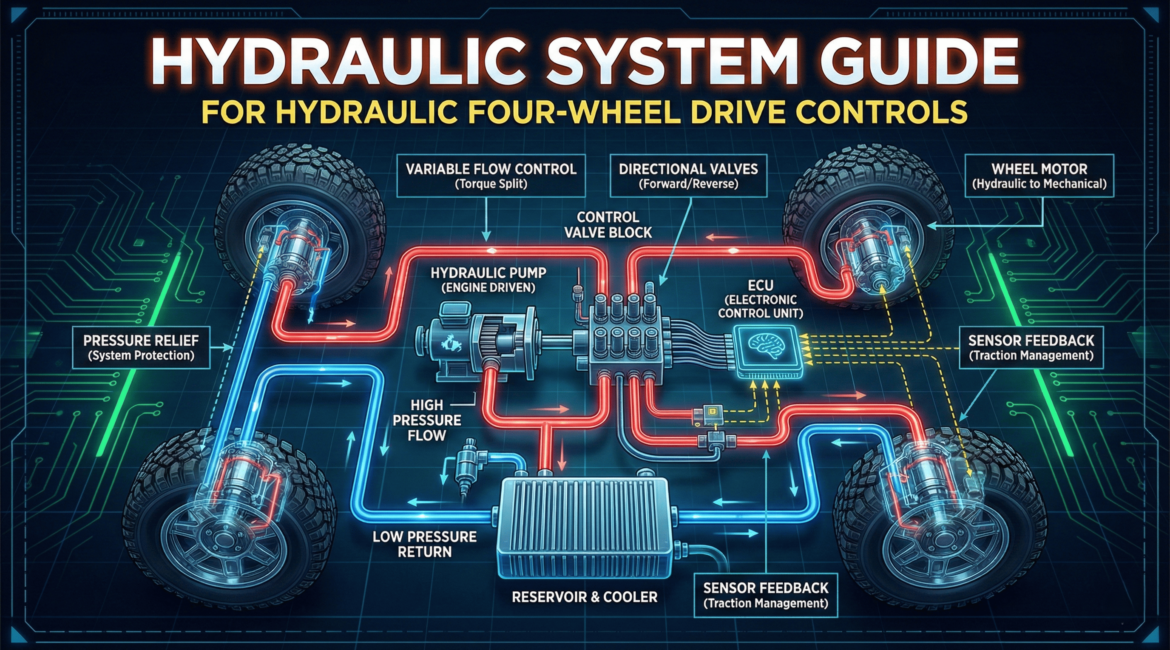
Doing an operation of a skid steer loader for the very first time is a really nice feeling. However, one can get quite confused about every detail of the hydraulic four-wheel drive controls of the machine. These devices are not like ordinary cars with the main difference being that each of the four wheels in them is separately powered by a hydraulic system.
That makes it possible for them to have a zero turning radius and be very powerful. An operator needs to be quite familiar with engine RPM, hydraulic flow, and joystick sensitivity in order to really master the skills. Whether it is just a backyard or a huge construction site, the very first step to being like a pro is to know how your hydraulic system is going to respond to you.
One of the steps at the beginning of mastering controls is to not “bang it.” The modern hydraulic systems are so responsive that with only a very small movement of the joystick the power can drop in a sudden and very surprising way.
Therefore, operators who are just starting out should switch their mindset from going for maximum power to minimum jerk in their working motion. By accelerating gradually and also decelerating by neutralizing joysticks slowly, you are protecting the hydraulic pumps and will be rightfully rewarded with a longer life of your equipment.
Understanding the Hydraulic Four-Wheel Drive System
- Power Distribution Independent: The hydraulic system delivers fluid under pressure to each wheel drive motor so that the power at each wheel can be controlled accurately.
- Zero-Radius Turning: The machine turns around its centre by the hydraulic four-wheel drive making the wheels on one side rotate forward and the other side backward.
- Dynamic Braking: In fact, the brake effect that results when one stops giving commands in a hydraulic system is due to the stopping of the fluid flow, which causes the machine to stop.
Essential Pre-Operation Safety Checks
Doing after measures is likely going to take the skid steer to the next level of operational safety. Checking an exhaust thoroughly is one of the things that a competent safety inspector should carry out as the first activity before inspecting the entire machine thereafter.
High-pressure hydraulic systems are being used and leaking of small quantities can cause the operator to lose control and to break the mechanisms.
Being proactive and checking leaks if the hoses looks “wet” of fluids, filling the fluids and making sure that the safety bars and seat sensors are working are all simple steps to prevent accidents on the site.
Any malfunction of the component can provoke at a moment the reaction of the machine, which is unexpected and very dangerous. A first-user is better off picking a machine behavior as normal as being a safe one. It is also worth emphasizing that improper or uneven tire wear can cause the hydraulic system to exert a force in a particular direction, thereby making it challenging to maintain a straight line.
The daily maintenance points should always be checked as per the instructions of your TYPHON machinery manual.
Safety Protocol Checklist
- Hydraulic Hose Inspection: Get out your magnifying glass and first look at places where ducts bend, before locating any that are cracked or bulging, then look for areas that are very wet so as to find leaks. A fluid injection injury as well as sudden loss of steering can result from these leaks.
- Operational Area Clearance: Are there any persons or objects within the machine’s turning area or “swing zone”? If the answer is no, then you can start to use the drive controls.
- Seat Bar & Interlock System: Lift the safety bar and it should disconnect the hydraulic functions, but if it doesn’t, then the worker should step out of the seat and make sure that it can.
Mastering the Joystick: Precision and Control
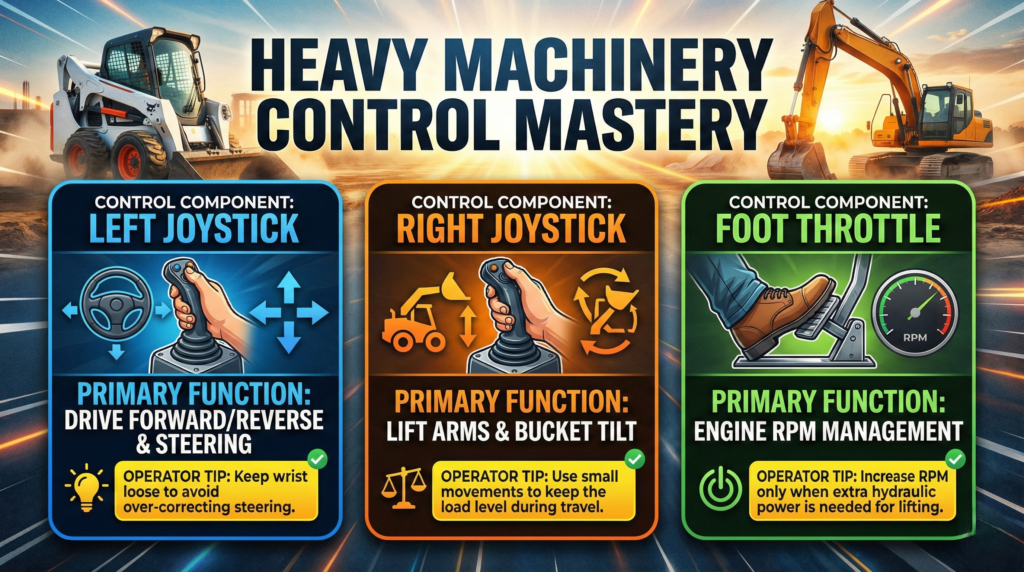
For a novice, the shift from manual operations with levers to hydraulic joysticks is quite a big hurdle. In order to drive a skid-steer already fitted with an ISO-layout control, the driver only needs to know that the left joystick controls all the movements – forward, reverse, and turning – and that the right joystick controls the loader arms and the bucket.
Thanks to this task separation, both driving and lifting can be done simultaneously, thus maximizing the loading cycles’ efficiency.
One thing you can do to achieve faster results is to use a feathering technique in handling your controls. This can be defined as the capacity to give just the right amount of input/output for let’s say, bringing the machine to move at an incredibly low speed. It is absolutely necessary when you have to move around tight corners, or if you are loading the trailer.
Only when you have sufficient space should you consider driving at high speeds because if the hydrostatic four-wheel drive is running at high RPM and the operator doesn’t have a steady hand, it may even become twitchy.
| Control Component | Primary Function | Operator Tip |
| Left Joystick | Drive Forward/Reverse & Steering | Keep wrist loose to avoid over-correcting steering. |
| Right Joystick | Lift Arms & Bucket Tilt | Use small movements to keep the load level during travel. |
| Foot Throttle | Engine RPM Management | Increase RPM only when extra hydraulic power is needed for lifting. |
Efficiency Tips for Hydraulic System Maneuvering
The efficiency of a skid steer is measured by how much work it can do compared to how long the machine lasts or its extent of wear. A typical mistake of new users is having the tendency to “scrub” the tires. The reason is that a hydrostatic four-wheel drive involves the tires being dragged to get a turn, thus the concrete tread gets worn very fast due to doing sharp turns there.
You are better off making large-radius turns whenever possible, and you should only perform a zero-radius turn if there is no alternative, which also means that you should save the zero-radius turns in the bag for times when you absolutely have no choice. Another efficiency secret that you may not have guessed is the throttle-hydraulic relationship. There is no need to drive at full throttle all the time.
With lower RPM running just for travel, you end up using less fuel and also less heat is generated in the hydraulic fluid. On the other hand, if you have to dig a hole in a mound of earth, then surely you have to put the engine RPM on so that the hydraulic motors are given enough flow to be working at the force level without stalling.
Pro-Efficiency Strategies
- Avoid turning in place or spinning your tires by using small three-point turns on abrasive surfaces.
- Reduce hydraulic cycling to a minimum will significantly decrease hydraulic heat.
- From getting drive motors protected from high pressure is the result of you always making a full stop before changing direction.
Maintaining Your Hydraulic System
The hydraulic system is probably the most important part of your four-wheel drive loader. Its biggest enemies are heat and foreign matter. At the end of a long day, if the machine has to go through a few minutes of idling it would be extremely helpful in most cases the suction of the hydraulic oil to be done through the cooler.
Oil will not be “cooked” in pumps which are not running. Besides, always keep the hydraulic couplers clean; just think what kind of havoc even a tiny speck of dirt brought into the system through changed attachment could do to the precision-machined valves.
Following the manufacturer’s schedule, the regular changing hydraulic filters and oil is essential. If you happen to notice that controls are getting “spongy” or the machine is “drifting” when the joysticks are in neutral, this is a signal that the hydraulic system needs to be recalibrated or repaired. Dealing with such problems in a timely manner guarantees that your control mastery is not hindered by technical inconsistency.
Routine Maintenance Tasks
- Cooler Cleaning: The hydraulic oil cooler must be kept clean at all times. The dirt and debris might clog the fins. So, the oil temperature will rise, and the system may overheat, especially if it’s under heavy use.
- Fluid Level Monitoring: Check through the transparent glass daily; the decrease in fluid level can cause cavitation, which can result in permanent damage to the hydraulic pumps.
- Coupler Hygiene: All quick-attach hydraulic fittings should be wiped down, to prevent internal contamination, prior to connecting the attachments.
Frequently Asked Questions – Hydraulic system for Hydraulic Four-Wheel Drive Controls
How do I stop a skid steer if the hydraulics fail?
Hydraulic four-wheel drive systems are “fail-safe” most of the time. It means that the brakes will be applied by the springs while released by the hydraulics in normal situations. As soon as the hydraulic pressure is lost, the brakes will automatically engage and stop the vehicle even if the engine is shut down.
Why is my skid steer jerky when I try to turn?
The most likely source of problems will have to be “over-controlling,” which implies that the joysticks have been moved too far and too quickly by a novice. Reducing your engine RPM will allow you to slow down your movements and make them more deliberate.
Can I drive a hydraulic four-wheel drive machine on a public road?
In general, skid steers cannot be considered as street- legal vehicles because they do not have a conventional steering system that would comply with the rules and their maximum speed is well below the minimum speed for highways. For longer distances, it would be necessary to transport a skid steer by a trailer.
What is the difference between a tracked and a wheeled hydraulic drive?
A wheeled four-wheel drive machine is capable of moving time faster and is a better option for hard surfaces, whereas the greater flotation and stability that a tracked machine (compact track loader) provide in mud or soft soil makes it the better option.
How often should I check the hydraulic fluid?
A very important safety step before working with a hydraulic system is hydraulic fluid level checking. This should be done by you every day before starting the machine.
Is it hard to learn the ISO control pattern?
On the average, most folks believe that left-hand drives, right-hand lifts (ISO) are more “instinctive” than the H-pattern that was used before. It is reported that after spending four to five hours in the driver’s seat most beginners can carry out basic operations.
What should I do if a hydraulic hose bursts?
After a major hydraulic hose defect, it is important to address the exhaust system immediately. Your first move is to turn off the engine and then lower the lift arms to the ground. Detection of the leak first by using the hands is not advisable since the high pressure of the hydraulic fluid can penetrate the human skin