

Understanding Lift Capacity of TYPHON STOMP mini skid steer: How to Match Your Skid Steer to Your Workload – Operating specifications explained
Figuring out which compact heavy equipment is right for you is sometimes as difficult as cracking a code if you don’t know the number of hands a machine can support before buying. Probably you will have to deal with such issues if you are a property owner who has a farm or a large garden to look after or a seasoned contractor who is constantly managing a construction site. Therefore, understanding the lift capacity of TYPHON STOMP mini skid steer is a major determinant of your safety and work efficiency.
The phrase “lift capacity” is commonly used to entice potential customers in brochures and sales presentations yet few people hear this term defined in a very practical manner that correspond to the actual needs of operators during the workday.
Such a misunderstanding of these metrics might be the cause why you end up purchasing a machine that is either too weak to heavy lift or domestically too big for your working area.
This article serves to interpret the full scope of operating specifications and their true practical value in matching a mini skid steer like the rugged TYPHON STOMP mini skid steer to your work load level.
Clarification of Main Parameters: ROC vs. Tipping Load
The real measure of the potential of your skid steer is by the correct understanding and consequently differentiation of the two most important figures in the specification sheet, i.e., Rated Operating Capacity (ROC) and Tipping Load. Although these two figures are related, to speak objectively, each has a completely different meaning to the operator.
The Tipping Load represents the limit beyond which the skid steer tips forward and rests on the front axle when the rear wheels are lifted off the ground. Therefore, it is the failure point and not the regular operational limit.
The Rated Operating Capacity, on the other hand, is a figure that has been adjusted for safety purposes. In fact, it is commonly set at 35%-50% of the Tipping Load depending on whether the machine is a tracked or wheeled model.
- Tipping Load is the point of machine losing balance: This is the weight of the load at which the machine will tip, affecting the safety of the operator and other people in the area.
- ROC is the figure representing the operator’s safety buffer: The manufacturers come up with the ROC figure intending to give the users enough safety and stability margin while the machine is in operation, making turns or carrying out a task especially at rough and uneven terrain.
- The influence of terrain on these figures: Even though these numbers/figures have been derived on the basis of a flat, smooth concrete surface, the actual working conditions on a muddy, sloped, or loose ground are quite different in terms of safety. Thus, the most realistic situation is that the amount you can safely lift will be significantly lower than the one indicated in the specs. Hence, it always advisable to get a machine whose ROC is higher than the heaviest load you are likely to carry.
Clarifying “Model Number”: Weight vs Capacity
Thus, what most buyers of mini skid steers would like to do is completely understand the difference between a machine’s operating weight and its lift capacity, a mistake that happens more often than not because the model numbers carry weight-related figures and therefore visually mislead people who are not initiated.
For example, you might look at a machine and see the label or be told of a TYPHON STOMP MINI SKID STEER 1800 that tingles you’ve run into the 1800 lbs. But you must be made aware that this figure very often is the operating weight of the machine itself, i.e., how heavy the unit is that will be sitting on your trailer, not how much it can lift in the bucket.
As a rule, a machine that weighs 1,800 lbs has a safe lifting capacity somewhere between 800 and 900 lbs which is more than enough for the majority of tasks, but it is not the same thing as lifting a ton of stuff.
- Checking the precise “Lift Capacity” metric: Don’t be misled by the model name or the header text; rather, make sure that you are referring to the “Lifting Capacity” or “Rated Operating Capacity” line item within the technical manual.
- The weight of the machine equals its stability: Indeed, the weight of the TYPHON STOMP MINI SKID STEER is 1,830 lbs and has long been considered a plus as it proposes the proper counterweight that allows the lift of heavy loads such as wet soil or gravel without getting tipped over.
- Being aware of the trailer’s capability: Knowing a machine’s operating weight does not necessarily have a direct correlation with its lifting ability but more importantly helps to keep your transport vehicle and trailer within their safe and legal limits when hauling equipment to and from the job site.
Breaking Down TYPHON STOMP mini skid steer Specs
Let’s say we try to apply the above-discussed principles to a specific top-selling model i.e. TYPHON STOMP MINI SKID STEER Mini Skid Steer. Well, the numbers shining through the nice and tidy specs table for this particular model metaphorize a productive protagonist that is on the small scale but packing a powerful performance. The beauty of this product is that it nicely bridges the gap between handling a small-sized job and yet getting the job done thanks to quite a powerful hydraulic system which, in turn, makes it a perfect case of the specs example workout.
The TYPHON STOMP mini skid steer has a 23HP engine with a Briggs & Stratton or Honda brand name most probably powering the unit capable of delivering the torque necessary to run the hydraulic pumps. Its rated payload capacity is 380 kg which is the approximately 837 lbs and it represents the perfect carrying capacity for such stuff as palletized landscape materials, large rocks, or full buckets of dense aggregates.
- The power of the engine supports the performance of the hydraulics: It is the 23HP engine that makes sure the travel speed and lift speed are not affected even when the bucket is fully loaded to its 830+ lb capacity, and thus the machine is neither bogged down nor overloaded.
- Hydraulic flow equates to any attachment’s compatibility: This machine comes sealed with a standard flow rate that is good enough for the running of common tools, so it can easily power augers and trenchers, but you have to be aware at this point that the weight of these attachments is also part of your total lift capacity and as such, needs to be accounted for.
- Small-size features for full accessibility: With dimensions approximately 1485mm x 1150mm, this machine can deliver such a lift-to-size ratio that it carries heavy loads through backyards and bring them through gates which can hardly be done even with large, high-capacity machines.
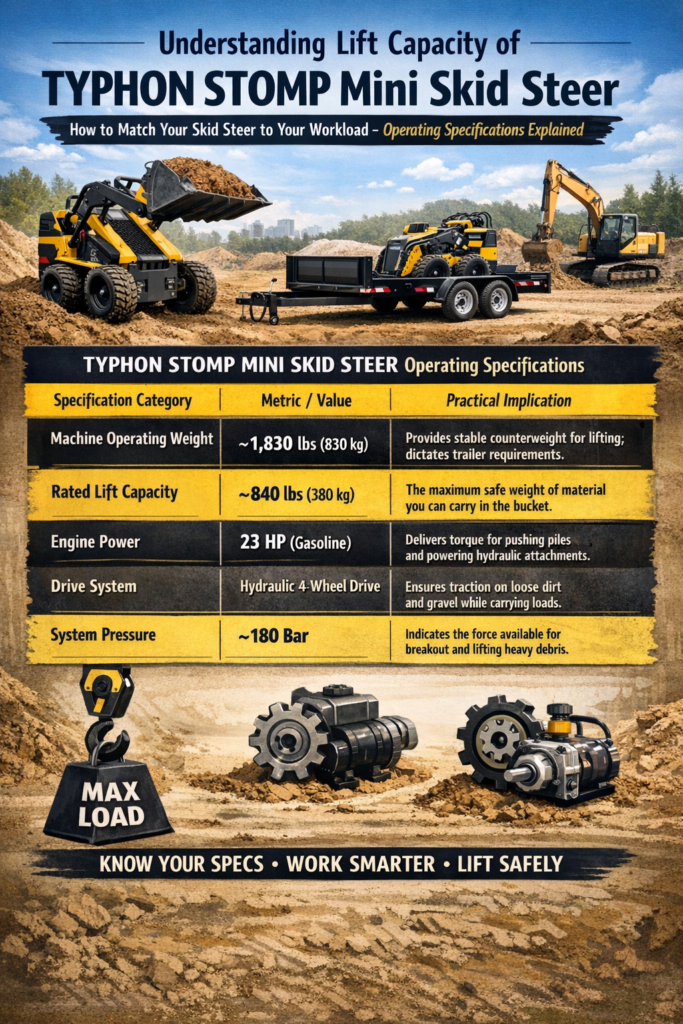
Table: TYPHON STOMP MINI SKID STEER Operating Specifications
| Specification Category | Metric / Value | Practical Implication |
| Machine Operating Weight | ~1,830 lbs (830 kg) | Provides stable counterweight for lifting; dictates trailer requirements. |
| Rated Lift Capacity | ~840 lbs (380 kg) | The maximum safe weight of material you can carry in the bucket. |
| Engine Power | 23 HP (Gasoline) | Delivers torque for pushing piles and powering hydraulic attachments. |
| Drive System | Hydraulic 4-Wheel Drive | Ensures traction on loose dirt and gravel while carrying loads. |
| System Pressure | ~180 Bar | Indicates the force available for breakout and lifting heavy debris. |
Working With the Load That You Have
Figuring out the right match of a skid steer with your required workload is by no means a piece of cake unless you are brutally honest about how dense the materials that you use or handle the most are. In general, the weight of one cubic yard of dry mulch is significantly less than that of the same volume of wet sand. Ultimately, your bucket size has to be adjusted or matched to the respective densities to preclude the risk of overloading the machine.
The ideal mini skid steer with a max. capacity of 840 lbs can handle a large full bucket of mulch, topsoil, or snow, and you don’t have to worry about cutting down the size of the bucket.
Yet, in the case of dense rock, wet clay, or concrete demolition debris, it is advisable to always keep the volume in mind since, to be in the safe zone, you might have to work with a half-filled bucket only.
- Learn about the densities of different materials: For instance, the weight of dry mulch can be somewhere between 400 and 800 lbs/yd³ whereas that of wet gravel may exceed 3,000 lbs/yd³. That being said, a small bucket of gravel can easily be heavier than a huge bucket of mulch.
- Calculate the weight of the attachment: If you have a grapple bucket or pallet forks, then you should know that the 840 lb capacity has to be further reduced by the weight of that heavy steel attachment in order for you to know how much actual material you can grab.
- Think about the leverage effect: When the loads are placed further away from the machine (for e.g., at the tips of the pallet forks that are longer than usual) then there is more leverage compared to a tight load in a bucket, and this, in effect, results in a reduction of your safe lifting capacity.
Hydraulic Attachments – Added Features
The true mini skid steer’s genius resides in the fact that it can leave the bucket behind and take on the other handful of tools, with every new attachment changing the lift capacity variables.
Thus, if you mount on the TYPHON STOMP MINI SKID STEER a very heavy trencher attachment, you will have increased the weight on the front end by a substantial amount. Besides, the machine is capable of lifting it, however, the operator must bear in mind that the room left for maneuvering stability is still less when the capacity is reduced.
Use of high-flow attachments can be heat-producing and demanding peak engine RPM, therefore, operators will need to constantly balance travel speed and hydraulic performance.
- Static vs. Dynamic Loads: A hammer attachment creates shock loads and vibrates, so the operator has to move gently and slowly in such situations unlike simply using a dirt bucket.
- Hydraulic flow management: The TYPHON STOMP MINI SKID STEER’s auxiliary pumps (each is 5.7 GPM) are powerful and made to handle these tools, but the downside is that lifting heavy arms and running the tools at the same time at full capacity can slow down your productivity.
- Quick-hitch convenience comes with the cost of weight: The device that makes it possible to interchange the tools rapidly is a sturdy and heavy one; therefore, you should always keep in mind that this interface is part of the “load” the lifting arms are carrying.
FAQs on TYPHON STOMP mini skid steer
What is the difference between Rated Operating Capacity (ROC) and Tipping Load?
Tipping Load is the maximum weight that will cause the machine to tip forward with the rear tires off the ground. Rated Operating Capacity (ROC) is a safety standard, usually calculated as 35% (for tracked loaders) or 50% (for wheeled loaders) of the tipping load. To maintain stability on uneven ground, the operator must always follow the ROC.
Does the lift capacity include the weight of the attachment?
Yes, the lift capacity that the manufacturer specifies is the total weight of all the items attached to the loader arms. To find out the weight of the material (payload) that you can safely lift, you have to subtract the weight of your bucker, grapple, forks, or auger drive from the Rated Operating Capacity.
How much can a mini skid steer lift?
Mini skid steers usually have lifting capacities varying between 500 lbs and 1,500 lbs which directly depend on the size of the model. E.g. TYPHON STOMP MINI SKID STEER’s lift capacity is ~840 lbs (380 kg), it is very efficient and handy for most landscaping projects that are not too large and after which one would be very much exhausted or wouldn’t want to take the next step with a bigger and heavier machine.
Is it possible to improve the lift capacity of my skid steer with counterweights?
On the one hand, mounting extra weights to the rear of your skid steer will raise the tipping load, but exceeding the manufacturer’s rated capacities is not safe or advisable. Machines that are overloaded will have axles, pumps, and frames that are put under great stress leading to their premature failure or even waiving the warranty.
Why do capacity specifications from different manufacturers not match for comparably sized machines?
Lift capacity differences often come from variations in a machine’s gravitational center, length of its wheelbase, and the settings of the hydraulic pressure. For example, a machine with a longer wheelbase or a heavier rear engine compartment generally has a higher tipping load. Up to a point, different brands may just refuse to adhere to the same safety margins when they decide to publish ROC (Rated Operating Capacity) data.
Which mini skid steer is better at lifting heavy loads – tracked or wheeled?
Generally, mini skid steers that are tracked offer better balance and higher tipping loads as a proportion of their weight since chains have a bigger ground contact area and thus load the ground more evenly. Nevertheless, wheeled units including the wheeled TYPHON STOMP MINI SKID STEER are usually faster and more suitable for the flat and hard surfaces where traction is more consistent.
How does a skid steer operator know when their load is too much?
Some very common signs of struggle include the back wheels lifting off as the machine tips over, the hydraulics stalling or making whining noises, and the machine responding slowly to the controls. If your machine feels like it’s going to tip over or be unstable, lower the load right away.
End of the story
The choice of a suitable skid steer depends on your understanding of the correlation between the lift capacity and your average daily tasks and is definitely more complex than simply buying the machine with the highest horsepower. Here is the TYPHON STOMP MINI SKID STEER which symbolizes the perfect mixture of compact design, exceptional maneuverability and the right amount of power needed to complete the task at hand while being rated at only ~840 lbs capacity which is adequate for most of the landscaping or light construction tasks.
In that sense, knowing the difference between operating weight and lifted weight as well as figuring out the impacts of using attachments and the densest materials are some of the ways to keep your purchase efficiently working for you in a safe and profitable environment for years. Spec sheets provide numbers to help you stay safe. The secret to machine and business longevity is going to still be operating within the Rated Operating Capacity.