
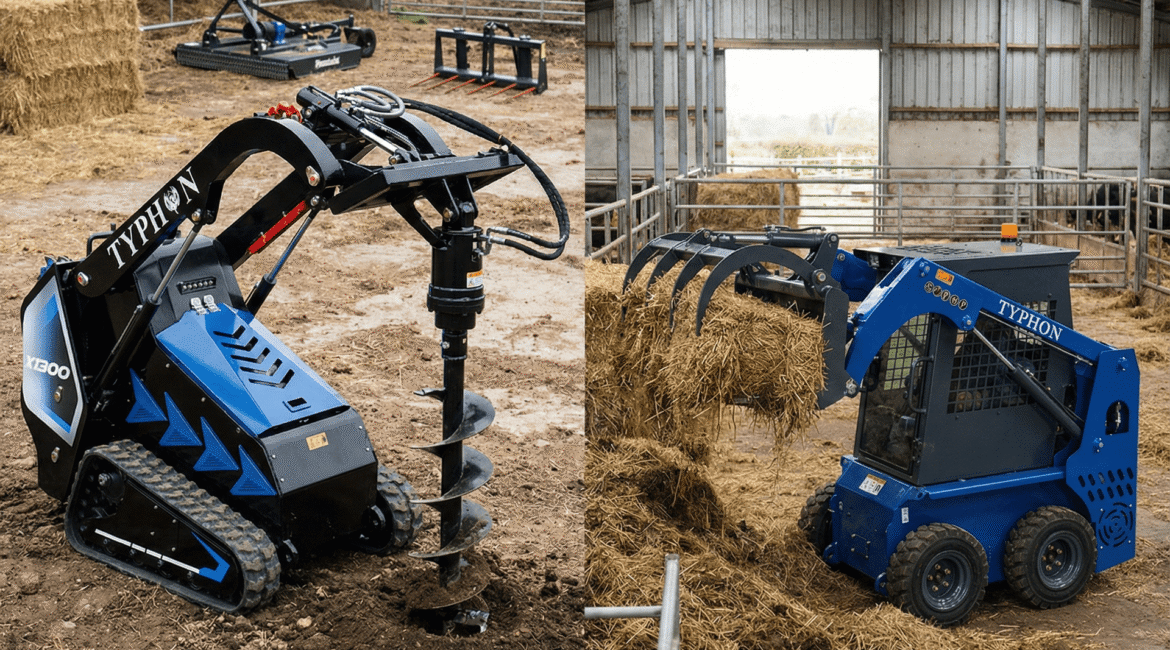
The Farm Hand That Never Sleeps: The Ultimate Guide to Agricultural Skid Steer Attachments
If you grew up on a farm, you remember the days when “versatility” meant owning a tractor and a really strong back. You had a bucket for the front loader, maybe a bale spear, and for everything else, you had a shovel and a pair of leather gloves.
But walk into a modern feedlot, a dairy operation, or a hobby farm today, and the landscape has changed. The tractor is still the king of the field, but the skid steer loader has become the king of the barnyard.
Why? Because of the attachments.
A skid steer without attachments is just a bucket on wheels. But with the right arsenal of tools, it transforms into a fencing crew, a feed mixer, a manure spreader, and a hay hauler—all before lunch. For farmers operating on thin margins and even thinner labor pools, these attachments aren’t just “nice to have”; they are the only reason the work gets done.
In this guide, we are going to move beyond the basic bucket and explore the specific agricultural attachments that turn a skid steer into the most valuable employee on your farm.
The Why Behind the Attachments
Before we start spending money on iron, let’s talk about farm economics. The golden rule of agricultural equipment is simple: One engine, many jobs.
Buying a dedicated machine for every task is a fast way to go broke. You don’t need a dedicated post-hole digging truck if you only dig fences twice a year. You don’t need a dedicated wheel loader if you only load silage in the winter. The beauty of the skid steer is its hydraulic system—the “Universal Quick Attach” plate is essentially a power outlet for mechanical muscle.
The “Sweat Equity” Calculation Think about mucking out a stall. By hand, it takes 30 minutes of back-breaking labor. With a skid steer and a manure fork, it takes 4 minutes. If you value your time at even $20 an hour, that fork attachment pays for itself in a single busy season. But more importantly, it saves your body. You can’t farm if you can’t walk.
The Hay Handlers: Moving Bales Without Breaking Your Back
If you have livestock, you have hay. And if you have hay, you know the struggle of moving 1,200-pound round bales.
The Bale Spear (The Essential) This is the first attachment every livestock farmer buys. It’s simple—usually one long forged steel tine and two shorter stabilizer tines. But there is nuance here.
- The Single Spear: Great for piercing the center of a round bale.
- The Dual Spear: Necessary if you handle large square bales. A single spear will just spin a square bale like a pinwheel, which is dangerous and frustrating.
The Bale Squeeze (The Gentle Giant) If you wrap your hay (haylage/silage), a standard spear is your enemy. Puncturing the plastic wrap lets oxygen in, and your expensive feed turns to mold. Enter the Bale Squeeze. This attachment uses two hydraulic arms to hug the bale from the sides. It handles the plastic gently, stacking bales without piercing the seal. It’s more expensive than a spear, but if it saves 10% of your winter feed from rotting, it’s a bargain.
Manure Management: The Dirty Reality
Let’s be honest: 30% of farming is just moving poop from one place to another. Skid steers were practically born for this.
The Manure Fork (The Muck Master) Using a standard solid bucket for manure is a rookie mistake. A solid bucket scoops up the liquids and the bedding along with the solids, making the load heavy and sloppy. A Manure Fork (or tined grapple) lets the liquid drain out. You pick up the solids, leaving the expensive sawdust or sand bedding behind. It creates a cleaner stall and a lighter load. Plus, the tines can pierce into a compacted pile of bedding that a smooth bucket would just bounce off of.
The Scraper Attachment For dairy farmers with concrete alleyways, the rubber tire scraper is legendary. It’s like a giant squeegee. You drive down the alley, pushing the slurry into the pit. It’s quiet, it doesn’t damage the concrete, and it scrapes cleaner than metal ever could.
Fencing and Post Work: The One-Man Crew
Fencing is the job every farmer hates. It involves heavy lifting, precise alignment, and endless digging. With the right skid steer setup, fencing becomes a one-person job.
The Auger Drive This is the game changer. A hydraulic auger can drill a 4-foot deep hole in clay in under a minute.
-
The Secret: Don’t just look at the bit width; look at the torque. Agricultural soil is full of surprises—rocks, roots, and compacted clay. A high-torque drive unit (planetary drive) keeps spinning when a direct-drive unit would stall.
-
The Tip: If you have rocky soil, spend the extra money on a “rock bit” with carbide teeth. A standard dirt bit will just polish the rock and make you cry.
The Post Pounder If you are driving T-posts or wooden posts in softer ground, an auger might be overkill. A vibratory post driver attachment grabs the post and vibrates it into the ground. No digging, no backfilling, no tamping. The post is set tight instantly. It turns a week-long fencing project into a weekend project.
Land Management: Fighting Back the Brush
Farms are in a constant war with nature. If you stop mowing for a month, the forest tries to take your pasture back.
The Brush Cutter (The Bush Hog) This is a heavy-duty mower deck that sits on the front of your loader. Unlike a tractor-pulled bush hog, the skid steer cutter is out front. This means you can cut down the tree before you drive over it.
-
Open Front vs. Closed Front: An “open front” cutter exposes the blades, allowing you to drive into thick saplings and chew them up. A “closed front” keeps debris contained and is safer for pasture mowing where you don’t want to throw rocks at your cows.
The Root Grapple After you cut the brush, you have to move it. A root grapple is an open-bottom bucket with hydraulic clamps (thumbs) on top. It allows you to grab a massive pile of limbs and logs while the dirt falls through the bottom slats. It is indispensable for storm cleanup. You can pick up a downed tree, limb it, and stack it without ever leaving the cab.
Feed Management: Precision Feeding
For larger operations, the skid steer is a central part of the nutrition program.
The Feed Pusher Cows are messy eaters. They push their TMR (Total Mixed Ration) away from the bunk as they sort through it. Once it’s out of reach, they go hungry, and milk production drops. A feed pusher attachment (often just a rotating rubber tire or an angled blade) sweeps the feed back to the fence. It sounds simple, but pushing feed up 4-5 times a day increases dry matter intake significantly.
The Silage Defacer If you store feed in a bunker silo, you need a nice, clean “face” on the pile. If you just rip at it with a bucket, you introduce air pockets deep into the pile, causing spoilage. A Silage Defacer scrapes the face of the pile downward, knocking loose feed onto the floor while leaving a smooth, sealed wall behind. It reduces waste and ensures the cows are getting fresh feed, not compost.
Winter on the Farm: The Snow Fighters
When the drifts are four feet deep and the milk truck is coming in an hour, the skid steer is your lifeline.
The Snow Pusher (The Box Plow) Don’t use a bucket for snow. It fills up in ten feet, and then you are just driving around with a full bucket. A Snow Pusher is a wide box that captures the snow and allows you to push massive volumes to the edge of the lot.
-
The Edge Matters: On a gravel farm lane, use a rubber or polyurethane cutting edge. It will glide over the gravel. A steel edge will scrape your expensive gravel off the driveway and deposit it in the ditch.
The Snow Blower If you run out of room to pile the snow, you have to throw it. A hydraulic snow blower attachment can launch snow 30 feet away, clearing fence lines and opening up paths to the barns that a plow simply can’t manage.
Buying Advice: New vs. Used vs. “Farm Built”
Farmers are frugal. We love a deal. But with hydraulic attachments, “cheap” can be dangerous.
The Hydraulic Flow Trap Before you buy any attachment, check your skid steer’s hydraulic flow rating (GPM – Gallons Per Minute).
-
Standard Flow (17-24 GPM): Fine for grapples, augers, and buckets.
-
High Flow (26-40 GPM): Mandatory for large brush cutters, snow blowers, and stump grinders. If you plug a “High Flow” brush cutter into a “Standard Flow” machine, the blades will spin slowly, the machine will overheat, and you will be frustrated. Always match the tool to the flow.
The “Homebrew” Risk You will see a lot of homemade attachments at farm auctions. A bucket with teeth welded on by “Uncle Jim.” A bale spear made from an old axle. Be careful. Skid steers exert thousands of pounds of breakout force. If a homemade weld snaps under load, that bale comes crashing down on the cab—or on you. Stick to certified, engineered attachments for anything that lifts heavy loads overhead.
Maintenance: Keeping the Rust at Bay
Farm attachments live a hard life. They sit in the weeds behind the barn, covered in mud and manure, until they are needed.
To keep them working, you need a “Grease and Release” policy.
-
Grease it before you park it: When you take the attachment off, grease the pins immediately. This pushes out the water and acids (from manure) that sat in there during the job. If you wait until next season, that pin will be rusted solid.
-
Check the Hoses: Hydraulic hoses on farm attachments get snagged on fences and chewed by rodents. Wrap your hoses in protective nylon sleeves (spiral wrap). It’s cheap insurance against a blown hose spraying hot oil all over your winter hay supply.
-
Clean the Couplers: We say it a million times, but it bears repeating. Wipe the quick-connect couplers before you plug them in. Farm dust is abrasive. If you inject dust into your skid steer’s hydraulic system, you are looking at a $5,000 pump repair.
The Force Multiplier
A skid steer on a farm is a force multiplier. It allows an older farmer to keep working comfortably into their 60s and 70s. It allows a solo operator to do the work of a three-man crew.
But the machine is only the platform. The real magic happens where the rubber meets the mud. Whether it’s a bale spear that saves your back, a brush cutter that reclaims your pasture, or an auger that builds your fences, the right attachment turns a loud, diesel-drinking machine into the most profitable partner your farm has ever known.
So, take stock of your daily chores. Look at the jobs that make you groan when you wake up in the morning. Chances are, there is an attachment that can turn that chore into just another 15 minutes in the seat. And in farming, time isn’t just money—it’s survival.