Hydraulic Flow Secrets: How to Pick Between High-Flow and Standard-Flow Attachments
Knowing how your skid steer’s hydraulic system works is the difference between a machine that works smoothly and one that stops working when it gets too much pressure.
It’s important for your return on investment (ROI) and the life of your equipment to know how to match the “Hydraulic Flow Secrets” of your STOMP X1300 or heavy-duty TERROR XIX to the right attachment. The main difference is between standard-flow and high-flow systems.
The Core Difference: Standard-Flow vs. High-Flow Systems
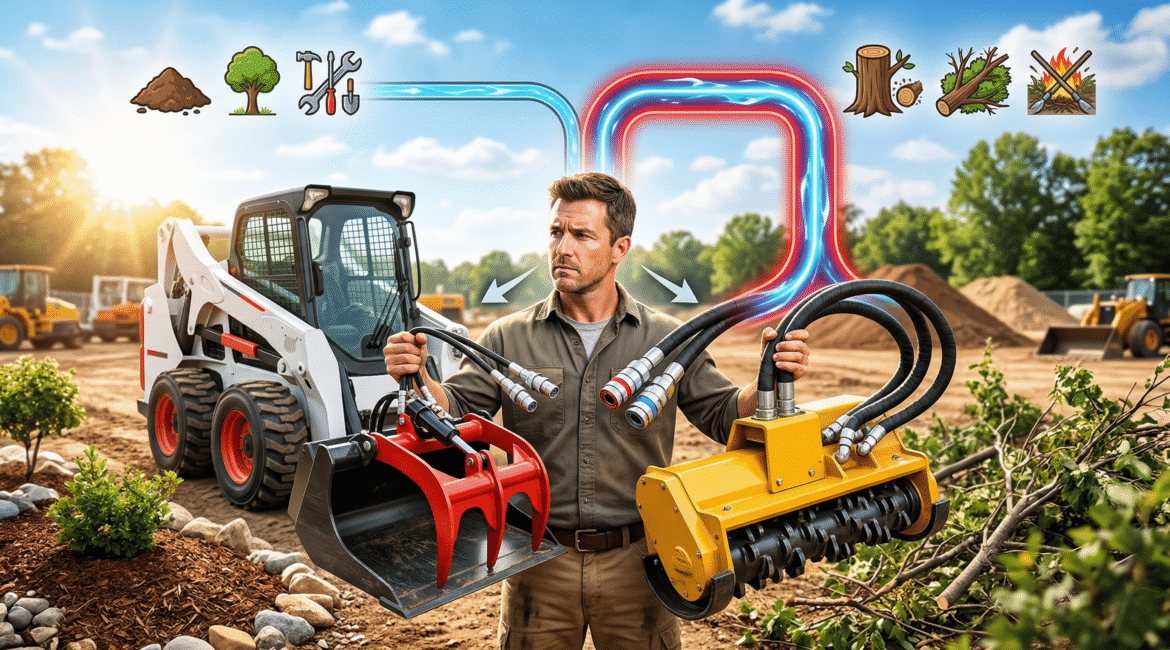
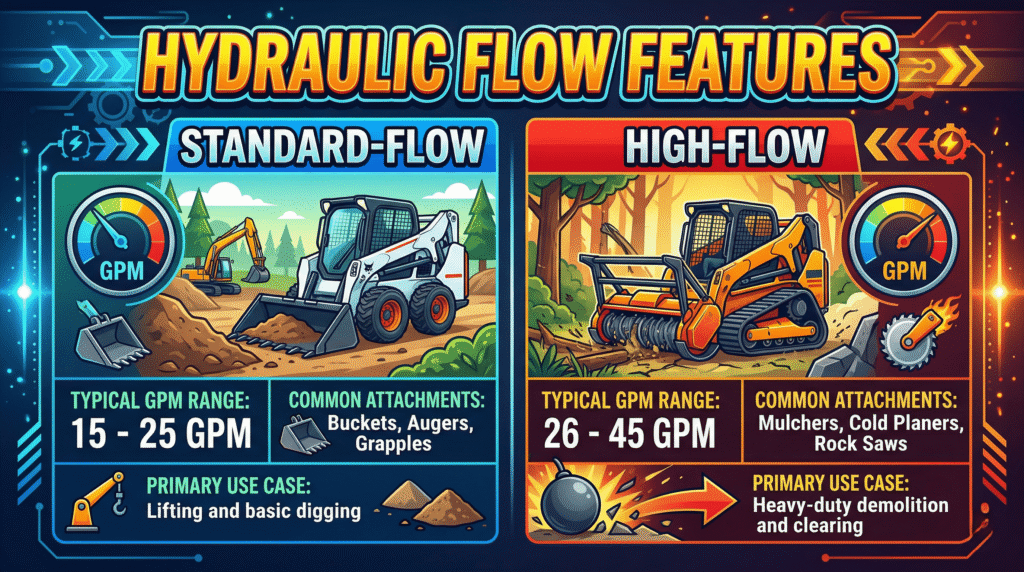
Standard-flow hydraulics are the norm in the industry, with flows between 15 and 25 gallons per minute (GPM). High-flow systems, on the other hand, go from 26 to 45 GPM, which is enough power for heavy-duty motor-driven tools.
- Pressure vs. Flow: Standard flow keeps the pressure steady for cylinders, while high flow focuses on volume to keep the motor turning.
- Identifying the System: Most modern loaders, such as the TYPHON STOMP series, use a 3-pump setup to handle these needs quickly and easily.
- Check for Compatibility: Always check the GPM rating of your machine before renting or buying a high-torque attachment to make sure it won’t overheat.
Table: Hydraulic Flow Features
| Feature | Standard-Flow | High-Flow |
| Typical GPM Range | 15 – 25 GPM | 26 – 45 GPM |
| Common Attachments | Buckets, Augers, Grapples | Mulchers, Cold Planers, Rock Saws |
| Primary Use Case | Lifting and basic digging | Heavy-duty demolition and clearing |
When Standard-Flow is the Best Thing for You
You don’t always need “the biggest and the baddest” to get things done. For 70% of common landscaping and construction tasks, standard-flow hydraulic flow secrets give you more than enough power while using less fuel.
- Accuracy Over Power: Attachments like the TYPH-5125 Digger or TYPH-5109 Auger need steady torque instead of fast blade rotation.
- Fuel Efficiency: Using standard-flow attachments lets the engine run at lower RPMs, which makes your Kubota diesel engine last longer.
- Less Maintenance: Seals and hoses tend to last longer in systems with less volumetric stress than in systems with high flow.
High-Flow Attachments: The Heavy Hitters
High-flow is a must when the job is to turn big trees into sawdust or cut through asphalt. These attachments need a lot of oil to keep the internal motors running at their best without losing speed.
- Controlling Vegetation: The TYPH-5126 Forestry Mulcher is a great example of a tool that needs high-flow secrets to keep its aggressive land-clearing performance.
- Constant Speed: High-flow systems make sure that the blade speed doesn’t drop too much when the attachment hits something hard, like a thick log.
- Heat Management: High-flow machines usually have special hydraulic oil radiators, like the ones in the TYPHON STOMP series, to keep engine heat from getting to the rest of the machine.
How to Find the Right Attachments for Your TYPHON Machine?
To pick the right tool from the SkidSteer.Online catalog, you need to know the specs of your machine. Not all loaders are the same, and putting a high-flow attachment on a standard-flow machine can cause the hydraulics to fail completely.
- Look at the Matrix: To find out which attachments, like the 4-in-1 Bucket (TYPH-5106) or Rotary Tiller (TYPH-5115), work with your flow rate, use the product comparison matrix.
- Synergy of Connectors: Make sure your flat-face couplers are the same size. High-flow machines often use bigger 3/4-inch or 1-inch connectors to handle the extra volume.
- Weight Distribution: High-flow attachments are usually heavier, so make sure your loader can handle tools like the Forestry Mulcher.
The Effect of Flow Selection on the Economy
It’s not just about physics to understand the secrets of hydraulic flow; it’s also about your bottom line. A high-flow machine costs more up front, but it gives you access to more profitable, specialized contracts.
- Versatility Premium: For a growing business, a high-flow loader is the best “all-rounder” because it can run both standard and high-flow tools.
- Speed of Job Completion: Having more GPM lets you move the machine faster while the attachment works, which cuts down on the number of hours needed to finish the job.
- Resale Value: Machines with high-flow auxiliary hydraulics usually sell for more on the secondary market.
Hydraulic Flow Secrets to Long-Lasting Maintenance
You need to take good care of high-performance hydraulics. The oil is the most important part to keep an eye on, whether you’re using a regular Pallet Fork or a high-torque Snow Blower.
- Quality of Oil: Use hydraulic fluids with a high viscosity that can handle the heat that comes from operations with a lot of flow.
- Filter Checks: If you switch between different attachments often, you should change your hydraulic filters more often to keep them from getting dirty.
- Taking Care of the Cooling Fins: When using mulchers or tillers that kick up a lot of dust, make sure the hydraulic radiator is free of debris.
Common Mistakes When Matching Hydraulics – Hydraulic Flow Secrets
Even experienced operators make the mistake of thinking that “more is always better.” But using a high-flow system on an attachment made for standard flow can be just as dangerous as the other way around.
- Over-Speeding: If you run a standard-flow motor on a high-flow circuit, the parts inside can spin faster than they are rated to, which can cause them to explode.
- Seal Blowouts: Too much oil can cause back-pressure that breaks the seals on smaller motors and cylinders.
- Wasted Energy: Using high-flow for a simple bucket or grapple just wastes fuel without making the performance any better.
FAQ: Hydraulic Flow Secrets
Is it possible to use a high-flow attachment on a skid steer that normally flows?
No, usually not. A high-flow attachment needs more oil than a standard-flow machine can give. The attachment will either move very slowly or not at all, which could cause your hydraulic pump to overheat.
How can I tell if my skid steer has high-flow hydraulics?
Look at the control panel or the auxiliary hydraulic couplers on your machine. A lot of the time, high-flow machines have three couplers instead of two, or they have a toggle switch that says “High Flow.” You can also look up the GPM rating in your VIN or manual.
Is the extra money for high-flow worth it?
Yes, if you want to clear land, blow snow, or mill roads for a living. Standard flow is more than enough and uses less gas if you mostly use buckets, forks, and augers.
What happens if I put a standard-flow attachment on a high-flow machine?
If you leave the high-flow setting off, you can usually do this safely. If you accidentally turn on high-flow, you could put too much pressure on the attachment and break the motor or seal.
Does high-flow make my skid steer able to lift more?
No. The weight, shape, and main hydraulic pressure of the machine all affect how much it can lift. High-flow only makes motor-driven attachments faster and stronger.
Is it possible to change my standard-flow machine to high-flow?
It is technically possible, but it is very costly and complicated, and it usually needs a new pump, bigger lines, and a bigger cooling system. Usually, it’s cheaper to trade in for a model with a high flow rate.